










Narayana Hrudayalaya India Margins Reach 26.8% in Q2 FY27
Key highlights
- Narayana Hrudayalaya reported Q2 FY27 consolidated operating revenue of ₹28,439.89 million, up 73.0% year-on-year.
- India hospital EBITDA margin reached 26.8%, or 23.6% excluding other income.
- India inpatient footfall rose 4% year-on-year and outpatient footfall increased 12% year-on-year.
- Combined India insurance and clinic losses fell to ₹200 million from ₹330 million in the prior quarter.
powered by IRIS
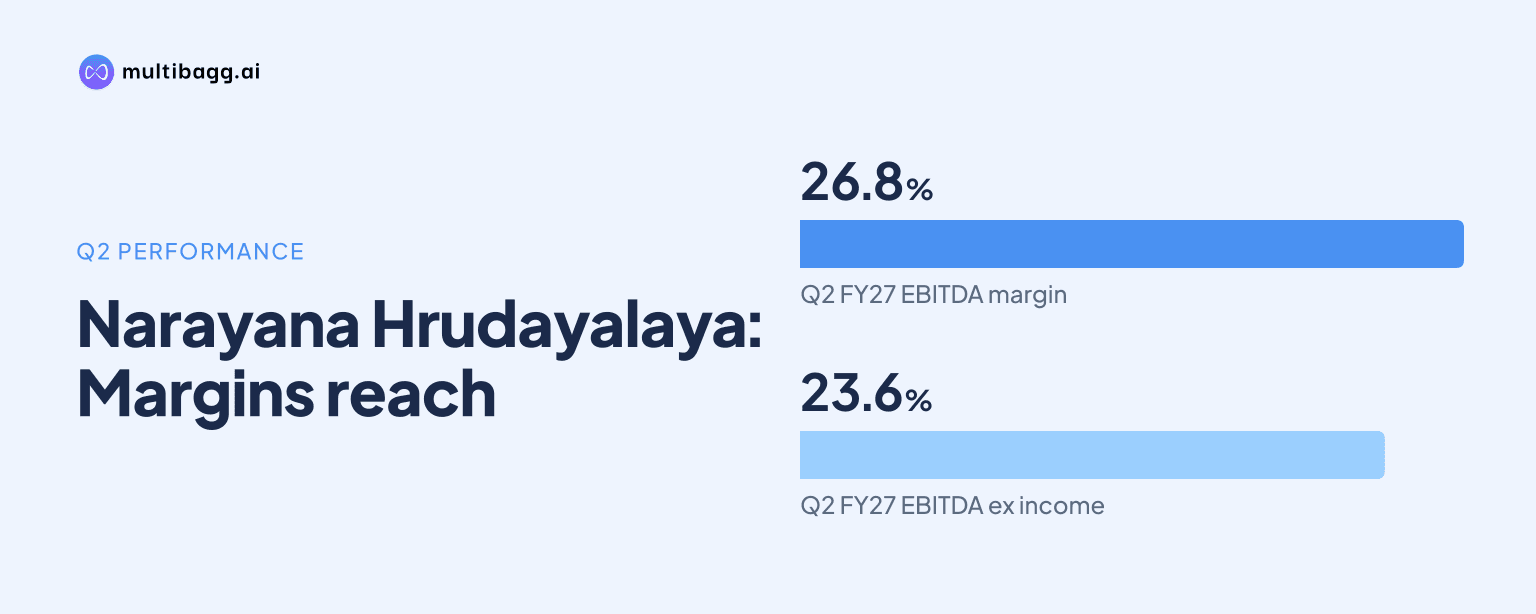
Narayana Hrudayalaya Limited reported a 26.8% EBITDA margin in its India hospital business in Q2 FY27, as consolidated operating revenue rose 73.0% year-on-year to ₹28,439.89 million. Higher patient volumes, price mix and operating leverage supported the performance, while management maintained that patient access and volumes remain its operating priority.
Know Narayana Hrudayalaya inside out
Results, valuation, peers and who's buying, in one view.
What did Narayana Hrudayalaya report for Q2 FY27?
Narayana Hrudayalaya reported consolidated operating revenue of ₹28,439.89 million for Q2 FY27, a year-on-year increase of 73.0%. Consolidated EBITDA stood at ₹6,054.15 million, while net profit from continuing operations was ₹3,011.53 million. The company’s quarterly materials described the result as being supported by stronger India hospital operations.
The India hospital business recorded an EBITDA margin of 26.8%, including other income. On an excluding-other-income basis, the margin was 23.6%. During the earnings call, management linked the margin performance to higher throughput, improvement in the revenue mix and operating leverage rather than to a stated effort to maximise margins.
The company also reported improved patient activity. India inpatient footfall grew 4% year-on-year and outpatient footfall increased 12% year-on-year. Inpatient footfall was also up 6% sequentially. These trends provided the operating base for revenue growth and cost absorption during the quarter.
How did volumes and cost leverage support India margins?
Higher volumes and lower staff costs as a share of revenue supported Narayana Hrudayalaya’s India business margin. Management said doctor and nursing costs as a percentage of revenue declined by 1.8%, reflecting operating leverage. This means the increase in patient activity and revenue was accompanied by a lower proportional cost burden in these categories.
The company’s Group COO said the second quarter is seasonally strong and noted that higher-end procedures and robotics contributed to the price mix. Management also referred to annualised ARPOB increasing from ₹17.5 million to ₹19.5 million. An analyst on the call said ARPOB was about ₹55,000, compared with about ₹70,000 for larger peers, highlighting the company’s comparatively lower revenue per occupied bed even as margins improved.
Management said it does not usually track conventional occupancy as the central operating measure. It cited occupancy of about 60% to 65% and explained that midnight-bed occupancy can understate activity in a model built around efficient patient turnaround. According to the company, occupancy has remained in this range for several quarters despite capacity additions, while greater throughput has contributed to revenue and margin leverage.
Why is Narayana Hrudayalaya focused on throughput and patient access?
Narayana Hrudayalaya said its strategy is to balance volumes and price mix, with patient access and volume taking precedence over targeting a specified margin. This approach is relevant because its India operations have produced a 26.8% EBITDA margin while management continues to focus on serving more patients rather than positioning the business solely around higher pricing.
The company’s reported outpatient growth of 12% year-on-year was higher than its 4% increase in inpatient footfall. The two measures indicate that activity increased across different points of patient engagement. The 6% sequential rise in inpatient footfall also shows that India hospital activity improved from the preceding quarter.
Oncology accounted for 15% of India hospital revenue, according to the Group CFO. The CFO said only some drugs had come under a price cap, with the measure going live from November 9. Management said the effect would become clearer after the implementation date, leaving the eventual impact on the oncology business unquantified in the Q2 discussion.
Got a follow-up? Ask IRIS
What were the developments in insurance and UK operations?
Narayana Hrudayalaya reported that combined losses from its India insurance and clinic businesses reduced to ₹200 million in Q2 FY27 from ₹330 million in the previous quarter. India insurance recorded a profit after tax loss of ₹151 million for the quarter. The reduction in combined losses represented a sequential improvement, though the insurance unit remained loss-making.
Management identified recovery in UK revenue and further reduction in insurance losses as important execution priorities. The available Q2 materials did not provide a separate UK revenue figure, a timeline for recovery or a quantified target for insurance profitability. Those issues therefore remain areas for investors to track through subsequent disclosures.
For the group, these businesses sit alongside a stronger India hospital performance. The Q2 result shows that the core India operation generated improved volume, revenue and margin metrics, while management continues to address loss reduction in insurance and revenue recovery in the UK.
How does the Q2 result matter to investors and the hospital sector?
The result matters because Narayana Hrudayalaya combined higher India patient volumes with a 26.8% EBITDA margin, supported by a 1.8% decline in doctor and nursing costs as a share of revenue. The figures demonstrate the effect that higher throughput can have on hospital cost structures, particularly where patient activity rises without a comparable increase in staffing costs relative to revenue.
The company’s reported occupancy range of 60% to 65%, despite capacity additions, also places attention on throughput rather than a single occupancy measure. Its explanation suggests that shorter care turnaround can allow hospitals to handle more activity even where a midnight bed count does not appear high. This is central to management’s stated operating model.
Investors will also need to assess the difference between India business margin including other income, at 26.8%, and the 23.6% figure excluding other income. In addition, the November 9 drug-price-cap implementation is relevant for an oncology business that accounts for 15% of India hospital revenue. The company did not quantify the expected financial effect during the call.
Conclusion
Narayana Hrudayalaya’s Q2 FY27 performance was led by its India hospital business, where patient volumes, price mix and cost leverage lifted EBITDA margin to 26.8%. Consolidated operating revenue reached ₹28,439.89 million, up 73.0% year-on-year, while the sequential reduction in combined insurance and clinic losses provided an additional improvement in the operating picture.
The next disclosures will be important for assessing whether India margins remain near current levels as volumes and capacity evolve. Investors will also watch for management’s assessment of the November 9 oncology drug-price-cap implementation, progress in reducing India insurance losses and evidence of UK revenue recovery.