










Narayana Keeps Insurance as Quarterly Losses Fall to Rs 22 Crore
Key highlights
- Narayana's combined clinic-and-insurance loss fell to about Rs 22 crore in Q2 FY27 from about Rs 33 crore in the previous quarter.
- Narayana's health-insurance loss declined to about Rs 14 crore in Q2 FY27 from Rs 19 crore in the previous quarter.
- Narayana's clinic loss fell to about Rs 8 crore in Q2 FY27 from Rs 14 crore in the previous quarter.
- Management gave no insurance break-even timeline and said it will spend moderate amounts while reducing distribution costs.
powered by IRIS
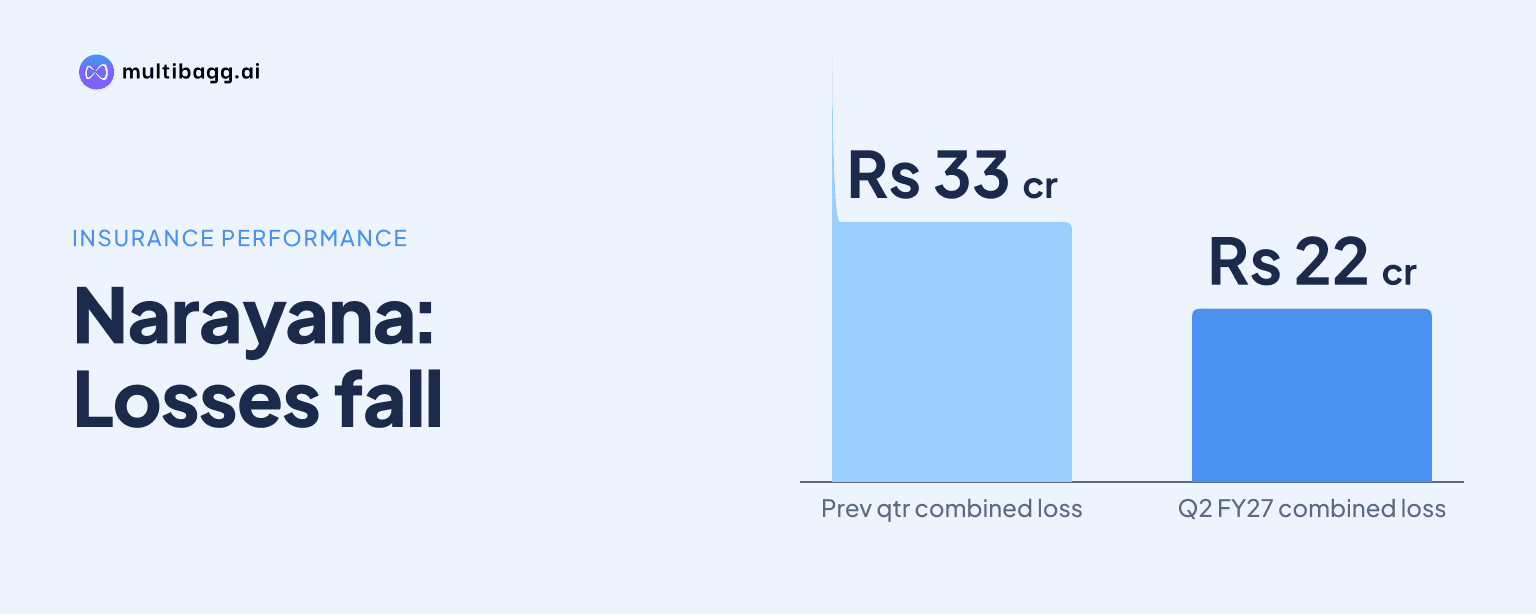
Narayana Hrudayalaya Limited said in Q2 FY27 that it will retain its insurance venture while limiting expenditure, after combined clinic-and-insurance losses fell to about Rs 22 crore from Rs 33 crore in the previous quarter. Management cited lower insurance and clinic losses but gave no timetable for insurance break-even.
Know Narayana Hrudayalaya inside out
Results, valuation, peers and who's buying, in one view.
Will Narayana exit its insurance business after the combined-ratio concern?
No, Narayana said it will neither give up insurance nor pursue the venture at any cost. An analyst cited a combined ratio of 280%, compared with an asserted 100% to 110% range for established insurers, but management said quarterly ratios can be distorted and that the claims ratio had declined significantly quarter on quarter.
Management did not disclose an insurance combined-ratio target, a break-even threshold or a date for profitability. Ravi Vishwanath said it was too early to provide a break-even timeline, although the company sees the insurance book moving in the right direction through revenue growth, lower claims ratios and lower actual expenses.
Narayana described its approach as different from a traditional insurance model. It is developing direct retail insurance, a small and medium enterprise, or SME, book and controlled group business, while seeking to position itself as a health partner rather than only as a claims processor. Management said the business is being built around patients and employer groups, but did not disclose policy counts or premium income on the November 2, 2026 call.
How much did Narayana's clinic-and-insurance loss fall in Q2 FY27?
Narayana's combined clinic-and-insurance loss fell by about Rs 11 crore sequentially to about Rs 22 crore in Q2 FY27 from about Rs 33 crore in the previous quarter. The decline reflected lower losses in both operations, with health-insurance loss reducing to about Rs 14 crore from Rs 19 crore and clinic loss falling to about Rs 8 crore from Rs 14 crore.
Nishant Singh corrected the analyst's assertion that losses had increased, pointing to the combined loss reduction from about Rs 33 crore to about Rs 22 crore. He also said Cayman insurance losses declined to $1.1 million from $3.7 million, although the call did not specify the comparable periods for those figures or provide an exchange rate for conversion into rupees.
The reduction was therefore not limited to insurance. Clinics accounted for about Rs 8 crore of the Q2 FY27 combined loss, down from about Rs 14 crore in the previous quarter. Narayana said it had disclosed both figures for several quarters, but will merge the clinic business into hospital reporting going forward.
What spending changes is Narayana making in insurance?
Narayana said it will spend moderate amounts on insurance and keep expenditure as low as possible. Viren Shetty said some strategies considered when the business began had not worked as expected, leading the company to adapt and pivot while seeking to maintain customer satisfaction and keep claims within its estimates.
The company identified insurance-distribution cost as a high-priority area for reduction. Management linked this effort to the focus on distribution costs expressed by the Insurance Regulatory and Development Authority of India, or IRDAI, chairman, and said it wants to reach break-even with a smaller book than peers. Narayana did not disclose a distribution-cost target, spending cap, premium target or policy target.
Management said direct retail policies are sold largely, though not exclusively, to people with a relationship with Narayana. The company also sells insurance to employers and employee groups, consistent with its stated focus on retail, SME and controlled group business. However, the Q2 FY27 call gave no breakdown of policy sales by hospitals, clinics, employers or other channels.
Narayana also plans to use healthcare data to engage customers beyond claim settlement. Management said the model seeks to support customers in getting well and staying healthy, but it did not quantify any reduction in claims, improvement in retention or increase in revenue arising from that approach during Q2 FY27.
Got a follow-up? Ask IRIS
Why is Narayana retaining clinics alongside insurance?
Narayana will retain clinics because management said they have proved valuable to patients and to doctors running evening outpatient departments, or OPDs. The company said its earlier committed spending on clinics will continue, even though clinic losses declined to about Rs 8 crore in Q2 FY27 from about Rs 14 crore in the previous quarter.
Management presents clinics and insurance as parts of a continuum of care rather than as stand-alone financial operations. Sandhya Jayaraman said Narayana does not measure the insurance business through a separate return on capital employed, or ROCE, because it sees insurance as a means of financing healthcare delivery.
The internal objective is to stop burning cash in insurance while continuing to provide the intended care to customers. That differs from setting a separate insurance ROCE target, and management said it does not expect to report ROCE separately for insurance even in the longer term. The call did not provide a date for reaching the no-cash-burn objective.
Management's integrated-care rationale is that a clinic visit, scan or hospital procedure can create a continuing patient relationship. Narayana said it builds health profiles and can offer annual check-ups, diagnostic scans, blood tests and vaccine camps, with insurance intended to help finance those interactions. It did not provide Q2 FY27 evidence linking this model to a stated financial outcome.
What evidence supports Narayana's wider care-network strategy?
Narayana said the clinic model has proved successful, while the insurance business remains in an investment and operating-improvement phase. The principal disclosed financial evidence was the approximately Rs 11 crore quarter-on-quarter decline in combined clinic-and-insurance losses, alongside management's statement that claims ratios and expenses are trending down.
The hospital network provides the patient base around which management is building its direct insurance relationships. In Q2 FY27, inpatient footfall increased 6% quarter on quarter and nearly 4% year on year, while outpatient footfall rose about 12.5% year on year. Management said India hospital occupancy was typically 60% to 65%, but emphasized patient throughput rather than midnight-bed occupancy.
Narayana said it had not added capacity and that traditionally calculated occupancy had remained around 60% to 65% for several quarters. Management nevertheless cited higher throughput, revenue uplift and cost leverage from existing facilities. Those hospital operating measures give context to the broader care network, but the company did not quantify how many hospital patients became insurance customers.
International patients contributed about 6% to 7% of hospital revenue, according to management, mainly through organic demand from Bangladesh. Narayana said it does not specifically target that segment, which contrasts with its deliberate effort to build direct retail, SME and employer-group insurance channels. The call did not disclose insurance revenue by channel or customer type.
Conclusion
Narayana's Q2 FY27 message was that insurance remains part of its care model, but spending will be controlled rather than open-ended. Combined clinic-and-insurance losses declined from about Rs 33 crore to about Rs 22 crore sequentially, with insurance accounting for about Rs 14 crore and clinics about Rs 8 crore. Management cited improving claims and expense trends but did not provide a break-even date, a combined-ratio target or a maximum investment amount.
The next reported measure to watch is the insurance loss after the clinic business is merged into hospital reporting. Management plans to reduce distribution costs, develop direct retail and controlled group business, and seek break-even at a smaller book than peers. Its Q2 FY27 insurance loss of about Rs 14 crore remains the disclosed benchmark while management works through the unresolved timeline for ending cash burn.