










NDR Auto says Rs 5 crore associate profit is sustainable
Key highlights
- NDR Auto reported Rs 5.2 crore of share of profit from associates in the quarter.
- Management said about Rs 5 crore of associate profit a quarter is sustainable.
- Toyo Seats turned profitable, while NHI’s loss reduced after customer price increases.
- NDR Auto’s other expenses rose by almost Rs 5 crore quarter-on-quarter, including Rs 2.5 crore related to NDR South.
powered by IRIS
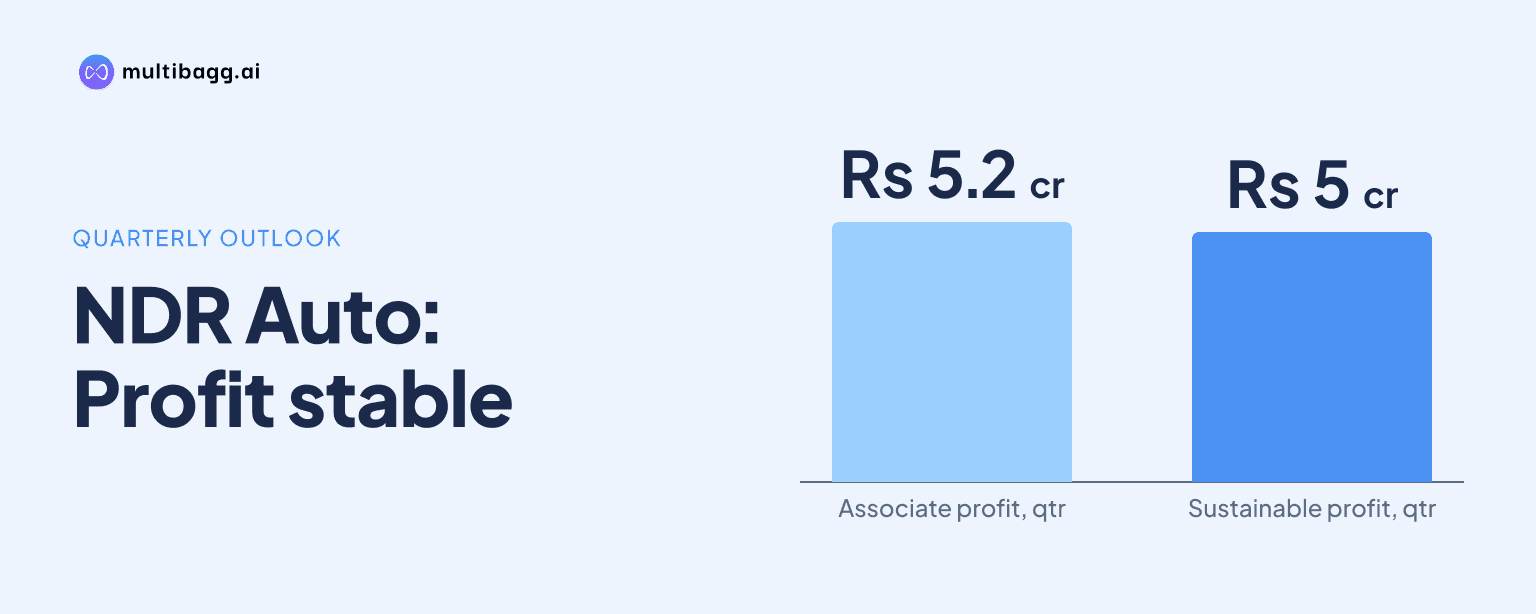
NDR Auto said its Rs 5.2 crore share of profit from associates in the reported quarter can be viewed as a sustainable quarterly run rate of about Rs 5 crore, after Toyo Seats turned profitable and NHI’s loss narrowed following customer price increases.
Know NDR Auto Components inside out
Results, valuation, peers and who's buying, in one view.
Why did NDR Auto’s associate profit rise to Rs 5.2 crore?
NDR Auto said the increase to Rs 5.2 crore in share of profit from associates was driven by two disclosed changes: TSIL, identified by management as Toyo Seats, turned profitable, while NHI reported a lower loss in the quarter. The explanation came after an analyst noted that the quarter-on-quarter increase in Bharat Seats’ profit after tax did not appear large enough by itself to explain the higher associate contribution.
The Rs 5.2 crore reported associate-profit figure was not attributed solely to Bharat Seats. Management specifically identified profitability at Toyo Seats and a reduced loss at NHI as additional contributors. That means the quarter’s associate income was supported by more than the quarter-on-quarter movement the analyst identified at Bharat Seats.
NDR Auto did not provide individual profit figures for Toyo Seats, NHI or Bharat Seats in this exchange. It also did not quantify how much of the Rs 5.2 crore came from each entity. The disclosure supports the stated drivers, but not a numerical allocation of the associate-profit increase among the three businesses.
Is about Rs 5 crore of quarterly associate profit sustainable?
Yes. NDR Auto management said it considered about Rs 5 crore of associate profit a quarter sustainable when directly asked whether investors should use that figure after the reported Rs 5.2 crore outcome. This was a management view on the run rate, rather than formal annual guidance or a target for a specified financial year.
The sustainability comment rests on the operational changes management described in the same discussion. Toyo Seats had moved into profitability, while NHI’s quarterly loss had fallen because customers granted price increases. Together, those developments explain why management viewed the approximately Rs 5 crore quarterly level as repeatable.
The statement should be read within its stated scope. NDR Auto confirmed a quarterly figure of about Rs 5 crore, not a full-year associate-profit forecast, and it did not state a range, margin assumption or entity-level earnings outlook. The reported-quarter amount was Rs 5.2 crore, while the sustainable level management cited was rounded to about Rs 5 crore per quarter.
What changed at Toyo Seats and NHI?
Toyo Seats became profitable in the reported quarter, according to NDR Auto, and NHI’s loss was lower because the business received price increases from customers. These were separate mechanisms: Toyo Seats moved into profit, while NHI reduced an existing loss through revised customer pricing.
The Toyo Seats change is material to the Rs 5.2 crore associate-income explanation because management named it when answering why the figure had risen. NDR Auto did not disclose when Toyo Seats became profitable, its quarterly revenue, its profit amount or whether the improvement was tied to a specific vehicle programme or product line.
For NHI, management gave a more specific mechanism: price increases from customers reduced the quarter’s loss. NDR Auto did not disclose the size of those increases, the date they took effect, or whether the higher prices fully offset cost movements. The disclosed conclusion is narrower: the customer price increase reduced NHI’s loss and supported the associate-profit contribution.
Got a follow-up? Ask IRIS
How did associate profit compare with NDR Auto’s other costs?
NDR Auto also confirmed an almost Rs 5 crore quarter-on-quarter increase in other expenses, split between Rs 2.5 crore related to NDR South and the balance from the Haryana minimum-wage increase. This cost discussion is separate from the Rs 5.2 crore associate-profit line, but it shows that the reported quarter included both improved associate contributions and higher operating expenses.
Management said Rs 2.5 crore of the increase in other expenses related to NDR South. The remaining portion of the almost Rs 5 crore quarter-on-quarter increase was attributed to the Haryana minimum-wage increase. On the figures stated in the call, the two items were each roughly Rs 2 crore to Rs 2.5 crore, although management specified only the Rs 2.5 crore NDR South amount exactly.
These figures should not be netted mechanically. NDR Auto described associate profit and other expenses as different accounting lines, and the call did not provide a bridge from the Rs 5.2 crore associate-profit contribution to consolidated profit. The comparison instead shows that the same quarter had higher associate income alongside costs linked to NDR South and Haryana wages.
What should readers watch in the next NDR Auto update?
Readers should watch whether Toyo Seats remains profitable and whether NHI’s lower loss persists after the customer price increases management cited. Since management’s about Rs 5 crore quarterly sustainability assessment follows a reported Rs 5.2 crore contribution, subsequent associate-profit disclosures will show whether the two identified drivers continue to support that level.
A second unresolved matter is the absence of an entity-level split. NDR Auto did not provide the Rs 5.2 crore allocation between Toyo Seats, NHI and Bharat Seats, so future commentary on associate earnings or NHI pricing would clarify the durability of the run rate. The company also did not provide annual associate-profit guidance during the call, leaving the quarterly outcome as the relevant measure to monitor.
Conclusion
NDR Auto’s message was that the reported-quarter Rs 5.2 crore share of profit from associates reflected more than Bharat Seats alone: Toyo Seats had turned profitable and NHI’s loss had reduced after customer price increases. Management therefore said about Rs 5 crore per quarter was sustainable, while providing no numerical split among the associates.
The next disclosure to watch is the associate-profit line against management’s approximately Rs 5 crore quarterly view, alongside confirmation that Toyo Seats remains profitable and NHI retains the customer-price benefit. The unresolved lack of a profit split among Toyo Seats, NHI and Bharat Seats remains the key limitation on assessing the individual sources of the reported Rs 5.2 crore contribution.