










NDR Auto says 90% utilisation drives Maruti plant expansion
Key highlights
- NDR says 90% plant utilisation is prompting Gujarat and Kharkhoda brownfield expansion for Maruti business.
- NDR said Rs 60 crore of announced projects and existing capacity will support its Rs 1,150 crore organic order book.
- NDR expects all Rs 1,150 crore of its organic order book to be executed before FY30.
- NDR said Rs 60 crore of separate joint-venture capital would take disclosed project and joint-venture spending to Rs 120 crore.
powered by IRIS
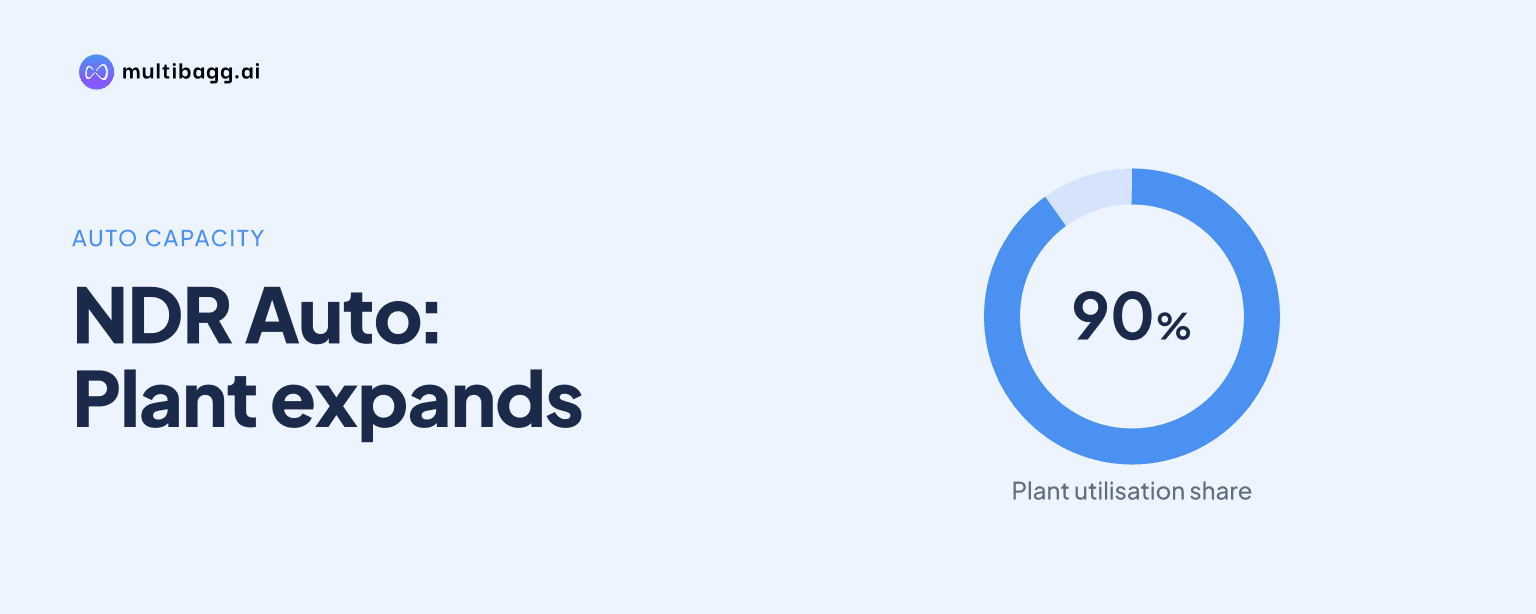
NDR Auto says factories operating at 90% utilisation are prompting brownfield expansion in Gujarat and Kharkhoda for Maruti business, while Rs 60 crore of announced projects and existing capacity are intended to deliver its Rs 1,150 crore organic order book rather than add capacity beyond it.
Know NDR Auto Components inside out
Results, valuation, peers and who's buying, in one view.
Why is NDR expanding Gujarat and Kharkhoda capacity?
NDR is expanding because its plants are operating at 90% utilisation and the announced capacity is for Maruti only. Management confirmed in response to a question on the new capex that both the Kharkhoda plant and the other announced plant were linked solely to Maruti business. The company did not disclose a separate rupee allocation, commissioning date or output figure for Gujarat versus Kharkhoda.
The projects are brownfield additions intended to support business already won rather than a speculative new manufacturing build-out. Management said Rs 60 crore of announced projects would be required alongside existing capacity to support the Rs 1,150 crore order book. That framing matters because plant utilisation is already high: NDR is adding capacity to execute contracted programme launches while continuing to use its installed manufacturing base.
How does the expansion relate to NDR's order book?
NDR said the Rs 60 crore capex will support its Rs 1,150 crore order book, and management explicitly described that capex as not incremental to the disclosed order-book value. In other words, the project spending is a delivery requirement for that pipeline, not management's indication of revenue additional to the Rs 1,150 crore figure. The company also said it will use some existing capacity for the same order book.
A large part of the Rs 1,150 crore order book is expected to start in about two years, according to management, with programme ramp-ups expected to be complete by FY30. NDR did not provide a yearly split for FY27, FY28 or FY29, saying that revenue timing depends on model mix and ramp-up. This leaves the pace of utilisation gains and the exact timing of revenue conversion undisclosed.
What revenue build-up does NDR expect before FY30?
NDR expects its current Rs 900 crore to Rs 1,000 crore top line plus the Rs 1,150 crore organic order book to take it to about Rs 2,000 crore before FY30. Management confirmed that all of the organic order book is expected to be executed before FY30. The capacity projects therefore sit within a stated plan to roughly double the current revenue base through existing operations and newly awarded business.
The company drew a distinction between this organic path and a further joint-venture opportunity. Management said it hopes to procure another Rs 800 crore to Rs 1,000 crore through a new joint venture, with production targeted for FY31. The combined value refers to the complete seat, including the value of components that NDR would manufacture and supply, rather than only the joint venture's assembly activity.
Management said the joint venture would be 51% owned by NDR and fully consolidated. It also said that for incremental seat business, NDR would continue to supply seat covers and frames while the venture undertakes assembly. That proposed structure differs from the Gujarat and Kharkhoda capex, which management identified as Maruti-only projects supporting the existing organic order book.
Got a follow-up? Ask IRIS
What capital spending and capacity risks did management disclose?
NDR disclosed Rs 60 crore for announced projects and another Rs 60 crore for the joint venture, plus annual capex that management expects to add over time. When asked whether the total was Rs 120 crore including maintenance capex, management agreed. The company did not break out maintenance spending from the two Rs 60 crore figures or provide a project-by-project schedule.
The order book also includes products beyond seating, including sunshades that are fitted in the vehicle door area to reduce heat. Management said it was still working with more original equipment manufacturers, or OEMs, to acquire sunshade business. It also said some order wins within the Rs 1,150 crore order book came from the two-wheeler segment, though it did not provide the exact split between passenger vehicles, two-wheelers and other segments.
Capacity utilisation and revenue conversion may also be affected by the timing of customer launches. Management said some new models would begin at the end of the year, while seat-related, seat-belt reminder and seat-class programmes were expected to start early the following year. Separately, it said a new capacity coming up in January should not create margin pressure in its initial six months because of low utilisation, though this was management's expectation rather than reported performance.
How does Maruti concentration fit NDR's customer plans?
NDR said the announced Gujarat and Kharkhoda capex is for Maruti only, making Maruti the direct customer linkage for the near-term expansion. Management said it was confident of maintaining its share with Maruti Suzuki even as it acknowledged that a new competitor could make entry into a new OEM more difficult. The company did not quantify Maruti's share of revenue or the expanded plants' customer concentration.
Beyond Maruti, management said the NDR Hayashi joint venture has orders from Toyota and is working to secure more Maruti Suzuki models. At Aurangabad, NDR said it had acquired land, had won some business for the Hayashi venture and planned to set up a plant there. It was also pursuing more Toyota business and said an update could come next quarter or the quarter after, if that business converts.
Conclusion
NDR's stated 90% utilisation explains why it is adding brownfield capacity in Gujarat and Kharkhoda, but the company has positioned that spending principally as execution infrastructure for awarded Maruti-linked programmes. The Rs 60 crore announced-project budget, together with existing plants, is meant to support the Rs 1,150 crore order book that management expects to execute before FY30, taking its organic revenue path to about Rs 2,000 crore.
The next items to watch are the start and ramp-up of the order-book programmes, for which NDR has not provided annual revenue splits, and progress on additional Toyota business at Aurangabad. Management also targets production from the proposed 51%-owned joint venture in FY31, with a potential Rs 800 crore to Rs 1,000 crore seat opportunity, while further annual capex remains unspecified.