










NDR Auto maintains 11-11.5% margin after Haryana wage rise
Key highlights
- NDR Auto reported Q2 FY27 revenue of Rs 247.86 crore and EBITDA of Rs 27.47 crore.
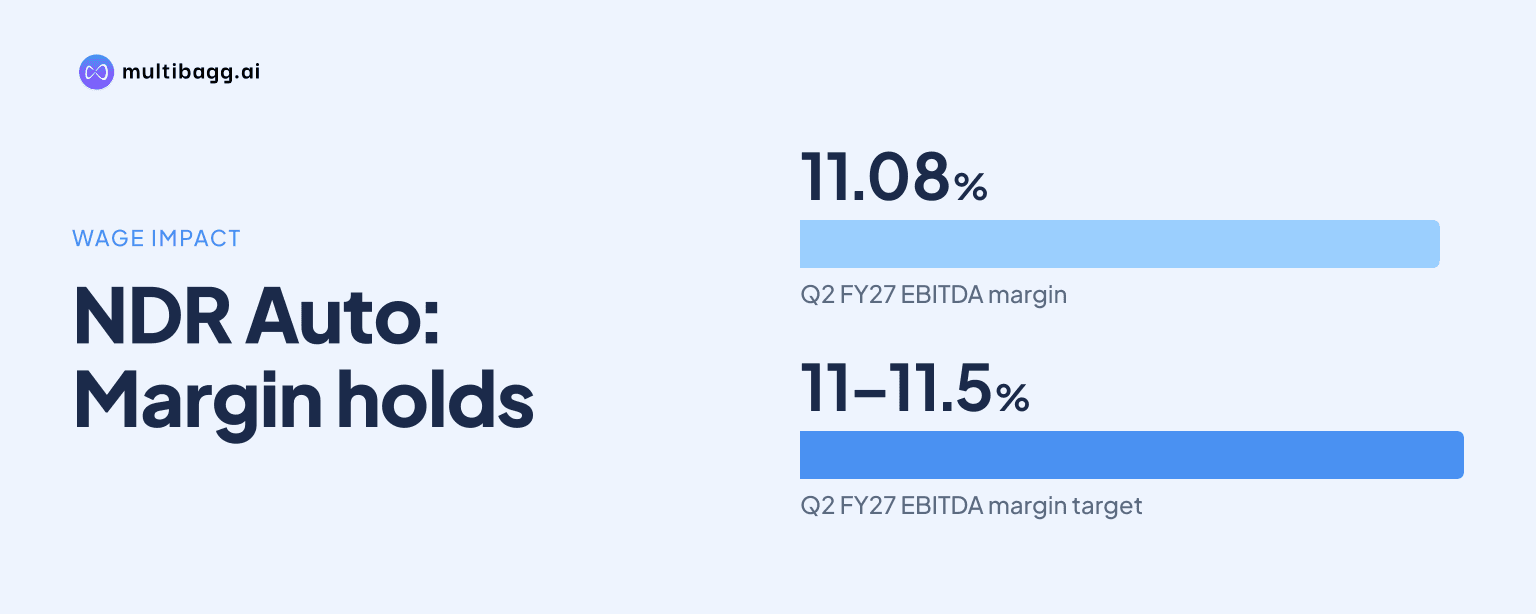
- NDR Auto stated a Q2 FY27 EBITDA margin of 11.08% and maintained an 11-11.5% target.
- Management said higher Haryana minimum wages largely increased Q2 FY27 other expenses.
- NDR Auto ended Q2 FY27 with a consolidated order book of Rs 1,190 crore.
powered by IRIS
NDR Auto Components Limited said on November 5, 2026 that higher Haryana minimum wages largely increased Q2 FY27 other expenses, but management maintained its 11-11.5% earnings before interest, tax, depreciation and amortisation (EBITDA) margin target after reporting Rs 27.47 crore of EBITDA on Rs 247.86 crore of revenue.
Know NDR Auto Components inside out
Results, valuation, peers and who's buying, in one view.
How did Haryana wage increases affect NDR Auto’s costs?
NDR Auto said higher minimum wages in Haryana were the main reason other expenses increased in Q2 FY27. Pranav Relan, Whole Time Director, gave that explanation when asked about the higher cost line, but management did not disclose the rupee value of the wage increase or identify the Haryana facilities affected.
An analyst on the November 5 call described other expenses as having risen about 41% during the quarter and asked whether a one-off item was involved. Relan responded that the increase was largely due to Haryana minimum wages, linking the movement to a recurring labour-cost mechanism rather than disclosing an exceptional charge.
The wage increase occurred in a quarter when NDR Auto reported Rs 247.86 crore of revenue, Rs 27.47 crore of EBITDA and Rs 19.78 crore of profit after tax. Management stated an EBITDA margin of 11.08% in its opening remarks, placing the reported figure within its stated 11-11.5% target range.
Can NDR Auto pass higher costs through to customers?
NDR Auto said it is mostly able to pass raw-material price changes to customers with no lag, but it did not say Haryana wage costs had been recovered. The management response on raw materials concerned price movements in inputs, while its explanation of the other-expenses increase separately identified minimum wages in Haryana.
That distinction limits what can be concluded about the Q2 FY27 cost rise. NDR Auto described a direct customer pass-through mechanism for raw materials, but the November 5 discussion provided neither a similar mechanism for wage costs nor a timetable or amount for any customer recovery related to Haryana labour expenses.
When asked whether margins could return to the 11-12% range from Q3, management said it would work on measures to come back to its “real EBITDA margin” and was hoping for that outcome. Management did not specify the measures, quantify cost savings, or give annual financial guidance for FY27.
What EBITDA margin is NDR Auto targeting?
NDR Auto is targeting an EBITDA margin of 11-11.5%, which management said would be sustainable for this year and next year. The target was stated in response to an analyst question and was accompanied by management’s statement that it does not provide annual guidance.
The management-stated Q2 FY27 EBITDA margin of 11.08% was within that 11-11.5% range. The quarter’s Rs 27.47 crore EBITDA was generated on Rs 247.86 crore of revenue, while profit after tax was Rs 19.78 crore; the call did not provide segment-level margins for seating, seat frames, trim or other components.
Another analyst referred to an EBITDA margin of about 9.7% and asked if the business could return to 11% from Q3. Management did not confirm the 9.7% figure; its own opening remarks cited 11.08% for Q2 FY27, and Relan said NDR Auto was hoping to reach 11% from Q3.
Got a follow-up? Ask IRIS
What could influence NDR Auto’s margins in coming quarters?
NDR Auto said capacity utilisation was about 90% across its plants, while brownfield expansions in Gujarat and Kharkhoda are intended to manufacture seat frames, trim and other automotive components. Management said the capacity being discussed was for Maruti, but did not disclose expansion capex in its margin-related responses.
Management said the expansion ramp-up had started and that next year should be slightly better, without quantifying revenue or EBITDA. It also told an analyst that it did not expect new capacity to create initial margin pressure from lower utilisation during the first six months, which is a management expectation rather than a reported outcome.
NDR Auto South had started operations by the Q2 FY27 call, and management said additional models were scheduled to start at the end of the year. It also referred to seat class, seat-belt reminder and seat programmes starting early next year, saying the effect on growth and margins would depend on model mix and ramp-up.
Management’s near-term view was that margins should remain at a similar level and growth could be similar to slightly better. That outlook links the margin target to the pace of programme launches and utilisation, rather than to a disclosed resolution of the Haryana wage-cost effect.
How does NDR Auto’s order book frame the margin outlook?
NDR Auto ended Q2 FY27 with a consolidated order book of Rs 1,190 crore, comprising Rs 1,150 crore in the standalone business and Rs 40 crore in the NDR Hayashi joint venture. Management said large seating and other automotive-component wins drove the increase, with orders predominantly from Maruti Suzuki and Suzuki two-wheeler and new business from Toyota.
Management said the Rs 1,150 crore standalone order book could translate into annual revenue of Rs 1,150 crore at peak. Seating remains the predominant part of the order book and revenue, although management said newer orders would broaden the portfolio; it did not disclose margins by customer, programme or product category.
The planned DYA joint venture is a separate growth initiative with a different profitability indication. NDR Auto plans to hold 51% and invest Rs 62.96 crore, while management estimated revenue potential of Rs 800-1,000 crore in FY31 and said the joint venture’s profitability would be slightly lower than the standalone business.
Management expects the DYA venture to make full seat assemblies, including assemblies and foam, for Hyundai Kia, while the standalone business continues supplying seat covers and seat frames. Because management said the venture would have lower profitability, its future revenue target should not be treated as carrying the same 11-11.5% margin target.
Conclusion
NDR Auto’s Q2 FY27 discussion identifies higher Haryana minimum wages as the main driver of the rise in other expenses, while management continues to state that an 11-11.5% EBITDA margin is sustainable. The reported 11.08% margin and Rs 27.47 crore EBITDA show that the quarterly result remained within that range, but the call did not quantify the wage cost or explain its recovery from customers.
The next developments to watch are management’s hoped-for return to 11% from Q3, the ramp-up of additional models at the end of the year and early next year, and utilisation at the Gujarat and Kharkhoda expansions. Management said model mix and programme ramp-up will determine whether growth is similar to slightly better, while the customer treatment of Haryana wage costs remains undisclosed.