










NDR Auto targets Rs 3,000 crore revenue, but JV is FY31
Key highlights
- NDR Auto reported a Rs 1,190 crore consolidated order book at the end of Q2 FY27, including Rs 1,150 crore in the standalone business.
- Management said the Rs 1,150 crore standalone order book will be executed before FY30 and can support Rs 2,000 crore of revenue.
- NDR Auto plans to invest Rs 62.96 crore for a 51% stake in the proposed DYA joint venture.
- The proposed DYA venture targets Rs 800 crore to Rs 1,000 crore of combined seat business in FY31.
powered by IRIS
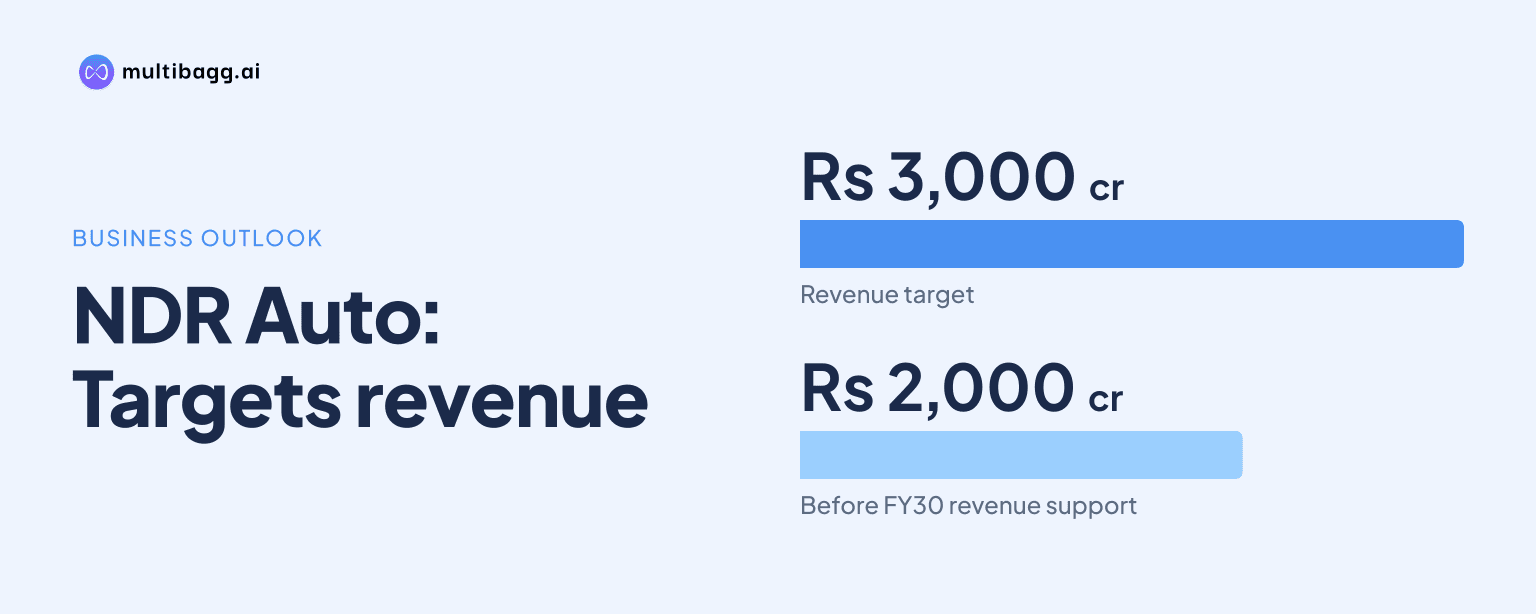
NDR Auto Components Limited said its Rs 1,150 crore standalone order book and current revenue base can support Rs 2,000 crore of revenue before FY30, but its proposed DYA joint venture is targeting Rs 800 crore to Rs 1,000 crore of business for FY31, leaving further initiatives necessary for the Rs 3,000 crore FY30 ambition.
Know NDR Auto Components inside out
Results, valuation, peers and who's buying, in one view.
How does NDR Auto plan to reach Rs 3,000 crore?
NDR Auto plans to reach Rs 3,000 crore through a Rs 2,000 crore organic revenue build-up, a proposed joint venture with DYA, and additional initiatives that management has not yet specified. During the Q2 FY27 call on November 5, 2026, management described the current revenue run rate as Rs 900 crore to Rs 1,000 crore and said the Rs 1,150 crore standalone order book could take revenue to Rs 2,000 crore before FY30.
The disclosed timing does not fully align with the FY30 ambition. Management said the DYA venture is seeking orders by the middle of the following year and is targeting production and business execution in FY31. It said the venture could add Rs 800 crore to Rs 1,000 crore of combined seat value, while other unspecified initiatives are being pursued to meet the Rs 3,000 crore goal earlier.
Management also said all of the Rs 1,150 crore standalone order book should be executed before FY30, although it did not provide a year-by-year revenue split. It indicated that FY29 and FY30 should be bigger execution years, while the pace of conversion depends on new-model launches, customer schedules and ramp-up patterns.
What supports NDR Auto’s Rs 2,000 crore organic goal?
NDR Auto’s organic plan is supported by its current business and a Rs 1,150 crore standalone order book, which management said is sufficient to reach Rs 2,000 crore before FY30. The company reported a consolidated order book of Rs 1,190 crore at the end of Q2 FY27, comprising Rs 1,150 crore at the standalone business and Rs 40 crore at the NDR Hayashi joint venture.
Management said the principal new orders came from Maruti Suzuki and Suzuki two-wheeler operations, with some new business from Toyota. Seating remains the predominant part of NDR Auto’s revenue and order book, but recent awards also cover other automotive components. The company cited seat frames, trim, latch products, seat-belt reminder systems and original equipment manufacturer-fitted sunshades among its product areas.
The order book is not a simple addition to current sales because its execution is spread across vehicle programmes. Management said a large portion may begin in about two years and would ramp up by FY30. It did not provide FY28, FY29 or FY30 guidance, saying annual revenue depends on model mix and programme ramp-up, although it said most new programmes were progressing broadly as scheduled.
NDR Auto reported Q2 FY27 revenue of Rs 247.86 crore, earnings before interest, tax, depreciation and amortisation of Rs 27.47 crore, and profit after tax of Rs 19.78 crore. These reported quarterly figures provide the current operating base, while the order book represents future programme value rather than a disclosed annual sales forecast.
What will the DYA joint venture contribute?
NDR Auto’s proposed DYA joint venture is intended to add full-seat assembly capability for Hyundai and Kia vehicles, with NDR Auto holding 51% and investing Rs 62.96 crore. Management said the venture would be fully consolidated in NDR Auto’s accounts, while the company would retain a 51% economic interest in the joint venture.
NDR Auto said its standalone operations would continue supplying seat covers and seat frames, while the joint venture would perform final full-seat assembly, including foam. The arrangement would allow the standalone business to retain component supply while the venture undertakes the final assembly directly for Kia. Management said this would expand value addition beyond the company’s existing frame and cover activities.
The Rs 800 crore to Rs 1,000 crore opportunity discussed on the call is the combined value of a complete seat, including frames and covers supplied by NDR Auto. Management clarified that this estimate currently relates only to Kia, while Hyundai opportunity has not yet been quantified. It said the venture’s margins are expected to be slightly lower than NDR Auto’s standalone business.
Management estimated content per vehicle for the proposed venture at Rs 50,000 to Rs 80,000 and said it was targeting annual volumes of about 1 lakh to 1.5 lakh vehicles. The programme is expected to involve new models. Management also cited Hyundai and Kia capacity expansion as part of the opportunity, but said business procurement remains in progress.
Got a follow-up? Ask IRIS
What investment and capacity plans support the order book?
NDR Auto has approved brownfield expansion at its Gujarat and Kharkhoda facilities, with the announced projects requiring about Rs 60 crore of investment. Management said this capacity, together with existing facilities, would support the Rs 1,150 crore standalone order book rather than generate an additional, separately disclosed order-book opportunity.
The DYA venture represents another roughly Rs 60 crore of project investment, including NDR Auto’s stated Rs 62.96 crore commitment. In response to an analyst’s calculation, management agreed that announced standalone projects and the venture together represented about Rs 120 crore, excluding yearly capital expenditure that may be added over time.
Capacity utilisation across NDR Auto’s plants was approximately 90% during the Q2 FY27 discussion. Management said three planned expansions were expected around January 2027 and that the following year should be slightly better as ramp-up proceeds. It said there should not be initial margin pressure from the capacity addition.
At Aurangabad, NDR Auto has acquired land for an NDR Hayashi facility after securing business for that venture. Management said it was also pursuing further Toyota business and could announce a project once that business converts. This remains an unresolved expansion element rather than part of the quantified Rs 1,150 crore standalone order book.
What could affect NDR Auto’s delivery of this plan?
NDR Auto said model ramp-up, mix and customer launch schedules will determine the timing of revenue conversion from its Rs 1,150 crore order book. Management said FY29 and FY30 should be bigger execution years, but also noted that new models can face last-minute delays. The company did not provide annual revenue guidance for FY27 or FY28.
Management reported an EBITDA margin of 11.08% for Q2 FY27 and said it was targeting an 11% to 11.5% sustainable range. It attributed higher other expenses partly to increased minimum wages in Haryana. Of an approximately Rs 5 crore quarter-on-quarter rise in other expenses discussed by an analyst, management said Rs 2.5 crore related to NDR South job-work activity, with the balance linked to wage increases.
Management said raw-material price movements are mostly passed through to customers without a lag. It also said some of the labour-cost increase had been passed on, while negotiations with original equipment manufacturers continued for the remainder. NDR Auto currently supplies only the Indian market and reported no direct exports during the call.
Conclusion
NDR Auto’s disclosed growth path supports a Rs 2,000 crore organic revenue objective before FY30 through its existing business and Rs 1,150 crore standalone order book. The proposed DYA venture could broaden the company’s role from component supply into full-seat assembly and add Rs 800 crore to Rs 1,000 crore of complete-seat business, but management places that opportunity in FY31 rather than FY30.
The next points to watch are whether DYA orders are secured by the middle of the following year, whether the January 2027 capacity expansions begin as planned, and whether Toyota-related business at Aurangabad converts into a disclosed project. Management also needs to provide detail on the additional initiatives it says are required to close the timing gap in its Rs 3,000 crore FY30 ambition.