










Neogen Chemicals targets Pakhajan approval by March 2027
Key highlights
- Neogen received electrolyte recipes from five of six Indian giga factories during trial production.
- Neogen estimates Dahej-to-Pakhajan site-transfer approvals could take two to three months.
- Neogen expects the broader electrolyte approval process to take two to six months and finish by March 2027.
- Two customers have used Neogen electrolyte in pilot or commercial lines, while three are testing it.
powered by IRIS
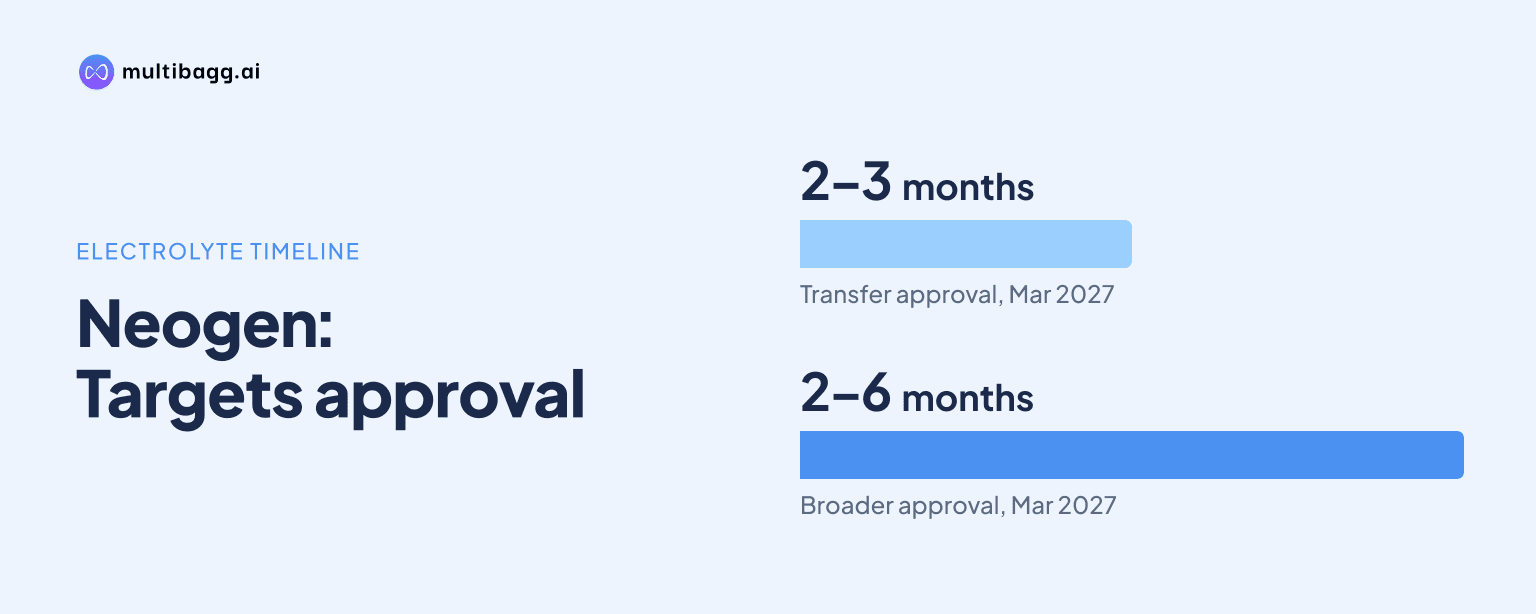
Neogen Chemicals expects Indian battery-cell customers to complete approvals for Pakhajan-made electrolytes by March 2027, after receiving recipes from five of six giga factories and estimating two-to-three-month approvals for transfers from Dahej. Management said subsequent sales will depend on customers’ cell-production ramp-up rather than qualification alone.
Know Neogen Chemicals inside out
Results, valuation, peers and who's buying, in one view.
When will Neogen complete Pakhajan electrolyte approvals?
Neogen expects Pakhajan electrolyte approvals to be completed by March 2027, with the process expected to take two months to a maximum of six months. Management said it aims to have approvals in place before cell makers begin regular production, allowing them to purchase locally made electrolyte from Neogen rather than first importing material from China.
The stated timetable puts the main qualification work in Q4 FY27 and Q1 FY28. Management said most customers were expected to be ready in that period once they had generated sufficient performance data using Pakhajan material. This is a customer-approval target rather than a sales forecast because the timing of purchases depends on each battery-cell maker’s production ramp-up.
Neogen’s timetable follows trial production and customer-specific recipe sharing. The company said it had received the relevant electrolyte recipe from five of six giga factories and would jointly produce the materials with those customers. That process allows customers to qualify the formulation intended for use in their own battery cells.
How far has Neogen progressed with Indian battery-cell customers?
Neogen said two customers had used its electrolyte in pilot or commercial lines, while three others were testing its electrolyte in research and development or external laboratories. Management said those tests compare Neogen’s material with Chinese electrolyte, giving customers a stated benchmark for assessing performance.
The two groups are at different stages. For customers that previously received Dahej samples and approved them, Pakhajan qualification is a site transfer rather than an entirely new product approval. For the remaining customers, Neogen said they can test Pakhajan material to confirm that it delivers the same performance as earlier research-and-development samples.
Management said all six customers were keen to work with Neogen, while adding that the immediate requirement for some customers was to determine how recipes could be shared. International teams from certain customers had visited the Pakhajan site and gave positive remarks, according to management. Those visits do not replace formal qualification, which remains the step required before commercial purchases.
The disclosed status also shows a progression across the six targeted factories. Five had supplied recipes during trial production, while one had not been identified by management as having done so. Among the five with a recipe pathway, two had already used Neogen electrolyte in pilot or commercial settings and three were testing it, moving the work from formulation access to customer-specific validation.
Got a follow-up? Ask IRIS
Why does a Dahej-to-Pakhajan approval transfer matter?
A Dahej-to-Pakhajan transfer matters because Neogen estimates that this route can be approved in two to three months, shorter than the broader two-to-six-month electrolyte qualification window. Management said two customers had received and approved material from Dahej, making their Pakhajan review an assessment of a new manufacturing site rather than a first-time review of Neogen’s electrolyte.
Neogen said Pakhajan material must nevertheless produce the same performance as previous samples. The company plans to jointly produce each customer’s recipe and supply it for testing, allowing customers to check whether the new site maintains results achieved with Dahej or research-and-development material. Consistency of formulation and manufacturing output is therefore central to the approval process.
The distinction is commercially relevant because approval may be completed before cell plants reach material consumption at scale. Management said it did not expect approvals to be a constraint for electrolyte once Pakhajan is operating, but said sales would depend on cell-production ramp-up. A completed qualification establishes supply readiness rather than guaranteeing a specific sales volume.
Neogen linked the domestic opportunity to battery-cell capacity expected to come online by the end of the current financial year or early in the next financial year. Management estimated total capacity at that point could be 60 gigawatt-hours, or 60 GWh. It said the capacity would serve both electric-vehicle and energy-storage applications, with energy-storage capacity currently higher than that required for electric vehicles.
What will determine Neogen electrolyte sales after March 2027?
Neogen said electrolyte sales after approval will depend primarily on how quickly customers stabilise cell production. Management said facilities may take six months, one year or two years to reach 50% or 80% utilisation, and described this pace as the principal uncertainty over the next two financial years.
That uncertainty differs from the qualification target. Neogen expects the approval process itself to be completed by March 2027, whereas customer utilisation could extend beyond that date. Qualification progress should therefore be considered separately from battery-cell output and the resulting electrolyte demand.
Local sourcing of lithium salt is another variable. Management said some customers now ask Neogen to use locally made salt in electrolyte, whereas a year earlier some accepted salt imported from Morita or China because prices were lower. Neogen expects clarity by Q4 FY27 on Indian customer choices between local and imported salt, as well as relevant government policy.
Management said Neogen has enough salt and electrolyte capacity for FY28 unless Indian customers specifically require it to contribute salt for local electrolyte production. It plans to consider additional salt capacity around the end of Q4 FY27 or Q1 FY28 if demand in India and the United States supports it. For an incremental salt or electrolyte facility at an existing site, management estimated a lead time of 15 to 18 months.
Conclusion
Neogen’s March 2027 target rests on a defined customer-qualification route: recipes from five of six giga factories, two customers with Dahej-related pilot or commercial use, and a two-to-three-month transfer process for customers that already approved Dahej material. The shorter transfer route compared with the wider two-to-six-month qualification range could reduce the time required for those existing customer relationships.
The next points to watch are whether customers complete qualification in Q4 FY27 or Q1 FY28, how quickly their cell plants stabilise after approval, and whether they specify locally produced salt. Management said it could decide on additional salt capacity by the end of Q4 FY27 or Q1 FY28 after assessing demand in India and the United States.