










Neogen sees US rules supporting 70%-80% salt utilisation
Key highlights
- Neogen began commercial lithium-salt supplies to 2 international customers by November 2, 2026.
- Neogen completed final Dahej audits with 3 US electrolyte manufacturers and had provisional approvals from 5 major international customers.
- Management expects calendar-2027 US non-FEOC sourcing requirements to support 70%-80% lithium-salt capacity utilisation next year.
- Battery-chemicals revenue rose to Rs 37 crore in Q2 FY27 from Rs 5 crore a year earlier.
powered by IRIS
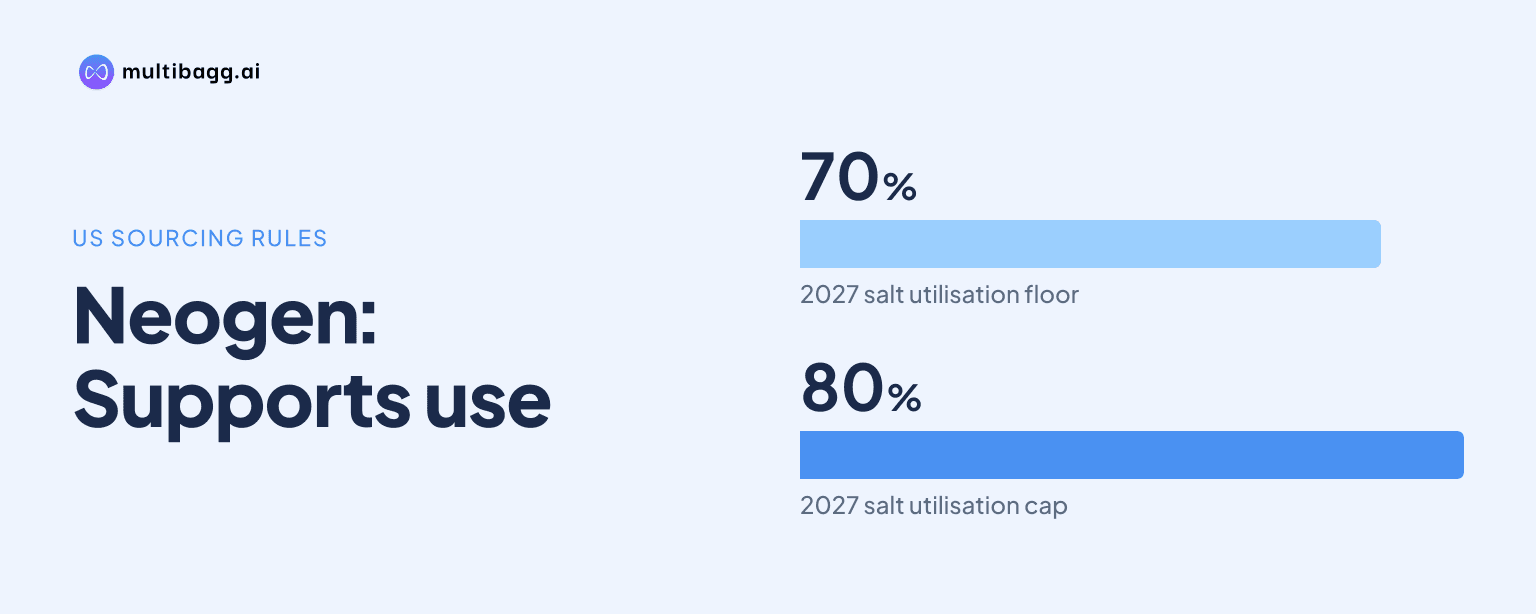
Neogen Chemicals Limited said on November 2, 2026 that calendar-2027 US non-FEOC sourcing requirements could support 70%-80% utilisation of its 5,500-tonne lithium electrolyte-salt capacity next year. Management cited commercial supplies to two international customers, final Dahej audits with three US manufacturers and its expectation of close to Rs 1,000 crore in salt revenue.
Know Neogen Chemicals inside out
Results, valuation, peers and who's buying, in one view.
Why does Neogen expect US rules to raise lithium-salt demand?
Neogen expects US battery-cell producers seeking the 45X tax credit to reduce dependence on foreign entities of concern, or FEOC, supplies from 2027, creating demand for non-FEOC electrolyte salts. Management said this calendar-2027 sourcing requirement is driving quarter-on-quarter growth in its salt demand and supports its utilisation outlook for the next financial year.
Management said US electrolyte makers already produce most electrolyte formulations locally, while electrolyte salts and additives have historically been supplied largely from China. Neogen identified its non-FEOC supply status and Morita technology as supporting its US opportunity. It said one Japanese supplier, one Korean supplier, Neogen and qualifying Indian companies would be among the alternatives as buyers shift sourcing.
How far has Neogen progressed with US customer approvals?
Neogen has secured provisional approvals at Dahej from five major international customers, completed final site audits with three US-based manufacturers and started commercial supply with two international customers. Management said it was in contact with all five US electrolyte producers and expected the fifth customer to qualify the Pakhajan site after that facility comes online.
Neogen expects to have access to the full US electrolyte-manufacturing ecosystem by June 2027, according to management. This remains an expectation rather than a contracted-volume commitment because management said its long-term salt contracts do not contain take-or-pay clauses. It is also discussing supply with non-contracted customers to underpin utilisation beyond contracted volumes.
What utilisation and revenue does Neogen target from salts?
Neogen expects at least 70%-80% utilisation of its lithium-salt capacity next year, with most output potentially sold externally. Management said that about 80% utilisation of its 5,500-tonne capacity, at prevailing prices, could generate roughly Rs 800 crore to Rs 1,000 crore of salt revenue before additional value from electrolyte production.
Management retained battery-chemicals revenue guidance of Rs 250 crore to Rs 300 crore for FY27, after revenue of Rs 37 crore in Q2 FY27 and Rs 17 crore in Q1 FY27. It said salts accounted for most Q2 revenue, while electrolyte contributed less than 5%-10%. For FY28, management said battery-chemicals revenue should exceed Rs 1,000 crore, with the outcome above that level dependent on electrolyte demand and customer choices.
Got a follow-up? Ask IRIS
What could change the mix between salt exports and electrolyte sales?
Neogen said US export demand supports external salt sales, but Indian cell makers may ask it to use locally produced salts in electrolyte formulations. Management said a local electrolyte sale adds value because salt represents about 50% of electrolyte value. The final mix depends on customer preferences for locally made salts or imported material and on price differentials.
For domestic electrolyte demand, management cited about 60 gigawatt hours of cell capacity expected to come online by the end of FY27 or early FY28. It said this capacity could require 6,000 to 10,000 tonnes of electrolyte and 500 to 1,000 tonnes of salts at roughly 12% salt content, subject to customer choice. Ola has received all approvals, while Exide was conducting trials and had announced Q4 commercialisation, management said.
When will Neogen decide on more lithium-salt capacity?
Neogen plans to decide on additional salt capacity around Q4 FY27 or Q1 FY28 after assessing US demand, Indian electrolyte ramp-up and government-policy clarity. Management expects Pakhajan to enter trial production by December 2026 and start producing significant quantities by February or March 2027, providing further salt output if electrolyte sales do not meet FY27 plans.
Management said an incremental salt plant would require about 15 to 18 months at an existing site, while the minimum scale would be 3,000 to 5,000 tonnes for liquid salts and about 1,000 tonnes for an additive. It expects electrolyte capacity to reach full utilisation by FY29, but said Indian cell-factory stabilisation could take from six months to two years.
Conclusion
Neogen’s stated US opportunity is tied to a calendar-2027 sourcing change rather than general export interest. Management expects non-FEOC requirements to move some demand away from Chinese supply, and it has progressed from customer audits to commercial supplies for two international customers. Battery-chemicals revenue rose to Rs 37 crore in Q2 FY27 from Rs 5 crore a year earlier.
The next disclosures to watch are Pakhajan’s planned December 2026 trial production, significant output targeted for February or March 2027, and management’s salt-capacity decision in Q4 FY27 or Q1 FY28. The pace of US customer qualification, the allocation between salt exports and domestic electrolyte production, and Indian cell-production ramp-up will determine how quickly utilisation advances.