










Neogen FY28 debt seen at Rs 1,300-1,500 crore despite QIP
Key highlights
- Neogen reported consolidated net debt of Rs 1,095 crore and liquid fixed-deposit investments of Rs 465 crore at September 30, 2026.
- Neogen expects FY28 net debt of Rs 1,300-1,500 crore despite its Rs 600 crore QIP.
- Neogen accepted a Rs 152 crore insurance claim on October 29, 2026, taking received and receivable on-account claims to Rs 316 crore.
- Neogen said it had initiated repayment of Rs 200 crore of bonds and targets about 180 days of standalone inventory by FY27-end.
powered by IRIS
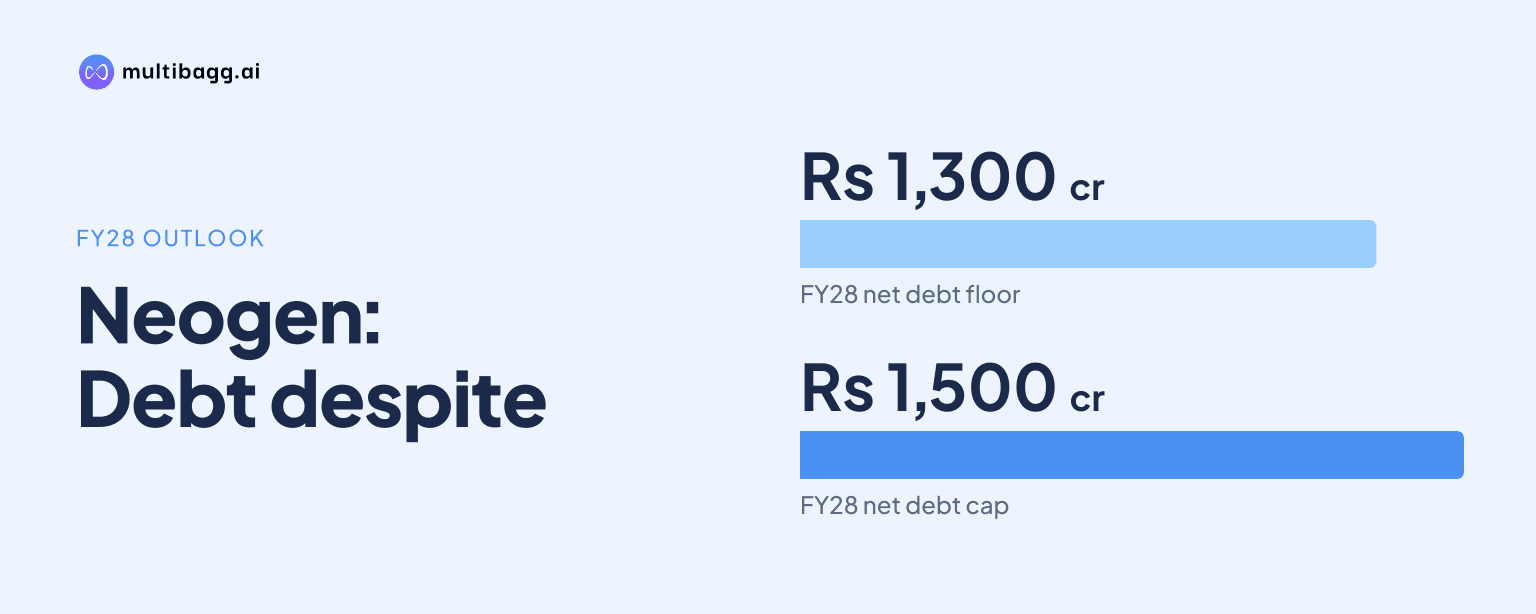
Neogen Chemicals Limited expects FY28 net debt of Rs 1,300-1,500 crore, compared with consolidated net debt of Rs 1,095 crore at September 30, 2026, despite raising Rs 600 crore through a qualified institutional placement, or QIP. Management cited remaining battery-project investment and working-capital needs as revenue and production capacity expand.
Know Neogen Chemicals inside out
Results, valuation, peers and who's buying, in one view.
What is Neogen's current debt and liquidity position?
Neogen reported consolidated net debt of Rs 1,095 crore at September 30, 2026, while standalone net debt was Rs 378 crore. The group also held Rs 465 crore in liquid investments in fixed deposits at that date, as battery-materials operations continued their production ramp-up and incurred initial fixed costs.
Neogen's consolidated debt position incorporates its battery-chemicals businesses, while the standalone figure covers the parent company's position. In Q2 FY27, consolidated revenue rose 42% year on year to Rs 296 crore and consolidated earnings before interest, tax, depreciation and amortisation, or EBITDA, rose 51% to Rs 45 crore, but the company said higher interest and depreciation charges from ongoing capital expenditure affected profit after tax.
Management said interest costs should decline as term debt is reduced with QIP proceeds, borrowing costs reflect the credit-rating action and insurance money is received. CRISIL revised the outlook on Neogen's long-term bank facilities to CRISIL A- stable from negative, while reaffirming its CRISIL A2+ short-term rating.
How will Neogen use the QIP and insurance money?
Neogen said its Rs 600 crore maiden QIP will be used primarily to deleverage the balance sheet, reduce working-capital borrowing dependence and meet general corporate purposes. Management said it had initiated the process to repay Rs 200 crore of bonds after giving notices to lenders and bondholders.
The QIP was oversubscribed 6.5 times, according to management, but the company did not say that all proceeds would be assigned to debt repayment. That distinction matters because the stated use includes working capital, while unfinished projects at Pakhajan and Dahej require further investment.
Neogen had recovered Rs 164 crore from insurance and salvage by the call date, consisting of Rs 155 crore in on-account claim payments and Rs 9 crore from salvage realisation. The Rs 155 crore included a Rs 15 crore tranche received in July 2026 after the Dahej incident and plant rebuild.
On October 29, 2026, Neogen accepted an additional Rs 152 crore insurance claim, which management expected to be released during Q3 FY27. Including accepted claims and scrap sales, on-account insurance claims received and receivable totalled Rs 316 crore; management said discussions on the remaining claim balance were continuing.
Why does Neogen expect FY28 net debt to increase?
Neogen expects FY28 net debt of Rs 1,300-1,500 crore, or Rs 205-405 crore above the Rs 1,095 crore reported at September 30, 2026. Chief Financial Officer Gopikrishnan Sarathy said the range depends on lithium prices and other prices prevailing at the time.
Management attributed the higher projected debt to residual capital expenditure at Pakhajan and Dahej and to working-capital requirements as battery chemicals scale. Neogen expects battery-chemicals revenue to exceed Rs 1,000 crore in FY28, although management said the extent of revenue above that level depends on electrolyte demand and customer production ramp-up.
The battery expansion remains in an execution phase. Neogen expects Pakhajan lithium-salt capacity to enter trial production by December 2026 and to produce significant quantities by February or March 2027. At Dahej, rebuilt-plant trial runs were under way, with commercial production expected within FY27 and fuller use of the facilities in the following quarter.
Neogen is also spending up to Rs 45 crore to double Organolithium capacity at Patancheru from 300 metric tonnes a year to 600 metric tonnes a year. Management targets completion by the end of the next first half and expects the additional capacity to contribute Rs 50-75 crore of revenue next year, rising to Rs 150-200 crore when fully utilised.
Got a follow-up? Ask IRIS
How does working capital shape Neogen's funding requirement?
Neogen said higher working capital will accompany battery-chemicals growth in FY28, adding to the funding requirement after debt repayment. Management linked the inventory increase in the first half of FY27 to the incomplete Dahej restart, ongoing toll-manufacturing arrangements and rising customer demand.
For standalone operations, Neogen targets inventory of about 180 days by the end of FY27 as Dahej resumes production. Management then aims to return to its historical 140-160-day range in FY28 and to reach 110-140 days in FY29-FY30, helped by a greater contribution from Organolithium and customer-specific manufacturing, or CSM, projects.
The battery business has a separate working-capital-cycle target of about 90 days. The eventual requirement will also be influenced by customer choices on locally made lithium salt versus imported salt, because using local salt in electrolyte production changes the balance between external salt sales and captive consumption.
Neogen expects an initial battery-chemicals revenue range of Rs 250-300 crore in FY27. For FY28, management said strong demand for salts, additives and solvents supports revenue above Rs 1,000 crore, but it had not determined whether electrolyte development could lift that figure towards Rs 1,200 crore or Rs 1,500 crore.
What could change Neogen's FY28 debt outcome?
Neogen said lithium and other prices are direct variables in its Rs 1,300-1,500 crore FY28 net-debt estimate. The timing of the Rs 152 crore insurance release is also relevant, although management expected the payment within weeks during Q3 FY27 after accepting the claim on October 29, 2026.
Production and customer qualification milestones could alter the pace of working-capital deployment. Neogen said five major international customers had granted provisional approvals for lithium electrolyte salts at Dahej, while it had commenced commercial supply with two international customers and completed final site audits for three US-based manufacturers.
Management said it may decide on additional salt capacity around the end of Q4 FY27 or Q1 FY28 if US non-Foreign Entity of Concern, or non-FEOC, demand and Indian electrolyte demand develop as expected. It estimates that incremental salt or electrolyte capacity at an existing setup would require about 15-18 months, creating a potential later funding requirement beyond the projects now being completed.
Conclusion
Neogen's FY28 debt outlook reflects two offsetting forces: the Rs 600 crore QIP, planned Rs 200 crore bond repayment, Rs 465 crore of liquid investments and expected Rs 152 crore insurance payment support deleveraging, while unfinished battery projects and a larger working-capital base require capital. Management therefore expects net debt to be above its September 2026 level even as it reduces selected borrowings.
The next disclosed milestones are receipt of the Rs 152 crore insurance claim in Q3 FY27, commercial production at the rebuilt Dahej plant within FY27 and Pakhajan trial production by December 2026. Management may also decide on added salt capacity around Q4 FY27 or Q1 FY28, depending on US non-FEOC demand, Indian electrolyte demand and customer ramp-up.