










Neogen targets Rs 150-200 crore from Organolithium expansion
Key highlights
- Neogen plans to double Patancheru Organolithium capacity from 300 to 600 metric tonnes per annum.
- The board-approved Organolithium expansion has an estimated capital outlay of up to Rs 45 crore.
- Management targets Rs 150 crore to Rs 200 crore of additional annual revenue after the new capacity is fully ramped up.
- Neogen reported a 300-tonne Organolithium run rate and Q2 FY27 consolidated revenue of Rs 296 crore, up 42% year on year.
powered by IRIS
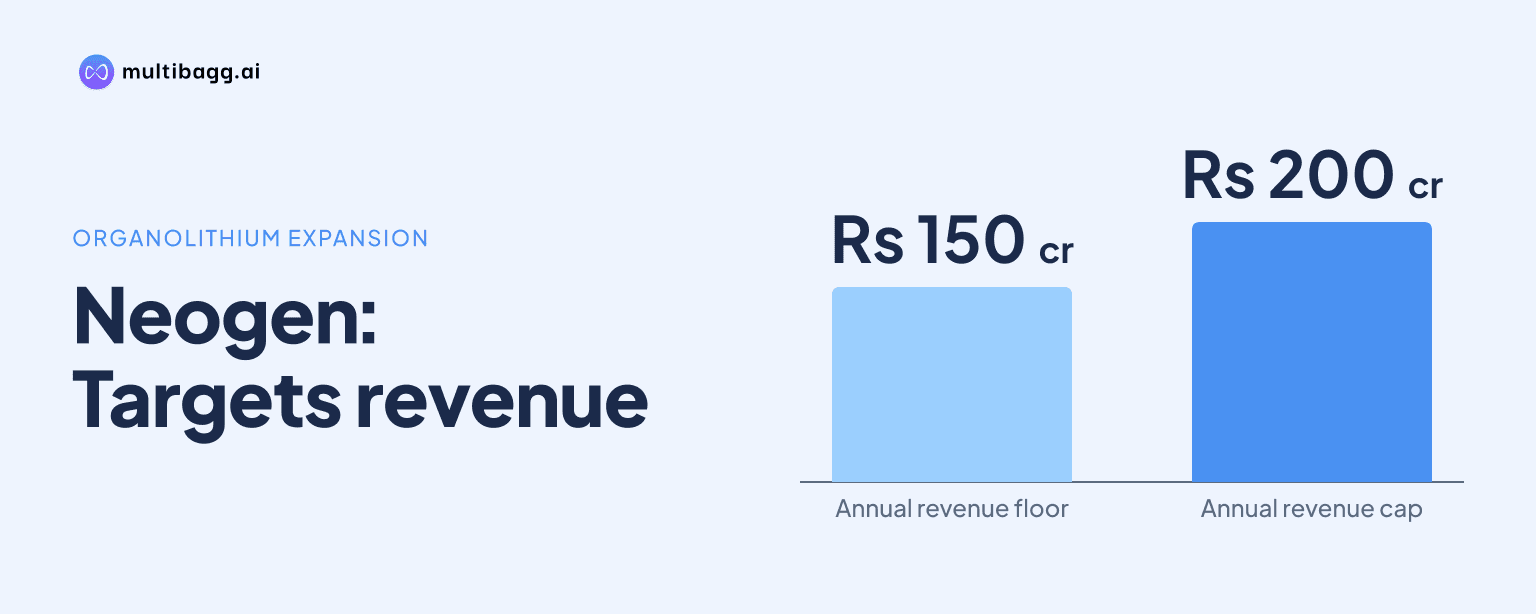
Neogen Chemicals Limited plans to double Organolithium capacity at Patancheru to 600 metric tonnes per annum from 300 tonnes, targeting Rs 150 crore to Rs 200 crore of additional annual revenue after ramp-up. The board-approved project carries an estimated capital outlay of up to Rs 45 crore and follows an existing 300-tonne operating run rate.
Know Neogen Chemicals inside out
Results, valuation, peers and who's buying, in one view.
Why is Neogen expanding Organolithium capacity?
Neogen is expanding because its existing Organolithium capacity is running at about 300 tonnes and management cited sustained volume improvement and widening end-market demand. On the November 2, 2026, Q2 FY27 earnings call, Managing Director Harin Kanani said the company could potentially achieve some incremental capacity increase by the end of FY27 even before the approved expansion is completed.
The project will double annual capacity at Patancheru, Telangana, from 300 metric tonnes to 600 metric tonnes. Neogen has estimated capital expenditure of up to Rs 45 crore for the additional 300 tonnes, which management described as an expansion supported by higher-growth applications rather than the introduction of a new Organolithium product line.
The capacity decision comes during a period of growth in Neogen's core operations. Consolidated revenue increased 42% year on year to Rs 296 crore in Q2 FY27, while organic chemicals revenue rose 29% to Rs 238 crore. Management said volume expansion across core segments, including Organolithium, supported quarterly revenue growth.
What revenue does Neogen expect from added Organolithium capacity?
Neogen management expects the additional Organolithium capacity to generate Rs 150 crore to Rs 200 crore of annual revenue once it is fully ramped up. The range is additional revenue potential from the expansion, not total Organolithium revenue, and management said it will depend on prevailing lithium prices.
Management outlined a phased contribution profile for the project. It expects the new capacity to contribute Rs 50 crore to Rs 75 crore in FY28, followed by the full Rs 150 crore to Rs 200 crore annual revenue potential in FY29. Those figures are management targets rather than reported revenue, and assume commissioning and customer demand develop as planned.
The call did not disclose expected Organolithium margins, pricing per tonne, utilisation assumptions or return measures for the Rs 45 crore project. For context, consolidated earnings before interest, tax, depreciation and amortisation, or EBITDA, rose 51% year on year to Rs 45 crore in Q2 FY27, but this measure includes Neogen's other businesses and cannot be assigned to Organolithium alone.
Which applications are driving Neogen's Organolithium demand?
Neogen cited pharmaceutical, agrochemical, semiconductor-material and specialty-polymer applications as the demand base for the capacity increase. Management said it had seen a strong rise in approvals in pharmaceuticals and had received international approvals in both pharmaceutical and agrochemical applications.
Demand has broadened beyond the Indian pharmaceutical market. Neogen said it expects demand from domestic and international pharmaceutical customers, alongside international semiconductor-material and specialty-polymer applications. The company said it had already received approvals in semiconductor materials and specialty polymers, where management sees strong volume demand.
These Organolithium applications are separate from Neogen's battery-chemicals activity, although both involve lithium-based chemistry. Battery-chemicals revenue was Rs 37 crore in Q2 FY27, compared with Rs 5 crore in Q2 FY26, while Neogen Ionics revenue was Rs 27 crore against Rs 5 crore a year earlier. Management linked the Organolithium project specifically to the 300-tonne run rate and approvals across pharma, agrochemicals, semiconductors and specialty polymers.
Got a follow-up? Ask IRIS
When will Neogen complete the Patancheru expansion?
Neogen is targeting completion of the added Organolithium capacity by the end of H1 FY28, according to management's stated target on the Q2 FY27 call. Management said the project was initially expected to take a full year but could be completed by the end of the next first half, which would be earlier than that initial timeframe.
The planned revenue profile indicates that output will build after commissioning. Management expects Rs 50 crore to Rs 75 crore of additional revenue in FY28, before targeting Rs 150 crore to Rs 200 crore in FY29. The transcript did not specify a monthly commissioning schedule, customer-wise allocation or production ramp-up rate for the new 300 tonnes.
Neogen was also progressing with a separate Dahej rebuild as of November 2, 2026. Trial runs at Dahej were under way, and management expected commercial production within FY27, with full use of the facility in the next quarter. That project concerns wider operations and does not change the separately disclosed Organolithium target of 600 tonnes per annum at Patancheru.
How does the project fit Neogen's funding position?
Neogen completed a Rs 600 crore qualified institutional placement, or QIP, during Q2 FY27, and management said the issue was oversubscribed 6.5 times. The company said it intended to use proceeds to deleverage the balance sheet and prepare to fund the next phase of growth, but did not allocate a specified portion of the QIP to the Rs 45 crore Organolithium expansion.
As of September 30, 2026, Neogen had Rs 465 crore in liquid investments in fixed deposits and consolidated net debt of Rs 1,095 crore. Management said interest costs were expected to decline through term-debt reduction using QIP proceeds, lower borrowing costs following the credit-rating action and insurance-claim disbursements.
Insurance recoveries and receivables totalled Rs 316 crore as of the call, comprising Rs 155 crore of on-account payments, Rs 9 crore from salvage realisation and an accepted additional claim of Rs 152 crore. Management said it expected the Rs 152 crore amount within the next few weeks, while separately forecasting FY28 consolidated net debt of Rs 1,300 crore to Rs 1,500 crore, depending on lithium and other prices.
Conclusion
Neogen's Organolithium expansion is based on an existing 300-tonne operating run rate and management-cited approvals across pharmaceutical, agrochemical, semiconductor-material and specialty-polymer applications. The Rs 45 crore project would double Patancheru capacity to 600 tonnes per annum, while management targets Rs 150 crore to Rs 200 crore of added annual revenue once the capacity is fully ramped up.
The next disclosed milestones are targeted completion by the end of H1 FY28 and an expected Rs 50 crore to Rs 75 crore contribution in FY28. Investors will also need to monitor whether customer approvals convert into volumes, as management has linked the full Rs 150 crore to Rs 200 crore revenue range to prevailing lithium prices and has not disclosed pricing or utilisation assumptions.