










NephroPlus says new clinics will drive most India growth
Key highlights
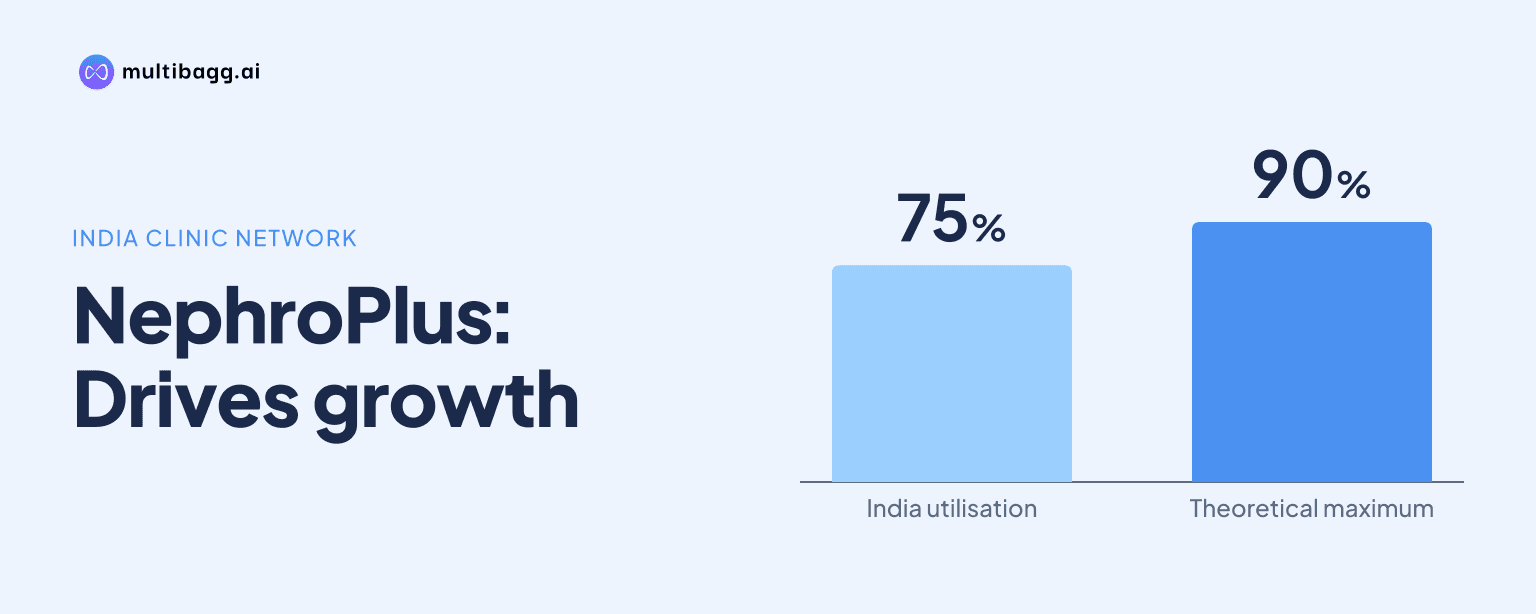
- NephroPlus said India network utilisation was approximately 75%, versus a theoretical maximum of around 90%.
- NephroPlus added 40 clinics on a gross basis in the first half of FY27 and targets 40 to 50 India additions annually.
- NephroPlus said Bihar greenfield PPP clinics took two to three months to stabilise volume, versus day one to one month for captive brownfield units.
- NephroPlus reiterated management guidance for 15% to 20% revenue CAGR over three to four years.
powered by IRIS
Nephrocare Health Services Limited said most future India growth should come from clinic additions, with its India network at about 75% utilisation and 40 gross clinics added in the first half of FY27. Management said existing clinics still have room for gradual organic growth, but new capacity will supply the larger share of expansion.
Know Nephrocare Health Services inside out
Results, valuation, peers and who's buying, in one view.
How will NephroPlus drive India growth from here?
NephroPlus expects the majority of India growth to come from clinic additions, while existing clinics continue to add volume gradually. Rohit Singh described the mix as an “80-20 rule”, with additions contributing the larger portion because each new clinic expands network capacity. Management did not quantify the precise split between expansion-led and organic growth.
India network utilisation was approximately 75%, compared with a theoretical maximum of around 90% for dialysis operations. Management said dialysis capacity is not expected to reach 100% use because the third of three daily shifts is less preferred; it ends at about 10:00 P.M. The company said it has improved overall utilisation in recent quarters, but expects additional improvement to be marginal.
NephroPlus had 500 clinics in India, up from 487, a net increase of 13 clinics. Management said gross additions and net additions differ because certain clinics can close during the year. In most closures, guests and treatment sessions are moved to a nearby clinic, meaning a lower net count need not indicate a matching reduction in treatment capacity.
Management retained its annual target of 40 to 50 India clinic additions after 32 net additions and 40 gross additions in the first half of FY27. Vikram Vuppala said business-development activity can arrive in uneven batches, making some quarters much stronger than others. He said full-year additions could be slightly above 50, without changing the stated guidance materially.
How quickly do NephroPlus greenfield and brownfield clinics ramp up?
NephroPlus said Bihar greenfield public-private partnership, or PPP, clinics took two to three months to stabilise on volume, while a captive brownfield unit in India could stabilise from day one to within one month. The distinction is whether the facility begins with an operating patient base or must build treatment volumes after launch.
Management also said the 40 additions discussed on the call typically stabilise in five to six months, depending on the mix of brownfield acquisitions and newly started PPP clinics. The Bihar rollout was identified as a component of those additions. This indicates that the initial ramp profile changes with the structure of the clinic, even when additions are counted in the same period.
For the Philippines, management gave a longer range of 18 to 24 months for a greenfield clinic to stabilise on volume. It said a Philippines brownfield acquisition generally stabilises in three to six months. In a broader India-Philippines comparison, management also placed captive units in India in a three-to-six-month range, alongside brownfield facilities.
A clinic can continue to grow after reaching volume stability because utilisation differs by location. Management said year-on-year growth at an operating clinic depends on its capacity utilisation, which varies clinic by clinic. This separates the initial stabilisation timeline from subsequent treatment-volume growth at a facility.
Got a follow-up? Ask IRIS
What types of India clinics is NephroPlus adding?
NephroPlus said PPP projects represented the larger share of growth in the period discussed, with Tamil Nadu, Bihar and Haryana contributing to additions. PPP awards can bring a group of clinics into the network in a short period. Captive and private-centre expansion, by comparison, was described as a steadier month-by-month process.
Management said a quarterly result can look heavily weighted towards PPP clinics when a contract is awarded, but the mix should average out over a longer period. It did not provide a numerical split of the 13 net India additions among PPP, standalone and captive centres. The company said its business-development team continues to pursue both PPP and captive opportunities.
Clinic counts do not show the same amount of capacity in every case. Management said a clinic can have five beds or 20 beds, with an average of 10 beds. It therefore identified revenue growth as a more important measure than a uniform quarterly clinic count and reiterated management guidance for revenue compound annual growth rate, or CAGR, of 15% to 20% over three to four years.
The 40-to-50 annual addition target is therefore an operating guide rather than a commitment to replicate first-half gross additions in every subsequent half-year. Management said development cycles can be irregular, while its activity is intended to support the 15% to 20% revenue CAGR objective. A larger number of smaller clinics would not necessarily have the same revenue effect as fewer higher-capacity sites.
What can existing NephroPlus clinics contribute to growth?
NephroPlus said existing India clinics can still deliver organic growth because approximately 75% utilisation remains below the roughly 90% theoretical maximum. Singh said the company sees “decent” year-on-year organic growth, but management expects capacity created by new clinics to make the larger contribution going forward.
The constraint on utilisation is scheduling rather than simply the number of installed beds. Management said the first two dialysis shifts are well occupied, whereas the late third shift has lower use because patients generally prefer not to finish treatment at about 10:00 P.M. This explains why the company does not treat 100% utilisation as an operating benchmark.
International expansion is a separate growth lever from India clinic additions. Management said NephroPlus operates about 570 clinics across its footprint and aspires to add 10 to 15 clinics a year in the Philippines, alongside 40 to 50 in India. It also said the company typically adds a new country about every one and a half years, and added Kazakhstan in the quarter discussed.
Management identified existing-clinic growth, new clinics, pricing and geographic mix as revenue drivers. It said Uzbekistan had a 5% price increase and that international mix was the main explanation for higher revenue per treatment in rupee terms. Foreign exchange accounted for 3% of quarterly revenue growth, while 97% came from organic, inorganic or price-related factors.
Conclusion
NephroPlus is planning India expansion primarily around additional clinics because its 75% utilisation leaves room for organic growth but not unlimited incremental capacity. The timing of that growth will depend on the model: Bihar greenfield PPP units took two to three months to stabilise, while operating brownfield units can have a faster volume ramp.
The next measure to watch is whether NephroPlus remains near its 40-to-50 annual India clinic-addition target after 40 gross additions in the first half of FY27. Management’s 15% to 20% revenue CAGR target over three to four years also depends on the mix of PPP awards, captive additions, existing-clinic utilisation and the capacity profile of each new centre.