










NephroPlus margin falls 80 basis points on expansion costs
Key highlights
- NephroPlus reported a 23.0% H1 FY27 adjusted EBITDA margin, compared with 23.8% in FY26.
- H1 FY27 revenue rose 23.6% year on year to Rs 585 crore, while adjusted EBITDA increased 15.3% to Rs 134 crore.
- Other expenses increased to 20.0% of revenue in H1 FY27 from 18.2% in FY26.
- NephroPlus expects FY27 capital deployment to exceed FY26’s Rs 165 crore as it develops its newest geography.
powered by IRIS
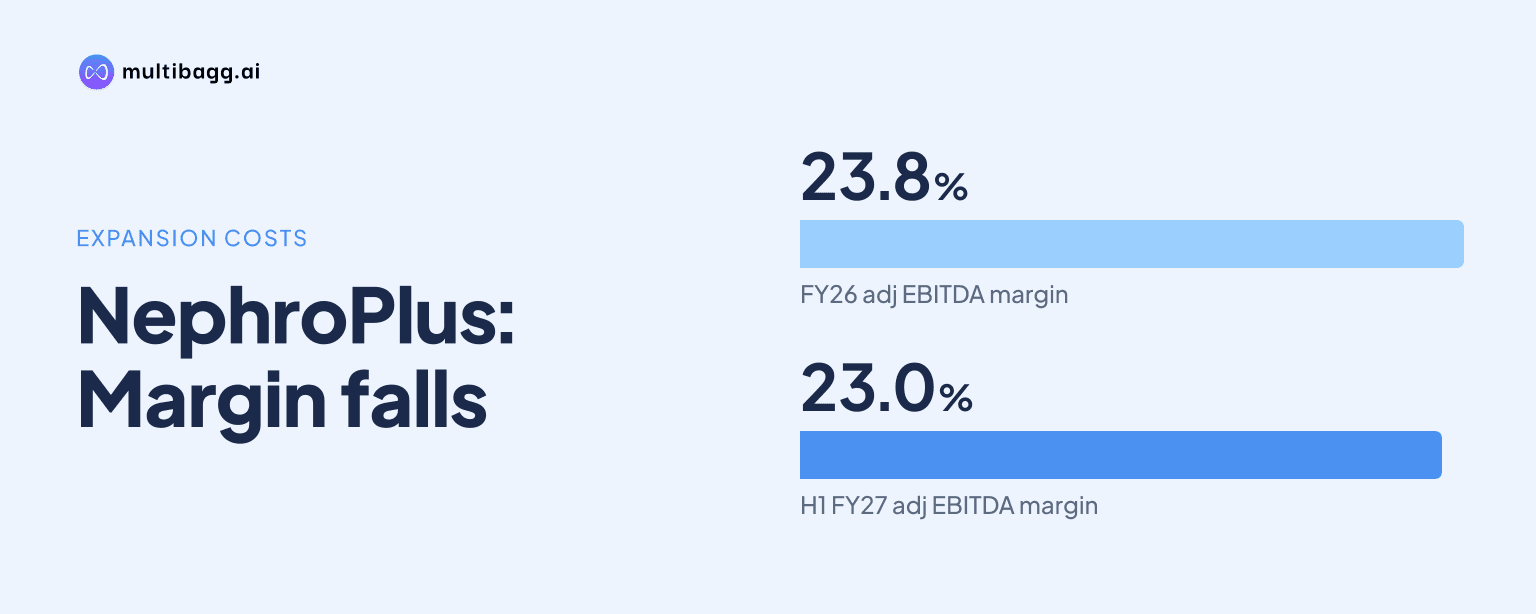
Nephrocare Health Services Limited reported a 23.0% adjusted EBITDA margin in H1 FY27, 80 basis points below FY26’s 23.8%, as international business-development, new-country teams, technology, listed-company costs and expected credit loss provisioning increased other expenses. NephroPlus said clinic-level materials and professional-fee ratios improved during the period.
Know Nephrocare Health Services inside out
Results, valuation, peers and who's buying, in one view.
How did NephroPlus’s EBITDA margin change in H1 FY27?
NephroPlus’s adjusted EBITDA margin declined by about 80 basis points from FY26 to H1 FY27, falling to 23.0% from 23.8%. Adjusted EBITDA increased 15.3% year on year to Rs 134 crore in H1 FY27, while revenue rose 23.6% to Rs 585 crore, meaning earnings grew more slowly than revenue.
Management said Q2 FY26’s 27.1% margin was not the appropriate comparator because NephroPlus was then private and had an annual audit cycle. Provisions were trued up during year-end audits, whereas auditor reviews now occur quarterly after the listing. Management therefore used the FY26 margin of 23.8% as the benchmark for H1 FY27.
Q2 FY27 adjusted EBITDA was Rs 68.9 crore, up 3.3% year on year and 5.8% from Q1, at a 22.7% margin. Quarterly revenue grew 23.5% year on year to Rs 303 crore and 7.7% sequentially. The Q2 margin was below the H1 FY27 average of 23.0%, while management cautioned that comparison with the pre-listing quarter has limitations.
Which costs caused NephroPlus’s reported margin decline?
Higher other expenses, rather than direct clinic costs, caused the reported margin moderation. Other expenses increased to 20.0% of revenue in H1 FY27 from 18.2% in FY26, a rise of 180 basis points. Management attributed the increase to international business development, new country teams, technology, listed-company costs and model-based expected credit loss, or ECL, provisioning that grows with revenue.
Materials, or cost of goods sold, moved in the opposite direction, falling about 95 basis points to 22.0% of revenue. Professional and hospital fees, the second-largest operational cost line cited by management, fell about 83 basis points to 18.4% of revenue, while employee costs remained broadly stable despite inflation. Management said these clinic-level movements represented improved core operating economics.
Management distinguished between established markets and prospective or newly entered markets. It said margins in existing geographies would improve and stabilise without the business-development and new-country expenses. However, NephroPlus plans to enter a new country every 12 to 18 months, requiring costs before new networks generate cash flows over the short to medium term.
Got a follow-up? Ask IRIS
Why is NephroPlus investing in new international markets?
NephroPlus is investing in overseas entry because management identifies new geographies as one of three growth levers, alongside existing clinics and new clinics in existing markets. The company entered Kazakhstan in Q2 FY27 by acquiring two clinics in Almaty and expects about one year for that business to reach steady-state margins.
Kazakhstan has about 12,000 dialysis patients across 150 clinics and universal coverage, according to management. NephroPlus ended September with 570 clinics across six countries, comprising 500 clinics in India and 70 internationally. The international network included 55 clinics in the Philippines after 11 additions during the year, including 10 acquisitions in H1 FY27.
Saudi Arabia remains in an investment phase until the Ministry of Health tender awards are known. NephroPlus has opened its first Riyadh clinic and started home dialysis in Riyadh and Jeddah. It is among 12 technically qualified providers eligible to bid for four clusters covering about 11,720 patients, with bids due in February 2027; management said the process would be competitive and did not assure an award.
NephroPlus also launched the NephroPlus International Dialysis Academy, or NIDA, during the year to develop renal nurses from India and the Philippines for international clinics. Management called access to trained renal nurses a constraint on overseas expansion. The academy is intended to create the staffing infrastructure for markets such as Saudi Arabia and future geographies.
What do NephroPlus’s revenue and cash-flow figures show?
NephroPlus’s H1 FY27 revenue grew 23.6% to Rs 585 crore, supported by treatment growth, revenue per treatment and a higher international mix. Treatments increased 12% in Q2 FY27, while revenue per treatment increased 9.7% to Rs 2,785 in H1 FY27. International business represented about 47% of revenue, compared with 42% in FY26.
Management said foreign exchange accounted for 3% of quarterly revenue growth, with 97% coming from organic, inorganic or price-related factors. Uzbekistan’s som appreciated 10% against the rupee, contributing favourable reported revenue in that market. Management also cited a 5% price increase in Uzbekistan, while declining to disclose country-level pricing details.
Operating cash flow was Rs 89 crore in H1 FY27, equal to about 67% of adjusted EBITDA, including Rs 52.4 crore in Q2. NephroPlus deployed about Rs 102 crore during the half and expects FY27 capital deployment to exceed FY26’s Rs 165 crore as it builds its newest geography. As of September 30, cash, deposits and investments were about Rs 507 crore against borrowings of Rs 80 crore.
Adjusted profit after tax was Rs 76.1 crore in H1 FY27, up 34.7%, with a 13.0% margin that was 107 basis points higher year on year. Finance costs fell to Rs 5.3 crore from Rs 51 crore after borrowings were repaid using initial public offering proceeds, while other income was Rs 15.1 crore. The Saudi joint venture recorded a Rs 7.5 crore first-half loss below EBITDA, which was added back in adjusted profit after tax.
Conclusion
NephroPlus’s 80-basis-point EBITDA-margin decline in H1 FY27 reflected the timing of international expansion and listed-company overheads rather than the clinic-level lines management highlighted. Revenue rose 23.6% to Rs 585 crore, while materials and professional and hospital fees declined as proportions of revenue; other expenses increased to 20.0% from 18.2% in FY26.
The next disclosed milestones are Kazakhstan’s progress toward management’s roughly one-year steady-state margin expectation, FY27 capital deployment above Rs 165 crore, and the Saudi tender, for which bids are due in February 2027. Management reiterated medium-term revenue-growth guidance of 15% to 20% over three to four years and does not provide annual guidance.