










NephroPlus enters Kazakhstan, expects margins in one year
Key highlights
- NephroPlus acquired two Almaty clinics to enter Kazakhstan in Q2 FY27.
- Management expects Kazakhstan to reach steady-state margins in about one year.
- H1 FY27 revenue rose 23.6% year on year to Rs 585 crore.
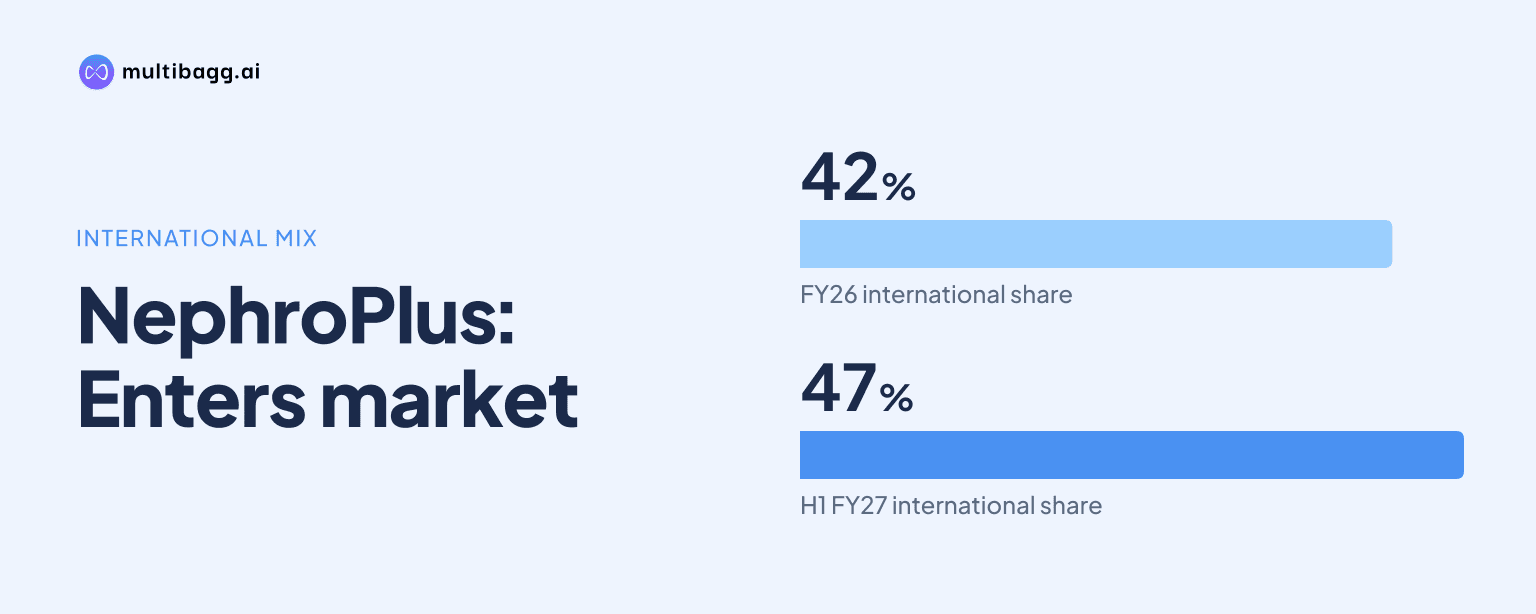
- International markets contributed about 47% of H1 FY27 revenue, up from 42% in FY26.
powered by IRIS
Nephrocare Health Services Limited entered Kazakhstan in Q2 FY27 through the acquisition of two Almaty clinics, and management expects the new market to reach steady-state margins in about one year. The sixth-country entry lifted NephroPlus to 570 clinics, while H1 FY27 revenue rose 23.6% year on year to Rs 585 crore.
Know Nephrocare Health Services inside out
Results, valuation, peers and who's buying, in one view.
Why did NephroPlus acquire two clinics in Kazakhstan?
NephroPlus entered Kazakhstan in Q2 FY27 by acquiring two clinics in Almaty, which management described as a starting point for understanding local market conditions before expanding the network. Kazakhstan has about 12,000 dialysis patients across roughly 150 clinics, according to management. The company said the market is a natural extension from Uzbekistan, where it has operated for more than four years.
The country has universal coverage, and management said its reimbursement structure resembles the Philippines, where private clinics are empanelled under a government programme. NephroPlus plans first to integrate the Almaty clinics and then assess further expansion, including acquisitions that meet its thresholds. Management expects about one year for the Kazakhstan operation to reach steady-state margins, while noting that new geographies can carry suboptimal margins during their initial years.
How does Kazakhstan fit NephroPlus's expansion model?
Kazakhstan is NephroPlus's sixth country and its third stated growth lever after growing existing clinics and adding clinics in existing markets. Management said it aims to enter a new country every 12 to 18 months when it can build a sustainable dialysis network. Its criteria include an adequately reimbursed patient base, political stability, the ability to repatriate profits, viable unit economics and the applicability of its India operating platform.
NephroPlus said its India platform is based on 16 years of standardised protocols, processes and governance. India had 500 clinics across 314 cities at September 30, 2026, serving more than 33,000 guests, with around 80% located in tier 2 and tier 3 towns. The company intends to apply this operating model internationally as overseas networks gain scale.
International markets accounted for about 47% of H1 FY27 revenue, up from 42% in FY26, while revenue per treatment increased 9.7% to Rs 2,785. The total network comprised 500 Indian clinics and 70 international clinics at the end of September. During H1 FY27, NephroPlus added clinics in India and the Philippines, entered Kazakhstan and started its first clinic in Saudi Arabia.
Got a follow-up? Ask IRIS
What is the financial effect of the Kazakhstan entry?
Kazakhstan adds a new investment requirement while NephroPlus pursues revenue growth across existing and new markets. Adjusted earnings before interest, tax, depreciation and amortisation, or EBITDA, were Rs 134 crore in H1 FY27, up 15.3% year on year, at a 23.0% margin. Management said the comparison with FY26's 23.8% margin, a reduction of about 80 basis points, is more meaningful than a year-on-year quarterly comparison because the company moved from annual private-company audits to quarterly reviews as a listed company.
Management attributed the difference mainly to higher other expenses, which rose to 20% of revenue in H1 FY27 from 18.2% in FY26. It cited international business development, new-country teams, technology, listed-company costs and expected credit-loss provisioning as contributors. Clinic-level lines moved in the other direction: materials costs declined by about 95 basis points to 22% of revenue, and professional and hospital fees declined by about 83 basis points to 18.4%, while employee costs were broadly stable.
Operating cash flow was Rs 89 crore in H1 FY27, equal to about 67% of adjusted EBITDA, including Rs 52.4 crore in Q2. NephroPlus deployed about Rs 102 crore during the first half and expects FY27 capital deployment to exceed the Rs 165 crore deployed in FY26 as it builds its newest geography. Cash, deposits and investments stood at about Rs 507 crore against borrowings of Rs 80 crore at September 30, 2026.
What will NephroPlus do next in Kazakhstan and abroad?
NephroPlus will focus first on integrating the two Almaty clinics and may pursue Kazakhstan acquisitions that meet its financial thresholds. Management did not disclose a clinic target, acquisition budget or revenue forecast for Kazakhstan. The stated one-year margin timetable therefore marks the clearest disclosed operational milestone for the new country.
The company is also developing staffing and clinical platforms for international growth. NephroPlus International Dialysis Academy, launched in FY27, is intended to train nurses from India and the Philippines for overseas clinics, as management identified trained renal nurses as a constraint in markets such as Saudi Arabia. Its GFR chronic kidney disease care platform remains in pilot, with selected patients being onboarded for trials.
Saudi Arabia remains in an investment phase until the Ministry of Health tender outcome is known. NephroPlus has opened a Riyadh clinic and started home dialysis in Riyadh and Jeddah. It is one of 12 technically qualified providers eligible to bid for four clusters covering about 11,720 patients, with bids due in February 2027; management said the process would be competitive and did not assure a win.
Conclusion
Kazakhstan gives NephroPlus an initial platform in a sixth country through two acquired Almaty clinics and a reimbursement framework management considers compatible with its international model. The entry coincides with a higher international revenue mix of about 47% in H1 FY27, but also with spending on country teams and business development that contributed to adjusted EBITDA margin moving to 23.0% from 23.8% in FY26.
The next disclosed milestone is the roughly one-year period management expects for Kazakhstan to reach steady-state margins. Investors can also watch for acquisitions that meet management's thresholds, FY27 capital deployment expected to exceed Rs 165 crore, and the February 2027 Saudi Ministry of Health tender deadline.