








Newjaisa identifies ₹2-3 crore excess stock in ₹25 crore inventory
MAX Plan at ₹4,999/yr

Find your next multibaggerBe a Pro Investor
Research stocks and track your picks on the go. Download the app.
Key highlights
- Newjaisa identified ₹2-3 crore of additional stock within its ₹25 crore inventory balance.
- Newjaisa estimates it needs ₹22-23 crore of inventory for 100-110 days of production.
- Newjaisa estimates 15-20% of stock is mainly sixth- and seventh-generation Windows-10-era equipment.
- Newjaisa operates at about 20% capacity and says it can produce 10,000-12,000 units a month without additional capital expenditure.
powered by IRIS
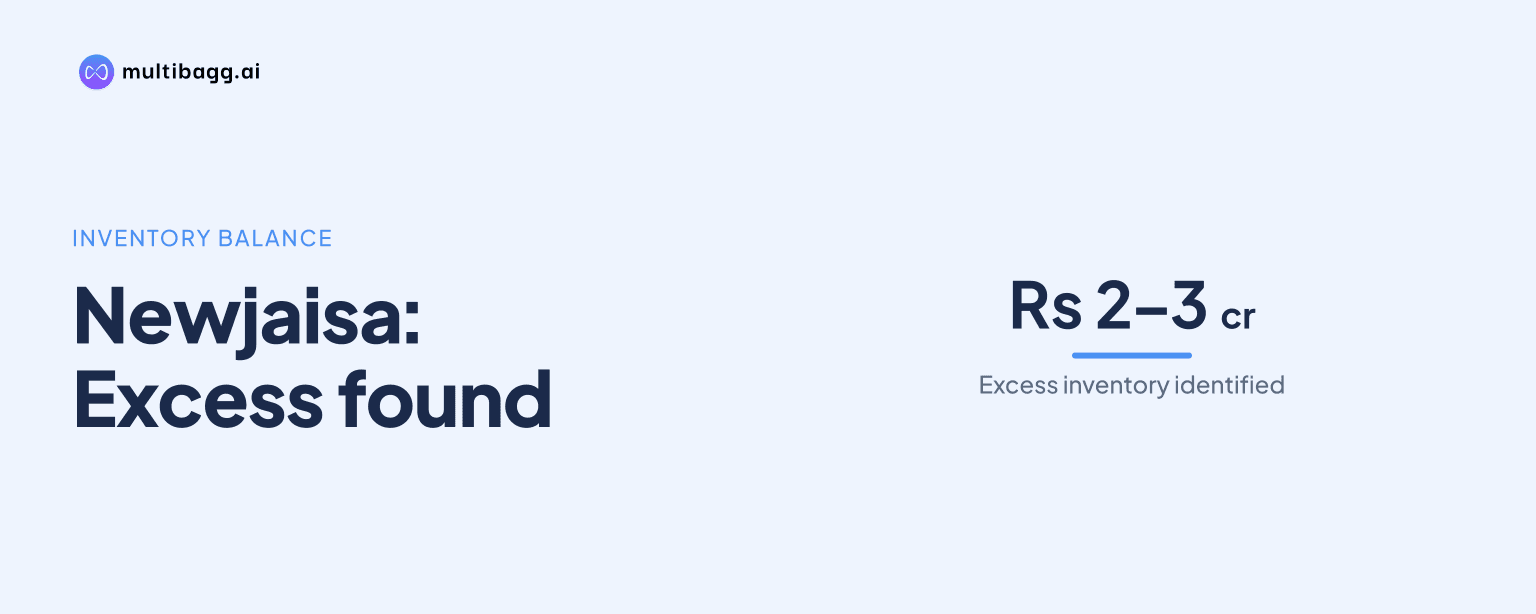
In H1 FY27, Newjaisa said its ₹25 crore inventory included ₹2-3 crore of additional stock above its current need of about ₹22-23 crore for 100-110 days of production. Management said it was working through the excess, while estimating that 15-20% of stock comprised older sixth- and seventh-generation machines.
Know Newjaisa Technologies inside out
Results, valuation, peers and who's buying, in one view.
How much of Newjaisa's inventory is excess?
Newjaisa said ₹2-3 crore of its ₹25 crore inventory was additional stock beyond its current operating requirement. Management put the requirement at about ₹22-23 crore, which it said represented three to four months, or 100-110 days, of production inventory at the current run rate.
The ₹2-3 crore estimate followed an investor's challenge to reconcile the inventory balance with monthly sales. The investor used a ₹5 crore monthly sales assumption and a 66% gross-margin assumption to argue that the stock level appeared higher than required, while management subsequently acknowledged the additional inventory and said H1 FY27 had seen a net inventory reduction.
Why does Newjaisa say it needs ₹22-23 crore of stock?
Newjaisa said it needs 100-110 days of production inventory because it operates a refurbishment business rather than a direct trading model. Management described the current requirement as ₹22-23 crore, but did not provide a split between raw materials, work in progress and finished goods during the H1 FY27 call.
The monthly revenue exit rate was not stated as one fixed figure. Management first cited approximately ₹4-4.5 crore, then referred to ₹4.5 crore or approximately ₹5 crore during the inventory discussion. That range affects the implied value of three to four months of stock, and the investor requested a detailed reconciliation in a future presentation after raising the matter for about one and a half years.
Newjaisa said the inventory balance had fallen on a net basis in H1 FY27, but did not disclose the opening balance, the size of the reduction or stock ageing by category. The call therefore establishes management's internal ₹22-23 crore requirement, while leaving the calculation method and inventory composition undisclosed.
What ageing risk does Newjaisa's inventory carry?
Newjaisa gave a rough estimate that 15-20% of inventory consisted of older machines, mainly sixth- and seventh-generation systems that were supported only by Windows 10 for roughly a year and a half. Management said it retains limited quantities because there is sporadic demand for devices priced around ₹15,000-16,000, including from students.
Newjaisa said machines below sixth generation, including fifth-, fourth- and third-generation systems and Celeron models, had already been removed in March 2026. The remaining older inventory is therefore concentrated in sixth- and seventh-generation products rather than the lower-generation machines previously removed.
Management said demand is increasingly focused on Windows 11-compatible eighth-generation i5 machines at lower price points. It also said constrained supply has increased procurement costs because companies are retaining and repurposing older devices, limiting the margin benefit from higher prices for new laptops.
Got a follow-up? Ask IRIS
Why did Newjaisa's volumes decline while inventory remained high?
Newjaisa said it intentionally reduced lower-value B2C, or business-to-consumer, sales because certain products became contribution-negative after marketing, warranty and other costs. It shifted towards laptops and desktops priced above ₹25,000, including i7 systems, and said it no longer had any product below ₹17,000 on its website.
The product and channel changes lifted blended average selling price, or ASP, to close to ₹20,000 in the current financial year from about ₹18,000 in the prior financial year. Newjaisa said its sales mix had moved to nearly 50:50 between online B2C and enterprise and education, from about 70:30 earlier, as it deliberately moderated B2C activity.
A logistics disruption also affected volumes for about two months. Management said returns to origin, or RTOs, nearly doubled to about 8% from 4% after a move to a cheaper logistics partner, resulting in an estimated 4% loss of volume over that period. An investor estimated that a 10% revenue decline alongside a 10% rise in realisation implied a roughly 20% volume decline; management cited product pruning and elevated RTOs as the causes.
What could change Newjaisa's inventory requirement next?
Newjaisa is operating at about 20% of manufacturing capacity and said it can produce 10,000-12,000 units a month without additional capital expenditure. Management described this as a five-times growth runway, but said reaching higher output would require more working capital, employees and channel development over a roadmap of a year or more.
The Redington arrangement remains in a three-month pilot using a demand-led pull model. Newjaisa said initial volumes started at about 300 units and were growing at about 10% month on month, while the 300-400 orders received were exclusively from direct B2B, or business-to-business, partners rather than an activated retail network.
Management said it was in advanced discussions for incremental bank debt to fund working capital and hoped to obtain an extension within a month, or potentially within a week. Existing bank borrowings carried a blended interest rate of about 8-8.25%, and management said any change could be limited to 0.20-0.25 percentage points.
Conclusion
Newjaisa has identified ₹2-3 crore of additional inventory within a ₹25 crore balance, while maintaining that about ₹22-23 crore supports its stated 100-110-day production cycle. The unresolved issue is the lack of an itemised reconciliation, particularly as management's rough estimate places 15-20% of stock in older sixth- and seventh-generation machines.
The next disclosures to watch are the end of Redington's three-month pilot, progress on the proposed debt extension and any inventory schedule that explains the ₹22-23 crore operating requirement. Management's plan to expand enterprise and education channels and move beyond 20% capacity utilisation will also determine its future working-capital and inventory needs.

