










NewJaisa restores positive EBITDA after 30% operating cost cut
Key highlights
- NewJaisa reported H1 FY27 EBITDA of Rs 80 lakh, versus a Rs 1.72 crore EBITDA loss before extraordinary items in H1 FY26.
- Revenue declined 8% year on year to Rs 21.35 crore, while gross margin increased to 34% from 33%.
- Employee, marketing and other operating costs fell by a combined Rs 2.83 crore, or 30%, in H1 FY27.
- NewJaisa’s net loss narrowed 78% to Rs 1.07 crore, while depreciation and interest totalled Rs 2.55 crore.
powered by IRIS
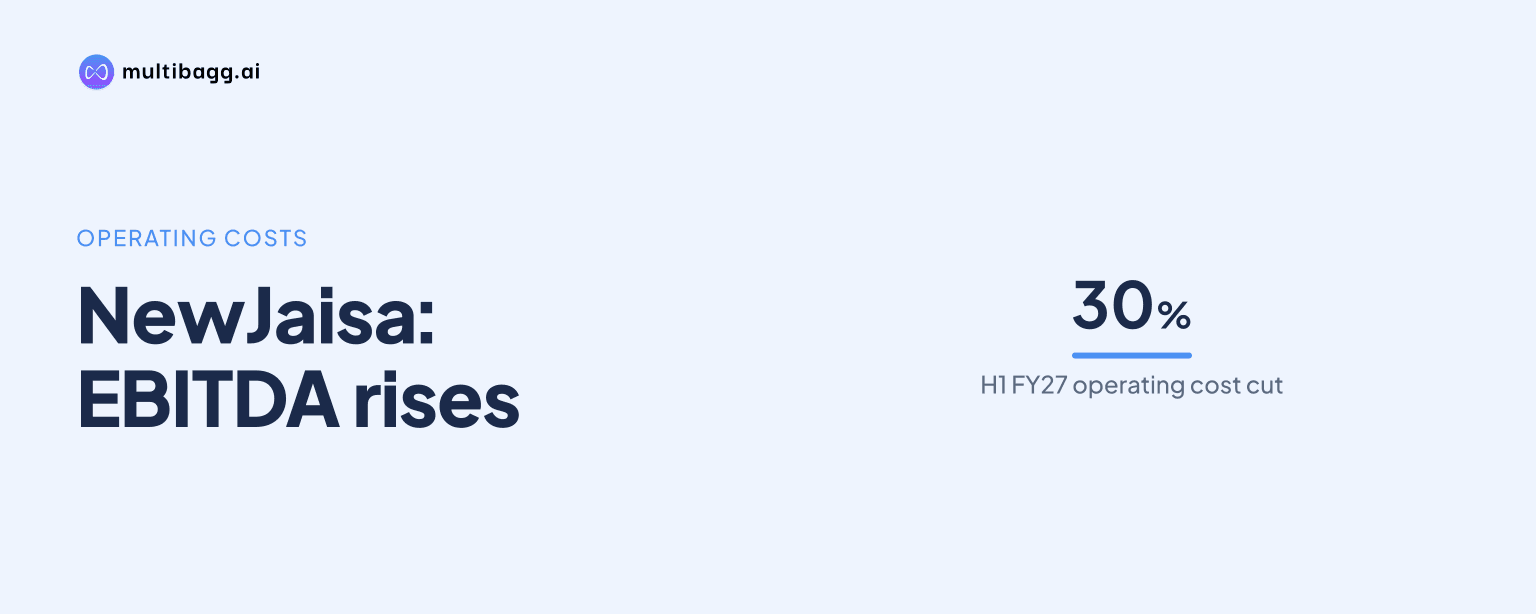
NewJaisa Technologies Limited reported positive EBITDA of Rs 80 lakh in H1 FY27 after cutting operating costs by Rs 2.83 crore, or 30%, while revenue declined 8% year on year to Rs 21.35 crore. The net loss narrowed 78% to Rs 1.07 crore, although depreciation and interest remained higher than operating profit.
Know Newjaisa Technologies inside out
Results, valuation, peers and who's buying, in one view.
How did NewJaisa’s H1 FY27 earnings change?
NewJaisa recorded earnings before interest, tax, depreciation and amortisation, or EBITDA, before extraordinary items of Rs 80 lakh in H1 FY27, against a Rs 1.72 crore loss in H1 FY26. Management described this as its first positive half-year EBITDA since FY25, even as sales fell from Rs 23.25 crore to Rs 21.35 crore.
The year-on-year improvement was wider after extraordinary items because H1 FY26 included Rs 1.45 crore of non-cash employee stock option plan, or ESOP, expense and a Rs 60 lakh inventory write-off. EBITDA after extraordinary items moved from a Rs 3.77 crore loss in H1 FY26 to Rs 80 lakh of profit in H1 FY27, when NewJaisa reported neither charge.
Gross margin increased to 34% from 33%, although gross-margin value declined to Rs 7.33 crore from Rs 7.64 crore as sales fell. Cost of goods sold decreased 10% to Rs 14.02 crore, compared with the 8% revenue decline, and management attributed the margin percentage gain to fewer higher-value units and improved pricing.
Which cost reductions restored NewJaisa’s EBITDA?
NewJaisa’s positive EBITDA was principally driven by a Rs 2.83 crore decline in employee, marketing and other operating costs from H1 FY26. Employee cost fell by Rs 1.11 crore to Rs 3.37 crore, marketing cost declined by Rs 86 lakh to Rs 2.67 crore, and other costs decreased by Rs 86 lakh to Rs 49 lakh.
Employee cost fell 25% and represented 16% of H1 FY27 sales, compared with 19% a year earlier, which management attributed to leaner refurbishment and sales teams. Marketing cost declined 24% to 13% of sales from 15%, as NewJaisa focused spending on higher-value products rather than volume-led activity.
Other costs dropped 64%, from Rs 1.35 crore in H1 FY26 to Rs 49 lakh in H1 FY27, reducing their sales share from 6% to 2%. Management said the reduction covered facilities and vendors, while the absence of the Rs 2.05 crore combined ESOP and inventory-write-off charge also changed the after-extraordinary comparison.
Got a follow-up? Ask IRIS
Why did NewJaisa revenue decline despite institutional growth?
NewJaisa’s revenue declined because direct-to-consumer, or D2C, sales decreased by Rs 2.53 crore, more than offsetting a Rs 63 lakh gain in institutional revenue. D2C revenue from newjaisa.com fell to Rs 11.62 crore from Rs 14.15 crore, while institutional sales across enterprise, education and channel customers rose to Rs 9.73 crore from Rs 9.10 crore.
Institutional sales accounted for 46% of H1 FY27 revenue, compared with about 39% in H1 FY26, while D2C represented 54%, down from about 61%. Management said education labs and repeat enterprise accounts in retail, healthcare and fintech replaced last year’s one-time bulk orders, but did not fully compensate for the D2C decline.
NewJaisa shifted its website mix toward higher-value business-grade devices and away from discount-led volume, and said average D2C order value rose 22%. It sold 5,801 laptops and 4,859 desktops, net of returns, in H1 FY27; management linked the mix change to the 34% gross margin.
Management also identified a rise in return-to-origin, or RTO, orders in August and September 2026, when undelivered cash-on-delivery shipments reversed D2C sales. NewJaisa said it blocked cash on delivery for repeat-RTO customers and introduced order confirmation before dispatch, reporting an RTO rate of 4% in October 2026 without quantifying the revenue effect.
Why did positive EBITDA not produce a net profit?
NewJaisa remained loss-making because Rs 1.91 crore of non-cash depreciation and Rs 64 lakh of interest exceeded its Rs 80 lakh EBITDA, despite Rs 43 lakh of other income. The company consequently reported a loss before tax of Rs 1.33 crore in H1 FY27, compared with a Rs 5.91 crore loss before tax in H1 FY26.
Depreciation declined 9% from Rs 2.11 crore but still equalled 9% of H1 FY27 sales, while interest rose 12% from Rs 57 lakh to Rs 64 lakh. A Rs 26 lakh deferred-tax credit reduced the final H1 FY27 loss to Rs 1.07 crore, versus a Rs 4.90 crore loss after a Rs 1.01 crore tax credit in H1 FY26.
NewJaisa reported shareholders’ funds of Rs 56.51 crore at 30 September 2026, down from Rs 57.60 crore at 31 March 2026. Borrowings totalled Rs 18.45 crore, including Rs 92 lakh of long-term borrowings and Rs 17.53 crore of short-term borrowings, against cash and bank balances of Rs 17.33 crore, resulting in reported net debt of Rs 20 lakh.
Conclusion
NewJaisa’s H1 FY27 result reflects a margin-led operating recovery rather than top-line growth. The Rs 2.83 crore operating-cost reduction, gross-margin increase to 34% and absence of Rs 2.05 crore of prior-year ESOP and inventory charges produced Rs 80 lakh of EBITDA, but Rs 2.55 crore of depreciation and interest kept the company at a Rs 1.07 crore net loss.
The next indicators are whether institutional sales and the Rs 11.02 crore forward business-to-business pipeline convert during FY27, and whether the October 2026 RTO rate of 4% persists under tighter cash-on-delivery controls. As of 12 November 2026, Rs 1.41 crore of the pipeline across five confirmed orders was under execution, while Rs 9.62 crore remained in proposal, negotiation or qualified stages.