










NGL Fine Chem Limited Q2 Profit Rises 69% on Volume Growth
Key highlights
- NGL Fine Chem's Q2 FY27 revenue rose 32% year-on-year to ₹158.71 crore.
- NGL Fine Chem's Q2 FY27 profit after tax increased 69% year-on-year to ₹16.25 crore.
- NGL Fine Chem's EBITDA margin improved to 17.68% from 14.27% a year earlier.
- Tarapur Phase 2 production began on September 24, 2026, with 30% to 40% utilisation expected over the next two to three quarters.
powered by IRIS
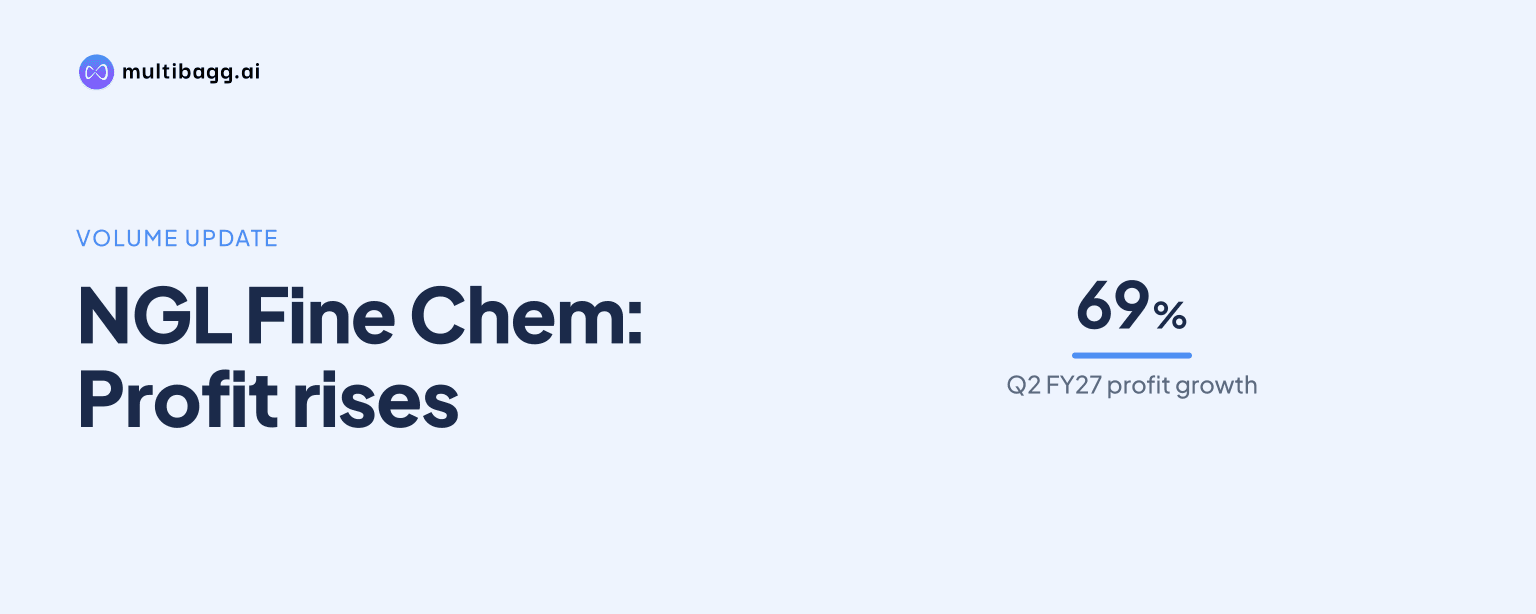
NGL Fine Chem Limited reported a 69% year-on-year rise in Q2 FY27 profit after tax to ₹16.25 crore, supported by 32% revenue growth to ₹158.71 crore. The Mumbai-based pharmaceutical intermediates manufacturer recorded higher volumes across its portfolio, while preparing for margin pressure as its new Tarapur capacity ramps up.
Know NGL Fine Chem inside out
Results, valuation, peers and who's buying, in one view.
What were NGL Fine Chem's Q2 FY27 financial results?
NGL Fine Chem reported revenue from operations of ₹158.71 crore in Q2 FY27, up 32% from a year earlier and 14% from Q1 FY27. Revenue also exceeded the ₹149.23 crore reported in Q4 FY26. Profit after tax rose 69% year-on-year to ₹16.25 crore, although it was 11.68% lower sequentially than the ₹18.40 crore reported in Q1 FY27.
Operating profitability improved during the quarter. EBITDA increased 64% year-on-year to ₹28.06 crore, while the EBITDA margin expanded to 17.68% from 14.27% in the corresponding quarter last year. The margin was also higher than 16.73% in Q1 FY27 and remained within management's indicated 15% to 18% range. Profit before tax rose 67% year-on-year to ₹21.60 crore.
What drove NGL Fine Chem's revenue and margin improvement?
NGL Fine Chem said revenue growth was led primarily by volumes across products and markets. Managing Director Rahul Nachne said a substantial part of the quarterly growth came from higher volumes, reflecting demand across the product portfolio rather than a one-off event. The company also stated that the improvement in performance was regular in nature.
The EBITDA margin benefited from partial price pass-through to customers in Q1 and better absorption of fixed costs at higher volumes. Management noted that gross margins have historically been in the 50% to 55% range and are currently at the better end of that range. It added that margins may move by a couple of percentage points in either direction, indicating that the Q2 margin level should be viewed alongside the changing cost base.
The year-on-year profit growth was faster than revenue growth because operating profit expanded sharply. However, the lower sequential profit shows that quarterly profitability can vary even when revenue continues to rise. For investors, the key operating indicators are therefore volume growth, fixed-cost absorption and the pace at which the new facility contributes to revenue.
Got a follow-up? Ask IRIS
How will the Tarapur Phase 2 facility affect margins?
NGL Fine Chem commenced production at Phase 2 of its Tarapur greenfield facility on September 24, 2026, completing the commissioning of the project. The additional capacity is central to the company's near-term operating transition because depreciation, finance costs and other fixed operating expenses begin before the facility reaches a meaningful revenue scale.
Management expects Tarapur utilisation of roughly 30% to 40% over the next two to three quarters, subject to customer demand, product mix and the pace of production ramp-up. Rahul Nachne said some margin pressure is expected during this period because costs will be incurred ahead of the facility's full revenue contribution.
This makes the commissioning a mixed financial factor in the immediate term. The project expands NGL Fine Chem's production base, but its early-stage cost burden may limit the benefit of the higher Q2 EBITDA margin. Management did not provide a specific revenue contribution from Phase 2 or a definitive timeline for reaching full utilisation.
What does the quarter mean for investors and the pharmaceutical intermediates business?
The quarter indicates that NGL Fine Chem entered the Tarapur expansion phase with revenue growth and operating margins within its stated range. Revenue of ₹158.71 crore and an EBITDA margin of 17.68% provide a current benchmark for assessing whether increased capacity is being absorbed without a material deterioration in profitability.
Working capital requirements are expected to increase with turnover. Management said short-term debt could rise modestly to fund higher working capital, but stated that there would definitely be no increase in long-term debt. This distinction is relevant because the company is adding capacity while seeking to contain longer-duration borrowing.
The company also identified regulated markets such as the European Union and the United States as medium-term opportunities, but management said it was too early to provide a realistic addressable-market or market-share target. As a result, existing-market demand and execution at Tarapur remain the more immediate variables disclosed during the earnings call.
Conclusion
NGL Fine Chem's Q2 FY27 results combined strong year-on-year growth with a softer sequential profit outcome. Revenue rose 32% to ₹158.71 crore, EBITDA grew 64% to ₹28.06 crore and profit after tax increased 69% to ₹16.25 crore. The results were supported by volume growth, improved fixed-cost absorption and a margin that remained within management's guidance range.
The next key disclosure point is the Tarapur Phase 2 ramp-up over the next two to three quarters. Investors will watch whether utilisation reaches the indicated 30% to 40% range, how fixed costs affect EBITDA margins, and whether modestly higher short-term debt remains aligned with working-capital needs without an increase in long-term debt.