








NHIT Q2 profit nearly tripled as Round 5 added Rs 138 crore
MAX Plan at ₹4,999/yr

Find your next multibaggerBe a Pro Investor
Research stocks and track your picks on the go. Download the app.
Key highlights
- NHIT's Q2 FY27 revenue from operations rose 28% to Rs 1,281 crore.
- NHIT's Q2 FY27 PAT increased to Rs 325 crore from Rs 112 crore.
- Round 5 assets contributed Rs 138 crore of Q2 FY27 revenue.
- NHIT declared a September 2026 distribution of Rs 2.529 per unit.
powered by IRIS
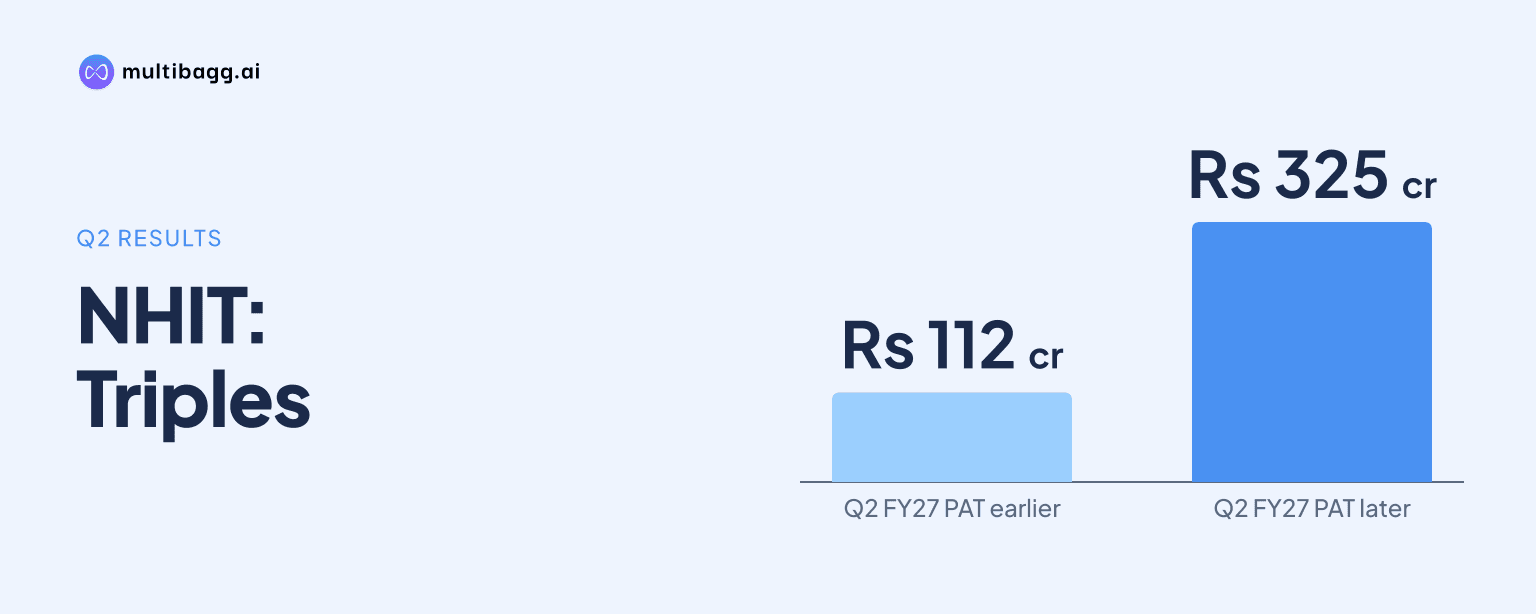
In Q2 FY27, National Highways Infra Trust reported profit after tax of Rs 325 crore, nearly triple the Rs 112 crore recorded a year earlier, as revenue from operations increased 28% to Rs 1,281 crore. Round 5 assets supplied Rs 138 crore, and revenue also increased across the R1-R4 asset groups.
Know National Highways Infra Trust inside out
Results, valuation, peers and who's buying, in one view.
Why did NHIT's Q2 FY27 revenue increase?
NHIT's revenue from operations increased by Rs 280 crore, or 28%, to Rs 1,281 crore in Q2 FY27 because Round 5 added Rs 138 crore and each of the three existing asset groups reported higher revenue. Round 5 accounted for about 49% of the Rs 280 crore year-on-year increase, based on the reported quarterly figures.
R1 and R2 revenue increased by Rs 43 crore to Rs 307 crore, R3 revenue rose by Rs 53 crore to Rs 402 crore, and R4 revenue increased by Rs 46 crore to Rs 434 crore. Excluding Round 5, combined R1-R4 revenue was Rs 1,143 crore in Q2 FY27 against Rs 1,001 crore in Q2 FY26, an increase of Rs 142 crore, or about 14%.
The R4 comparison has a disclosed difference in underlying traffic and revenue data. Its assets had an appointed date of 1 April 2025 and remained under transition until September 2025, with fixed remittances flowing to the relevant entity; Q2 FY27 includes electronic toll collection and non-electronic toll collection data, whereas Q2 FY26 covers only Indian Highways Management Company electronic toll collection data.
How did Round 5 affect NHIT's quarterly results?
Round 5 generated Rs 138 crore of revenue from operations in Q2 FY27, while the Q2 FY26 comparison column recorded no revenue from these assets. NHIT lists 1 April 2026 as the appointed date for Round 5, which added a new revenue stream to the FY27 reporting period.
The presentation separately states that operations of the R5 Project were taken over from 1 October 2026 onwards. That operating milestone follows the 1 April 2026 appointed date, so future disclosures can indicate how the takeover affects the revenue contribution from the new round.
Round 5 also coincided with a larger unit base. Total units outstanding were 213.86 crore in Q2 FY27, compared with 193.68 crore in Q2 FY26, while the presentation says Round 5 units were issued at Rs 153 per unit. Net asset value, or NAV, was Rs 160.7 per unit in September 2026, up from Rs 156.2 per unit in June 2026.
How did NHIT's EBITDA and profit change in Q2 FY27?
NHIT's earnings before interest, tax, depreciation and amortization, or EBITDA, rose by Rs 193 crore to Rs 1,005 crore in Q2 FY27, while profit after tax, or PAT, increased by Rs 213 crore to Rs 325 crore. EBITDA was about 24% above Rs 812 crore in Q2 FY26, and PAT was about 190% above Rs 112 crore.
Other income increased from Rs 12 crore in Q2 FY26 to Rs 15 crore in Q2 FY27. Finance charges also rose, increasing by Rs 34 crore to Rs 488 crore from Rs 454 crore, meaning the increase in reported profit occurred alongside higher finance charges rather than lower borrowing costs.
The Rs 280 crore rise in revenue from operations exceeded the Rs 193 crore increase in EBITDA in absolute terms. The presentation reports the income statement figures but does not provide a separate reconciliation assigning the Rs 213 crore PAT increase among operating, financing, tax or other individual drivers.
Got a follow-up? Ask IRIS
How did NHIT's debt and coverage metrics change?
NHIT's period-end debt was Rs 25,170 crore in Q2 FY27, up by Rs 3,423 crore from Rs 21,747 crore in Q2 FY26. The 16% increase in debt accompanied the addition of Round 5 revenue and compared with the 28% increase in total revenue from operations.
NHIT reported a debt service coverage ratio, or DSCR, of 2.17 in Q2 FY27, marginally above 2.16 in Q2 FY26. Debt to total assets was 0.49, compared with 0.48 a year earlier, showing only a 0.01 movement in this reported ratio despite the Rs 3,423 crore increase in debt.
The financial presentation does not disclose debt maturities, interest rates or the source-wise composition of the Rs 25,170 crore period-end debt. It does disclose that finance charges increased to Rs 488 crore in Q2 FY27, from Rs 454 crore in the prior-year quarter.
What distribution did NHIT declare for September 2026?
NHIT declared a distribution of Rs 540.83 crore for September 2026 on 6 November 2026, equal to Rs 2.529 per unit. The aggregate distribution was Rs 62.24 crore higher than the Rs 478.59 crore reported for Q2 FY26, an increase of about 13%.
Distribution per unit increased by Rs 0.058, from Rs 2.471 in Q2 FY26 to Rs 2.529 in Q2 FY27. The aggregate distribution grew faster than the per-unit amount as total units outstanding increased by 20.18 crore to 213.86 crore over the comparison period.
NHIT's distribution history in the presentation shows Rs 3.19 per unit for Q1 FY2027 and Rs 2.529 per unit for Q2 FY2027. The presentation also reports cumulative distributions of Rs 35.95 per unit across the periods displayed from FY2022 through Q2 FY2027.
Conclusion
NHIT's Q2 FY27 result combined revenue from the newly added Round 5 assets with growth in R1-R4. Revenue from operations rose by Rs 280 crore to Rs 1,281 crore, EBITDA increased by Rs 193 crore to Rs 1,005 crore, and PAT rose by Rs 213 crore to Rs 325 crore, while period-end debt increased to Rs 25,170 crore and finance charges reached Rs 488 crore.
The next results can show the continuing contribution of Round 5 after the presentation's stated 1 October 2026 operational takeover. NHIT also disclosed a September 2026 distribution of Rs 2.529 per unit, declared on 6 November 2026, providing the next reported distribution benchmark alongside revenue, debt and DSCR developments.

