








NHIT reports zero fatalities across 4.40 million work-hours
MAX Plan at ₹4,999/yr

Find your next multibaggerBe a Pro Investor
Research stocks and track your picks on the go. Download the app.
Key highlights
- NHIT reported 0 fatalities and 0 lost-time injuries across 44,00,608 work-hours.
- NHIT conducted 18,546 toolbox talks, 59 safety review meetings and 57 mock drills.
- NHIT consumed 4,842 MWh of energy, including 154 MWh of captive renewable energy.
- NHIT reported 3,676 metric tonnes of RAP usage, linked to 38 metric tonnes of bitumen savings.
powered by IRIS
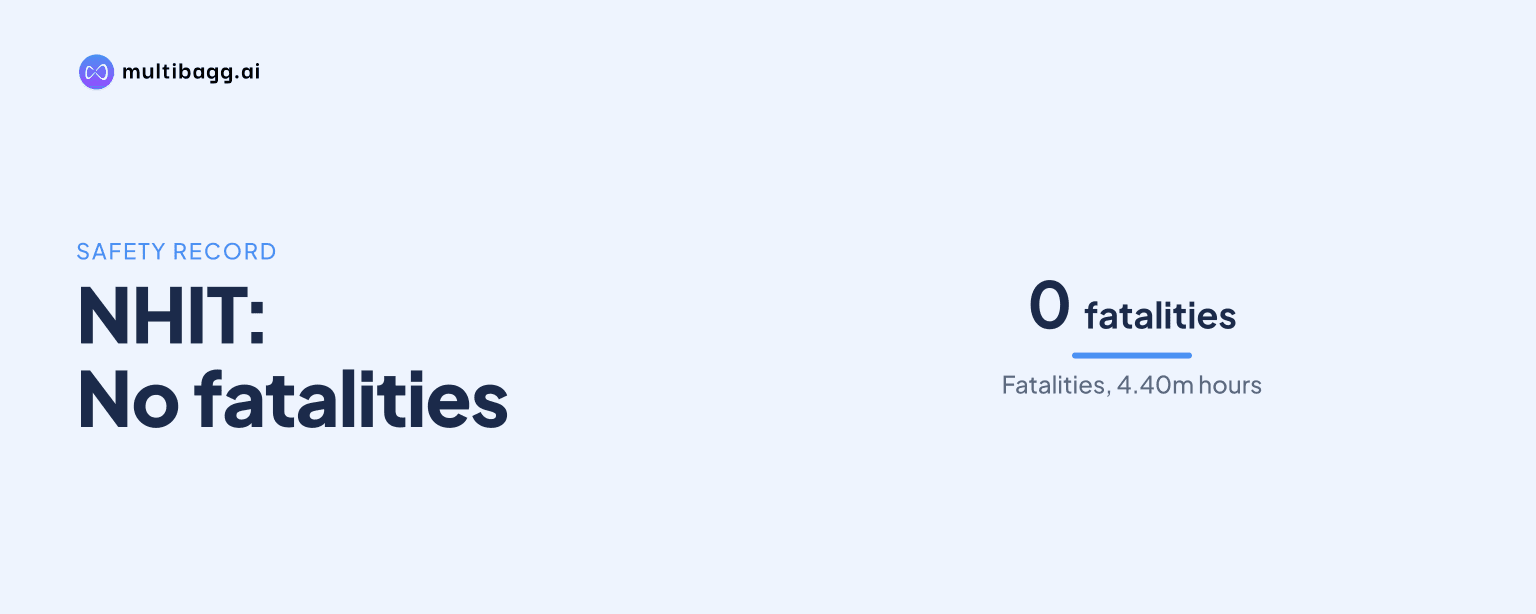
National Highways Infra Trust (NHIT) reported zero fatalities, zero lost-time injuries and a 0.00 accident frequency rate across 44,00,608, or about 4.40 million, work-hours. Its environmental disclosures also recorded 4,842 megawatt-hours (MWh) of energy consumption, including 154 MWh of captive renewable energy, and 3,676 metric tonnes of RAP usage.
Know National Highways Infra Trust inside out
Results, valuation, peers and who's buying, in one view.
What safety outcome did NHIT report?
NHIT reported 0 fatalities, 0 lost-time injuries and an accident frequency rate of 0.00 across 44,00,608 total man-hours worked. The presentation also recorded 44,00,608 total safe man-hours, matching the total-hours figure and supporting the stated zero-fatality and zero-injury outcome.
NHIT classifies fatalities, lost-time injuries and accident frequency as lagging indicators, while its preventive activities are presented as leading indicators. The presentation does not assign a specific reporting period to the 44,00,608-hour dataset, although a related disclosure refers to more than 9,150 man-hours during Q2 FY2026-27.
The occupational health and safety disclosure covers special purpose vehicle staff, workmen and contractors undertaking improvement, routine maintenance and major repair works. This stated coverage matters because the 4.40 million safe-hours measure includes operational activities beyond toll-plaza staff alone.
How did NHIT manage preventive safety activity?
NHIT reported 18,546 physical toolbox talks, 59 safety review meetings and 10,279 safety observations that were reported and complied with. The presentation says toolbox talks took place before work began at a site or toll plaza, making them a stated pre-work safety process.
NHIT also recorded 57 mock drills and 43 near-miss cases across its operations. The 57 drills are separately described as having been conducted across all operational projects, while the 43 near-miss cases provide an indicator of events reported before becoming recorded injuries.
The presentation links its safety activity to emergency preparedness, including the 57 mock drills, but does not give a quarterly breakdown for the 0 fatalities, 0 lost-time injuries or 0.00 accident frequency rate. It does, however, identify more than 9,150 man-hours in Q2 FY2026-27 in the occupational health and safety section.
What did NHIT disclose on energy and emissions?
NHIT reported total energy consumption of 4,842 MWh, including 154 MWh of captive renewable energy consumption. It said the captive renewable energy use resulted in a reduction of 109 tonnes of carbon-dioxide-equivalent emissions.
NHIT reported 850 tonnes of carbon-dioxide equivalent, or 20%, as Scope 1 emissions from diesel and petrol used in diesel generators and administrative vehicles. It reported 3,438 tonnes of carbon-dioxide equivalent, or 80%, as Scope 2 emissions from electricity used for toll-plaza operations and highway lighting.
The disclosed emissions mix assigns a larger share to Scope 2 electricity emissions, at 80%, than to Scope 1 fuel emissions, at 20%. NHIT identifies highway lighting and plaza operations as the electricity-use mechanisms, compared with generators and administrative vehicles for the diesel and petrol category.
The presentation provides no prior-period energy or emissions figures and states no numerical emissions-reduction target. Its renewable-energy disclosure therefore quantifies 154 MWh of consumption and 109 tonnes of carbon-dioxide-equivalent reduction, but does not show a trend across reporting periods.
Got a follow-up? Ask IRIS
How did NHIT report water use and material circularity?
NHIT reported water consumption of 0.018 million cubic metres and installation of 2 electro-flow meters on operational borewells across operational projects. The meters are the disclosed mechanism for monitoring borewell water at those projects.
For resource conservation, NHIT reported 26,919 metric tonnes of DBM used at Agra Bypass, Shivpuri Jhansi and Assam package locations, alongside 3,676 metric tonnes of RAP usage. It attributed 38 metric tonnes of bitumen savings and avoidance of 19 tonnes of carbon-dioxide-equivalent emissions to the RAP usage.
NHIT also reported planting 132,689 saplings across avenue, median and toll-plaza premises. The location figures listed in the presentation are 2,146 avenue saplings, 111,026 median saplings and 517 toll-plaza saplings, which total 113,689 rather than the stated 132,689 total.
The gap of 19,000 saplings between the reported total and the three listed location categories is not explained in the presentation. Similarly, the 3,676 metric tonnes of RAP and 38 metric tonnes of bitumen savings are disclosed without a comparative figure from an earlier period or project set.
What social and governance measures did NHIT disclose?
NHIT reported women represented 6.5% of total strength across the Investment Manager and special purpose vehicles, while the attrition rate was 13.44%. It also reported 438 female staff across 4 toll plazas and 26 projects, covering roles including lane assistants, toll collectors, cashiers and housekeeping staff.
NHIT stated that 20 women-only power rooms have operated at toll-plaza premises since inception to provide private space for women on the move. The 20-room measure sits alongside the 438 female-staff figure, but the presentation does not provide an earlier workforce composition or attrition comparison.
On governance, NHIT reported constitution of sustainability committees at board and operational levels, formulation and adoption of a sustainability policy, and public disclosure of sustainability performance. These governance measures accompany the 18,546 toolbox talks and 57 mock drills disclosed for health and safety activity.
Conclusion
NHIT’s disclosures combine a zero-fatality and zero-lost-time-injury outcome across 4.40 million work-hours with operational measures spanning 18,546 toolbox talks, 4,842 MWh of energy use and 3,676 metric tonnes of RAP usage. The presentation also quantifies 154 MWh of captive renewable energy, 109 tonnes of associated emissions reduction and 2 electro-flow meters on operational borewells.
The next NHIT disclosure will be important for period-by-period context, because this presentation does not state a reporting period for the 44,00,608 safety hours or provide prior-period comparisons for energy, emissions, water or RAP use. It also leaves unresolved the 19,000-sapling difference between the stated 132,689 total and the 113,689 saplings listed across three locations.

