










NIS Plans to More Than Double Trainees for Own Contracts
Key highlights
- NIS plans to increase its trainee base from about 1,400 to more than 3,000 over the next year or so.
- NIS's Odisha DDU-GKY order is worth Rs 7.93 crore and covers training around 1,200 people.
- NIS expects Odisha training and placement to take about 6 months, with payments spread across roughly 9 months.
- NIS said the West Bengal programme covers training more than 200 youths and placement of 150 candidates.
powered by IRIS
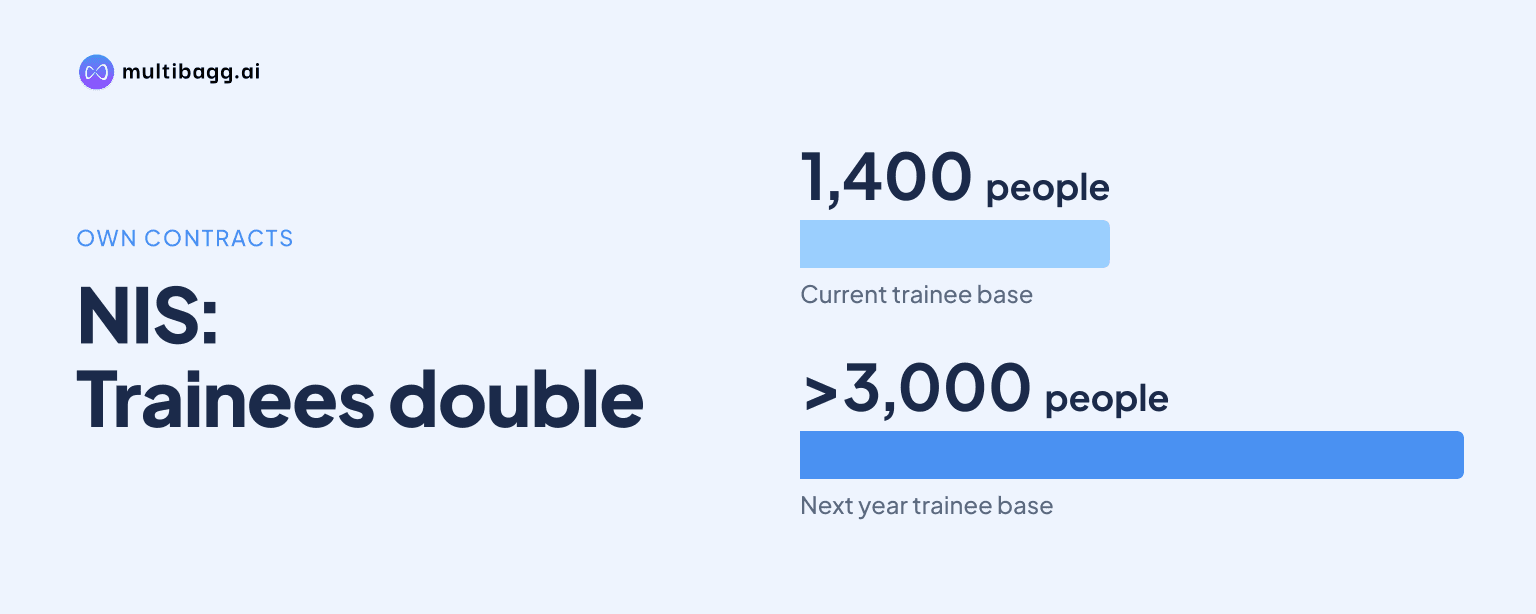
NIS Management said it plans to expand its skill-development trainee base from about 1,400 to more than 3,000 over the next year, using training in security, housekeeping and facility services to build a potential workforce pipeline for its own contracts. The Rs 7.93 crore Odisha training-and-placement order covers around 1,200 people.
Know NIS Management inside out
Results, valuation, peers and who's buying, in one view.
How will NIS expand its trainee base beyond 3,000?
NIS expects to take its trainee base from about 1,400 to more than 3,000 over the next year through additional DDU-GKY, or Deen Dayal Upadhyaya Grameen Kaushalya Yojana, projects. Management said NIS and Keertika have capacity both to train candidates and to induct students into their own payroll, particularly in security guarding, housekeeping and facility-services trades.
The current project base includes Odisha and West Bengal government work. Odisha is the larger assignment because much of its allocation was issued in the first order, while West Bengal allocations are expected to be issued in tranches after the first lot is completed. NIS also has a Maharashtra DDU-GKY application pending final assessments, reviews and evaluations; management said approval could add a substantial manpower source.
The planned increase represents more than 1,600 additional trainees versus the current base of about 1,400. Management described this as reserve capacity for further DDU-GKY projects rather than a committed order book, so the pace of expansion remains linked to allocation decisions in West Bengal and the unresolved Maharashtra application.
Why does NIS want to deploy trainees on its contracts?
NIS intends to use trainees as a potential recruitment pool for its security guarding, housekeeping and facility-management contracts. Management said the courses are in the same trades that NIS serves through operating contracts, allowing trainees to be considered for deployment with government and corporate customers after training and placement.
The approach is designed to address limited availability of skilled personnel in security, housekeeping and related facility-services roles. Management said integrating NIS and Keertika operations could enable the group to move a larger number of skill-development students into regular contracts, combining government-backed training activity with staffing requirements in the same states.
NIS did not state that every person trained under the Odisha or West Bengal programmes would join its payroll. It described the trainees as a “ready pool” for deployment, while the Odisha project requires placement before billing. That means placement is central to the project’s commercial model, but the transcript does not specify the proportion that will be absorbed internally rather than placed with other employers.
The West Bengal order illustrates the distinction between training capacity and deployment outcomes. The disclosed scope is to train more than 200 youths and place 150 candidates, with further lots contingent on completion of earlier allocations. By comparison, the Odisha order has a broader first allocation of around 1,200 people, which could provide a larger near-term pool if execution begins as expected.
Got a follow-up? Ask IRIS
When will NIS invoice the Odisha training order?
NIS expects to begin raising invoices for the Rs 7.93 crore Odisha order in Quarter 4 of the current year after completing training and placement requirements. Management said billing cannot occur merely after training: candidates must first be trained, skilled and placed before NIS can raise bills with the client.
The project requires upfront expenditure on training centres, teachers, residential accommodation for students and schooling. Management expects training and placement together to take about 6 months, creating a period in which NIS incurs setup and operating costs before the main billing cycle begins.
Payments will arrive in tranches over about 9 months rather than as a single receipt. NIS expects a smaller payment per candidate within the first month, another payment after completion of training, and a final payment after a further 6 months. The staged structure means initial Quarter 4 invoicing would not represent collection of the full Rs 7.93 crore work-order value.
The Odisha and West Bengal assignments also differ in how work is allocated. Odisha’s first order already includes most of its allotment, according to management, while West Bengal is expected to issue subsequent lots after prior batches are completed. This difference could affect the timing of trainee additions, placement activity and revenue recognition across the two programmes.
What other workforce opportunities does NIS see?
NIS sees further skill-development demand through its four Industrial Training Institutes, or ITIs, particularly in technical trades. Management linked this opportunity to the government’s Make in Bharat programme and said the four ITIs are positioned to provide skilled workers if demand for technical-trade personnel rises.
Management said students graduating from its ITIs have a high placement ratio, although it did not disclose a percentage or student count. It also said growth in NIS security services and facility-management operations should allow it to absorb a larger number of skilled youths than it currently can, extending the internal-deployment rationale beyond DDU-GKY programmes.
International placement is a possible third channel, but NIS said it has not yet pursued it. Management expects the opportunity to evolve over the next 2 to 3 years as requirements grow in different countries for skilled people in technical trades and soft services; it did not disclose target countries, trainee volumes, contracts or expected revenue.
NIS is also developing technology-enabled service offerings alongside its manpower model. Management said conventional security contracts could move towards hybrid arrangements combining guards with access control, closed-circuit television, or CCTV, and intrusion-detection systems. It is discussing centralised control-room services with banks and said any resulting subscription revenue could become a significant part of revenue over time, without providing a value or target year.
Conclusion
NIS is seeking to combine skill-development activity with workforce supply for its security, housekeeping and facility-management operations. Its plan to increase trainees from about 1,400 to more than 3,000 rests on the Rs 7.93 crore Odisha order, staged West Bengal allocations and capacity for further DDU-GKY projects, while internal deployment remains a potential rather than guaranteed outcome for each trainee.
The next disclosures to watch are the start of Odisha invoices in Quarter 4, progress through its roughly 6-month training-and-placement cycle, further West Bengal allocations and the outcome of Maharashtra’s pending assessments. Management has also identified international placement as a possibility over the next 2 to 3 years, but has not yet provided an execution plan or financial target for that channel.