










Nitin Spinners expects Rs 1,000 crore annual expansion revenue
Key highlights
- Nitin expects the new project to add Rs 1,000 crore of annual revenue after ramp-up.
- Nitin estimates Rs 300 crore to Rs 350 crore of revenue from the expansion in FY27.
- Finished woven-fabric utilisation is expected to reach normal levels around August or September 2027.
- Nitin expects total debt to peak at about Rs 1,950 crore at the end of March 2026.
powered by IRIS
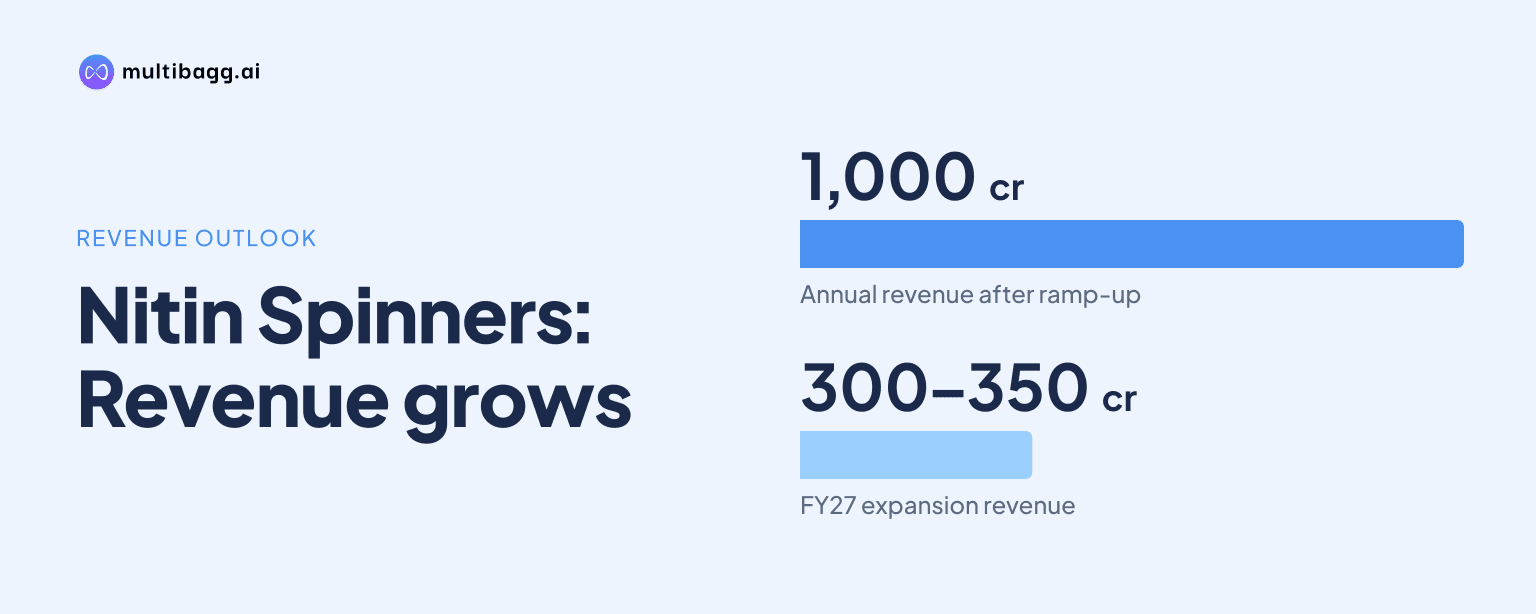
In the earnings call, Nitin Spinners said its new capacity expansion is expected to add Rs 1,000 crore of annual revenue, while finished woven-fabric utilisation is scheduled to reach normal levels around August or September 2027. Management estimated Rs 300 crore to Rs 350 crore from the project in FY27 as spinning, greige fabric and finished fabric ramp at different rates.
Know Nitin Spinners inside out
Results, valuation, peers and who's buying, in one view.
How much revenue will Nitin’s expansion add?
Nitin expects the new project to add Rs 1,000 crore of annual revenue once the capacity operates at the intended level. Management described Rs 1,000 crore as the annual revenue expected from the expansion in the next financial year, while estimating a contribution of about Rs 300 crore to Rs 350 crore in FY27.
The FY27 estimate is materially below the Rs 1,000 crore annual expectation because the project is being commissioned and utilised in stages. At the midpoint of management’s FY27 range, Rs 325 crore is less than one-third of the projected annual contribution. The expansion covers spinning and woven fabric, with greige fabric, or unfinished fabric, expected to scale faster than finished fabric.
Management did not provide a revenue split among spinning, greige fabric and finished fabric within the Rs 1,000 crore estimate. It did identify finished woven fabric as the part of the new project requiring customer and product development, making that sales process relevant to the timing of the full revenue contribution.
When will Nitin’s new capacity reach normal utilisation?
Nitin said commercial production from the new project should begin within the quarter discussed on the call, with individual segments commercialised as they are completed. Management expects spinning capacity to reach normal utilisation of 95% or more by the end of March under its stated timetable.
Woven greige-fabric capacity is also expected to reach top capacity over a similar period, according to management. Finished woven fabric will take longer, with normal utilisation expected around August or September of the following year, corresponding to the September 2027 ramp-up timetable. Management attributed the longer period to marketing constraints and the development of finished-fabric products and customers.
The utilisation path is expected to be gradual rather than immediate. Management said a new operation generally starts at about 50% utilisation before moving step by step toward 90% to 95%, as productivity, efficiency and the product mix improve. Renewable energy, or RE, power linked to the project was expected to ramp immediately and reach full capacity by January in management’s schedule.
Got a follow-up? Ask IRIS
What could affect Nitin’s finished-fabric ramp and margins?
Nitin identified customer development and product development as the main reasons finished-fabric capacity will lag spinning and greige fabric. Commercial production alone will therefore not determine when the Rs 1,000 crore annual revenue expectation is achieved, because finished-fabric customers must also approve and purchase the company’s product range.
Management cited rising costs for dyes, chemicals, coal, packaging and freight, including sea freight. Nitin reported an earnings before interest, tax, depreciation and amortisation, or EBITDA, margin of 17.8% in the quarter discussed. Management said its operating range is 16% to 20%, rather than a separate 20% margin target.
Nitin expects increased scale and RE power to cushion some of these cost increases by lowering power costs. Management also cited automation, artificial intelligence in production facilities, energy-saving work and alternative fuels as continuing cost initiatives. It did not quantify the savings from those measures or specify their effect on the 17.8% EBITDA margin.
The company’s comments on cost pass-through remained conditional. Management said margin effects will depend on whether higher input and freight costs can be passed on to customers, while its immediate objective is to retain prevailing margin levels. This makes the pace of price increases in dyes, chemicals, coal, packaging and sea freight relevant during the production ramp.
How does Nitin’s expansion fit its revenue and funding plans?
Nitin said it aspires to reach revenue of Rs 4,800 crore to Rs 5,000 crore by FY29 through existing assets and balancing of operations. Management described stabilising the current major expansion and its revenue stream as the immediate priority before committing to another large capacity project.
For the next roughly one year, management said spending would focus on modernising and balancing equipment to support the Rs 4,800 crore to Rs 5,000 crore revenue aspiration. It has not decided the next major expansion, though it said it will evaluate both existing business lines and opportunities further up the value chain as it engages with markets, customers and brands.
The current project is accompanied by a disclosed debt schedule. Management expects term debt to peak at about Rs 1,440 crore at the end of March 2026. Working-capital debt, then at about Rs 400 crore, could rise to more than Rs 500 crore, taking total debt to about Rs 1,950 crore at that point.
Nitin said annual debt repayments should be about Rs 180 crore to Rs 200 crore for the following six to seven years. Management also expects an average interest subsidy of about 2.5% on relevant capex loans, with a blended borrowing cost of about 6.5% to 6.75%. These funding assumptions form part of the context for delivering the project’s Rs 1,000 crore annual revenue plan.
Conclusion
Nitin’s disclosed expansion plan combines a Rs 1,000 crore annual revenue expectation with different ramp schedules across its product lines. Spinning and greige fabric are expected to reach intended utilisation before finished woven fabric, whose timing depends on developing products and customers. The Rs 300 crore to Rs 350 crore FY27 estimate shows management expects the project’s contribution to build in stages.
The next developments to watch are commercial production across the separate segments, progress toward 95% or higher spinning utilisation by the end of March, and finished-fabric customer development through the August or September 2027 timetable. Management’s next major capacity decision remains unresolved while it focuses on modernisation, balancing equipment and its Rs 4,800 crore to Rs 5,000 crore FY29 revenue aspiration.