










Fratelli Vineyards Limited says UP policy will challenge FY27
Key highlights
- Fratelli Vineyards Limited said Uttar Pradesh sales were down roughly 30% in H1 FY27 after an excise-policy change.
- Fratelli's H1 FY27 net revenue rose about 10% to Rs 91.4 crore from Rs 83.4 crore.
- Fratelli's H1 FY27 RTD sales reached Rs 18 crore, versus approximately Rs 8.5 crore a year earlier.
- Fratelli is raising up to Rs 29.87 crore through a rights issue scheduled to close on 17 November 2026.
powered by IRIS
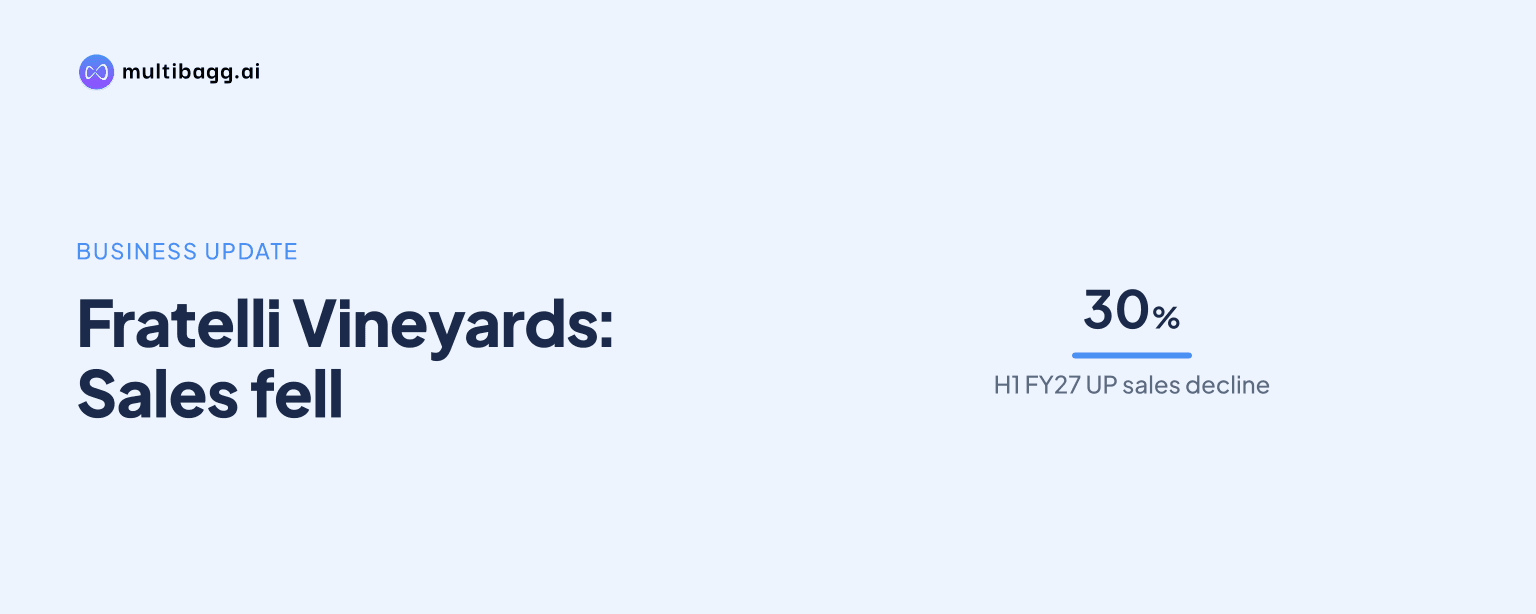
Fratelli Vineyards Limited said its Uttar Pradesh sales fell roughly 30% in the first half, or H1, of FY27 after an excise-policy change, making the year more challenging than prior years despite a slightly better third quarter, or Q3. The top-seven market, alongside Karnataka, was a major contributor to weaker premium-bottle sales.
Know Fratelli Vineyards inside out
Results, valuation, peers and who's buying, in one view.
How much did the Uttar Pradesh policy disrupt Fratelli?
Uttar Pradesh was a material drag on Fratelli's H1 FY27 bottle sales, with the market down roughly 30% after the state excise-policy change. Management said Uttar Pradesh had been among Fratelli's fastest-growing markets for the previous four years and remains one of its top seven, increasing the effect of the category-wide slowdown.
Management attributed the pressure to an industry-wide slowdown in wine rather than to a specific Fratelli brand. Uttar Pradesh and Karnataka, a top-six market, were the two largest contributors to the decline in the premium segment. Fratelli did not disclose the rupee value of lost Uttar Pradesh sales or the state's share of group revenue.
The disruption occurred while total H1 revenue rose about 10% to Rs 91.4 crore from Rs 83.4 crore. EBITDA moved from an approximately Rs 1 crore loss in H1 FY26 to a Rs 1.4 crore profit, showing that growth in other markets and products offset part of the policy-related loss of momentum.
Which markets supported Fratelli's H1 FY27 growth?
Delhi, Telangana and several other states supported Fratelli's H1 FY27 revenue growth while Uttar Pradesh and Karnataka were under pressure. Delhi grew 1% for the half year after a subdued first quarter and a recovery in the second quarter, while management cited strong growth in Kerala, Goa, Orissa, Telangana and Pondicherry.
Telangana was one of Fratelli's strongest H1 markets, according to management, while Delhi returned to a positive growth trajectory in Q2. That recovery was relevant because management described Delhi as a historically strong Fratelli market, even though its 1% H1 growth was modest compared with the expansion cited in several other states.
Excluding Uttar Pradesh and Karnataka, Fratelli said bottle-side growth was approximately 6% to 7% in H1 FY27. This was lower than the company's roughly 10% total revenue growth, indicating that ready-to-drink, or RTD, products also contributed to the overall increase. Distribution reached 32,000 touchpoints, including more than 11,000 outlets carrying Shotgun.
What does Fratelli expect from Uttar Pradesh in FY27?
Fratelli expects FY27 to remain challenging in Uttar Pradesh compared with preceding years, although management said Q3 was looking slightly better and Q4 appeared positive. Management said the new state policy will apply from 1 April and did not expect a major additional pressure from elections during the current financial year.
Management did not provide an Uttar Pradesh sales recovery target, a full-year revenue forecast or FY28 guidance. Chairman and Managing Director Gaurav Sekhri said Fratelli would wait for the main seasonal Q3 quarter before offering revenue guidance on the next earnings call, particularly because bottled wine sales are normally most robust in Q3.
Fratelli said it expects Q3 and Q4 in Uttar Pradesh to be similar to the prior year's second half, rather than indicating an immediate reversal of the H1 decline. That outlook remains conditional on the seasonal trading period, while the state policy change has already affected H1 premium-bottle volumes.
Got a follow-up? Ask IRIS
Can RTD growth offset Fratelli's weaker wine sales?
RTD growth is diversifying Fratelli's revenue base, with H1 FY27 RTD sales of Rs 18 crore against approximately Rs 8.5 crore a year earlier. Management said Shotgun revenue doubled in H1 and case volumes were close to 100,000, with the brand on course for 200,000 cases by the end of FY27.
Fratelli introduced Shotgun in Karnataka and launched a Jamun flavour during H1 FY27. Its TiLT wine-in-a-can product became one of the leading RTD brands in the Canteen Stores Department, or CSD, within six months of launch, while Merlot and Sparkling wines also started selling in CSD. Management expects Shotgun to enter CSD before the end of FY27.
The larger RTD mix affected reported margins in Q2. An analyst cited gross margin of roughly 76.7% in Q2 versus 79% to 80% in the preceding quarter, and management attributed the movement mainly to a product-mix change as RTD became a sizable contributor. Management retained its FY27 gross-margin range of 77% to 80%.
RTD expansion is also carrying marketing spending. Management said RTD brand expense was about 9% of RTD sales in Q2 and could remain between 8% and 10% for another two to three quarters as products reach new markets. It said Shotgun is classified as aromatized wine and does not face the regulatory risks management associated with fortified wine, which Fratelli does not make.
How is Fratelli funding its operating plans?
Fratelli is raising up to Rs 29.87 crore through a rights issue that was open on the 12 November 2026 call and scheduled to close on 17 November. Management said promoters would subscribe to their full entitlement and take any unsubscribed portion.
Management said the proceeds will support the balance sheet, settle trade payables, fund winery equipment and oak barrels at operating subsidiaries, and meet general corporate purposes. Sekhri said the company did not expect a major debt reduction, although working-capital utilisation could temporarily decline after the issue.
Conclusion
Fratelli's H1 FY27 results show that growth in RTD, Delhi's Q2 recovery and gains in Telangana and other states countered, but did not remove, the effect of Uttar Pradesh's roughly 30% decline. Revenue increased about 10% to Rs 91.4 crore and EBITDA turned profitable, while management identified Uttar Pradesh and Karnataka as the central restraints on premium-bottle sales.
The next indicators are Q3 seasonal wine sales, Uttar Pradesh's performance through Q4 and the application of its new policy from 1 April. Management also plans to pursue entry into Jammu and Kashmir and TASMAC in Tamil Nadu during FY27, targets 200,000 Shotgun cases by year-end, and said it will provide revenue guidance after assessing Q3 trading.