










Fratelli Vineyards Limited RTD sales double to Rs 18 crore
Key highlights
- Fratelli reported H1 FY27 RTD portfolio sales of Rs 18 crore, versus approximately Rs 8.5 crore a year earlier.
- Shotgun nearly reached 100,000 cases in H1 FY27, and Fratelli targets 200,000 cases by FY27-end.
- Shotgun was present in more than 11,000 of Fratelli’s 32,000 domestic touchpoints in H1 FY27.
- Fratelli expects RTD marketing expense to remain 8% to 10% of RTD sales for another two to three quarters.
powered by IRIS
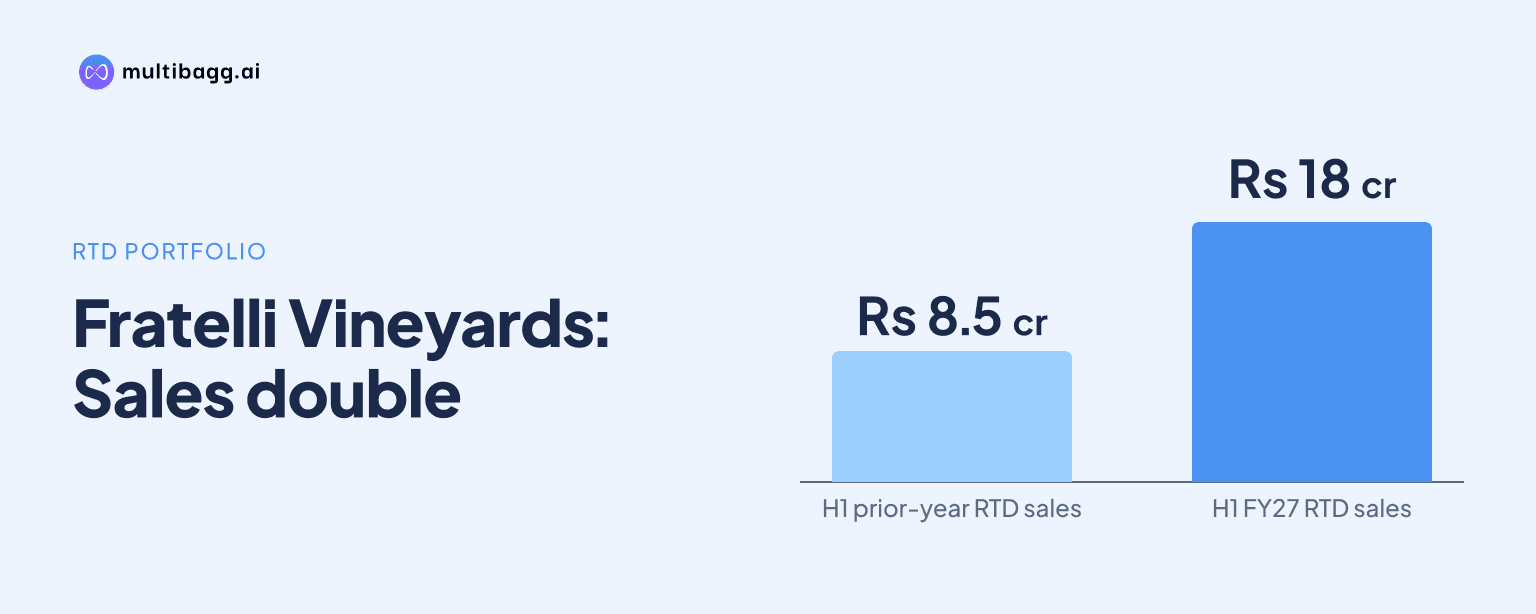
Fratelli Vineyards Limited reported ready-to-drink, or RTD, portfolio sales of Rs 18 crore in H1 FY27, more than double approximately Rs 8.5 crore in H1 FY26, while its Shotgun brand nearly reached 100,000 cases. Management said Fratelli was on course for 200,000 Shotgun cases by the end of FY27.
Know Fratelli Vineyards inside out
Results, valuation, peers and who's buying, in one view.
How fast is Fratelli’s RTD business growing?
Fratelli’s RTD portfolio revenue more than doubled in H1 FY27, rising to Rs 18 crore from approximately Rs 8.5 crore a year earlier. Management said Shotgun revenue also doubled in the half year and the brand had almost reached 100,000 cases. The Rs 18 crore figure covers the full RTD portfolio, rather than Shotgun alone.
The RTD advance outpaced the company’s overall revenue growth. Net revenue from operations increased about 10% to Rs 91.4 crore in H1 FY27 from Rs 83.4 crore in H1 FY26, despite policy-related disruption in Uttar Pradesh. Management said Uttar Pradesh was down about 30% at the H1 level, making RTD, premiumisation and new-market additions important contributors to growth.
Management’s target of 200,000 Shotgun cases by FY27-end would be more than double the previous year’s performance. Fratelli did not disclose Shotgun’s standalone revenue, a flavour-level volume breakdown or the RTD portfolio’s precise share of H1 revenue. The disclosed evidence is the near-100,000-case Shotgun milestone alongside Rs 18 crore of RTD portfolio sales.
Where is Fratelli expanding Shotgun distribution?
Fratelli has introduced Shotgun in Karnataka and plans to introduce it to the Canteen Stores Department, or CSD, channel before year-end. Karnataka is a key market for the company, although management also identified it, with Uttar Pradesh, as a main contributor to weaker premium bottled-sales performance in H1 FY27. The Shotgun launch gives Fratelli a new RTD route in a market facing broader industry headwinds.
CSD is another distribution route for the RTD portfolio. Management said TiLT, Fratelli’s wine-in-a-can product, had established itself among the leading RTD brands in CSD within six months of its launch. Merlot and Sparkling products had also started selling through CSD, while management gave no revenue or case-volume disclosure for TiLT, Merlot or Sparkling in that channel.
Fratelli had 32,000 domestic touchpoints in H1 FY27, with Shotgun present in more than 11,000. That places Shotgun in more than one-third of the company’s touchpoints based on the disclosed totals. Fratelli was available in 28 states and planned entry into Jammu and Kashmir and Tamil Nadu State Marketing Corporation, or TASMAC, in Tamil Nadu during FY27.
What supports Fratelli’s 200,000-case Shotgun target?
Fratelli is supporting the Shotgun target through flavour additions and greater retail distribution. Management said its newly launched Jamun flavour received a very positive response and indicated that ethnic flavours were attracting consumers. The call did not provide Jamun sales, retail pricing or its contribution to the almost 100,000 Shotgun cases reported for H1 FY27.
Retail is the principal sales channel for RTD. Management said approximately 97% to 98% of RTD sales are in retail, compared with an approximately 65:35 split between HoReCa, meaning hotels, restaurants and cafes, and retail for the bottled business. This makes the more than 11,000 Shotgun touchpoints a central part of the 200,000-case plan.
Shotgun’s seasonal pattern may also differ from the bottles business. Management described Shotgun as an all-year-round product, with sales probably somewhat higher in summer and also healthy in the Q3 festive season. Bottled wine normally has its most robust quarter in Q3, management said, but Fratelli did not disclose quarterly Shotgun revenue or case volumes to measure the difference.
Got a follow-up? Ask IRIS
How is RTD growth affecting Fratelli’s margins and marketing?
Fratelli said a higher RTD mix was the main reason for gross-margin movement in Q2 FY27. An analyst cited Q2 gross margin of approximately 76.7%, compared with 79% to 80% in the preceding quarter, and management said RTD had become a sizeable portion of sales. Management retained gross-margin guidance of 77% to 80% for FY27 and cited a moderate industry-wide increase in sugar costs.
Marketing spending is being weighted towards RTD market entry. Management said RTD brand expenses were about 9% of RTD sales in Q2 FY27 and expected the ratio to remain between 8% and 10% for another two to three quarters. Overall bottle-related spending was about 5% to 6% of net sales, showing that the higher ratio applies specifically to RTD activity.
At the company level, earnings before interest, tax, depreciation and amortisation, or EBITDA, moved to a Rs 1.4 crore profit in H1 FY27 from an approximately Rs 1 crore loss in H1 FY26. Management said more sales growth was reaching the bottom line while it continued to invest in RTD and premium brands. It did not separately disclose RTD profitability.
What could affect Fratelli’s Shotgun rollout in FY27?
Fratelli’s ability to meet its 200,000-case objective depends on planned state launches, CSD entry and continued distribution additions rather than on a formal revenue forecast. Management said it would consider giving revenue guidance after the Q3 FY27 call, once it had assessed the main seasonal quarter for wine. Uttar Pradesh’s H1 decline of roughly 30% also remains relevant to overall company growth, although it relates to broader sales rather than Shotgun specifically.
Tamil Nadu availability and Shotgun pricing remained unresolved on November 12, 2026. Management said the TASMAC file was under process and therefore did not disclose a maximum retail price or an exact launch date. It hoped to provide a positive update at the end of Q3 and said more information could be shared after some point in December.
Capacity was not presented as an immediate constraint. Management said Fratelli’s existing capacity could support RTD growth to double its then-current level without additional capital expenditure. Fratelli was also raising up to Rs 29.87 crore through a rights issue closing on November 17, 2026, with proceeds earmarked for balance-sheet strengthening, trade payables, winery equipment, oak barrels at subsidiaries and general corporate purposes.
Conclusion
Fratelli’s H1 FY27 disclosures show RTD becoming a larger growth contributor, with portfolio sales more than doubling to Rs 18 crore as Shotgun neared 100,000 cases. The company is combining that volume progress with a Karnataka launch, prospective CSD distribution, the Jamun flavour and more than 11,000 Shotgun retail touchpoints, while total revenue rose 10% to Rs 91.4 crore.
The next disclosed checkpoints are the potential Shotgun introduction in CSD, the TASMAC update expected around the end of Q3 FY27 and management’s proposed Q3 revenue-guidance discussion. Investors can also watch whether RTD marketing expense remains within the indicated 8% to 10% of RTD sales for the next two to three quarters and whether Shotgun advances toward the 200,000-case FY27 target.