










Ddev Plastiks lifts FY27 revenue target to Rs 3,800 crore
Key highlights
- Ddev Plastiks raised its FY27 revenue target to Rs 3,800 crore from Rs 3,340 crore.
- H1 FY27 average realizations were close to Rs 190, compared with the roughly Rs 150 used in the earlier revenue estimate.
- Ddev Plastiks retained its FY27 EBITDA target of about Rs 360 crore and its 10% to 15% volume-growth guidance.
- H1 FY27 revenue was Rs 1,968 crore, up 36% year on year, while exports contributed 29% of sales.
powered by IRIS
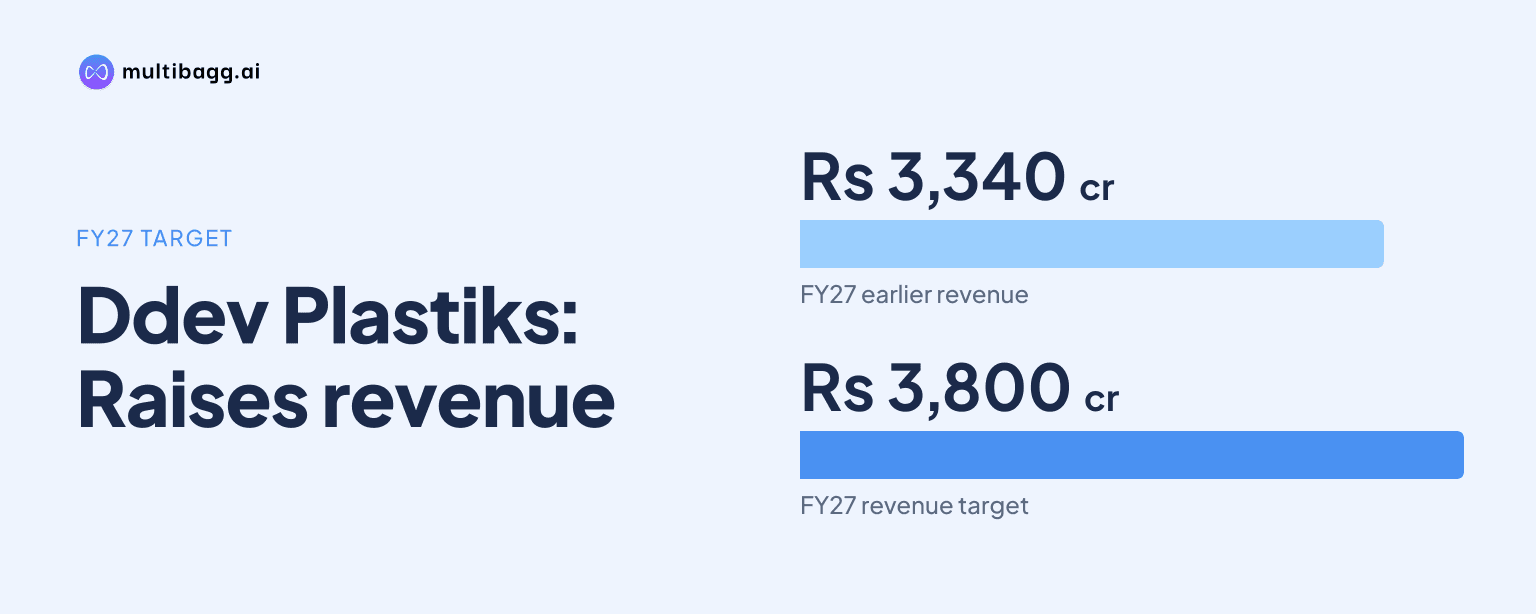
Ddev Plastiks Industries Limited raised its FY27 revenue target to Rs 3,800 crore from Rs 3,340 crore after average realizations reached about Rs 190 in the first half, versus the Rs 150 assumed earlier, while management retained its Rs 360 crore earnings before interest, tax, depreciation and amortization (EBITDA) target.
Know DDev Plastiks Industries inside out
Results, valuation, peers and who's buying, in one view.
Why did Ddev Plastiks raise its FY27 revenue target?
Ddev Plastiks raised its FY27 revenue target because average selling realizations remained above its original assumption for two quarters. Management said the prior Rs 3,340 crore estimate used realizations of about Rs 150, while the first-half FY27 average was close to Rs 190. It consequently lifted its target by about 14% to Rs 3,800 crore.
Management attributed the higher realization to increased raw-material prices amid geopolitical tension in the Middle East. It said the higher input prices were passed through to customers, which raised reported revenue. Management also said the revised target incorporated both the higher price level and its existing volume assumptions.
The volume-growth guidance itself remains unchanged at 10% to 15% for FY27. In the first half, volume growth was only about 1% to 2%, according to an analyst’s question, as longer export transit times, higher freight and movement restrictions affected shipments. Management said the second half usually contributes more because cable laying increases after the monsoon.
Management described the Rs 3,800 crore target as implying 79% year-on-year growth for FY27. Its longer-term target remains Rs 5,000 crore of revenue from the compounding business by FY30, based on realizations lower than those prevailing in FY27. Management said any revenue from the planned battery energy storage system, or BESS, business would be additional to that compounding-business target.
What EBITDA target is Ddev Plastiks maintaining for FY27?
Ddev Plastiks is maintaining its FY27 EBITDA target of about Rs 360 crore despite the revenue upgrade. Management said EBITDA per tonne is a more useful measure than percentage margin when raw-material costs and selling prices rise together. The Q2 FY27 EBITDA margin was 9%, while EBITDA rose 16% year on year to about Rs 86 crore.
For Q2 FY27, management said EBITDA per tonne was close to Rs 17,000, compared with about Rs 15,500 in the September quarter of the prior year. The preceding full-year average was about Rs 15,700 per tonne. Management said the Q2 level was among the highest of the past few years, although it included some export war-risk premium in July and part of August.
Management continues to cite Rs 14,000 to Rs 17,000 per tonne as its normal EBITDA benchmark. It said the current result was near the top of that range because freight rates and transit times on both imports and exports had been elevated for two quarters. If the Middle East disruption subsides and input prices moderate, management expects the percentage EBITDA margin to improve.
Product mix remains relevant to profitability. Management identified cross-linked polyethylene, or XLPE, compounds as the main revenue and margin driver, while other products have lower margins and revenue. It also said exports normally earn margins a couple of percentage points above domestic sales, although the freight disruption has temporarily reduced that difference.
Got a follow-up? Ask IRIS
How did Ddev Plastiks perform in Q2 and H1 FY27?
Ddev Plastiks reported Q2 FY27 revenue of about Rs 970 crore, up 44% year on year, and H1 FY27 revenue of Rs 1,968 crore, up 36%. Management attributed the growth to wire-and-cable demand, higher realizations and a rising contribution from exports. Export sales represented 29% of H1 FY27 revenue, compared with about 25% in the prior financial year.
Profit after tax was Rs 52 crore in Q2 FY27, up 10% year on year, and Rs 116 crore in H1 FY27, up 17%. Revenue grew faster than EBITDA and profit during the half because freight costs rose sharply. Management said export freight was the largest pressure in other expenses during both the September quarter and the preceding quarter, rather than a one-time charge.
H1 FY27 volume reached 1.02 lakh metric tonnes as of September 2026. Management said its earlier annual quantity estimate was about 2.30 lakh metric tonnes, indicating that much of the planned volume is expected in the second half. Ddev Plastiks spent about Rs 79 crore on capital expenditure in the first half for capacity expansion, supply-chain capabilities and future growth platforms.
What must happen for Ddev Plastiks to meet its FY27 targets?
Ddev Plastiks needs a second-half volume recovery, continued customer acceptance of realizations and smoother export logistics to meet the Rs 3,800 crore revenue target. Management expects the post-monsoon period to support cable-related demand and said its annual volume-growth guidance remains 10% to 15%. The company expects the second half to account for the balance of its earlier 2.30 lakh-tonne annual quantity estimate.
New capacity utilization is another factor. An analyst cited overall utilization of 63%, down from 81% in the prior year, following capacity additions in polyvinyl chloride, or PVC, and XLPE compounds. Management said the new plants had been operating at roughly 25% to 30% utilization initially and expects them to reach close to 50% utilization by the end of FY27.
Management said the capacity ramp-up should begin from mid-to-late November 2026 after the festive period. It also said export transit times have been unpredictable since March 2026, with shipments to the same destination sometimes taking two weeks and at other times four weeks. The company is maintaining its presence in those markets while seeking further geographic expansion.
Capital expenditure is planned at about Rs 175 crore in FY27, followed by another Rs 50 crore to Rs 70 crore in the following year. The BESS project remains under construction, and management said it was reviewing a state incentive policy announced on November 5, 2026 before full execution. It indicated that the first quarter of the next financial year could be the appropriate time to begin production.
Conclusion
Ddev Plastiks’ FY27 revenue revision is principally driven by higher realizations rather than a higher volume-growth assumption. The company lifted its target to Rs 3,800 crore after first-half realizations approached Rs 190 against the earlier Rs 150 assumption, but retained the Rs 360 crore EBITDA goal and the 10% to 15% volume-growth guidance.
The next indicators are second-half shipment volumes, new-plant utilization toward management’s close-to-50% target, and whether Middle East-related freight and transit disruptions ease. Management’s review of the November 5, 2026 state incentive policy will also determine the next execution steps and timing for the BESS project.