










Ddev Plastiks Gets 80% of H1FY27 Revenue From Wires and Cables
Key highlights
- Ddev Plastiks reported Rs 1,968 crore of revenue in H1FY27.
- The wires and cable industry contributed 80% of Ddev Plastiks’ H1FY27 revenue.
- PE products accounted for 88% of Ddev Plastiks’ H1FY27 revenue.
- Ddev Plastiks targets about Rs 3,800 crore of topline in FY27E.
powered by IRIS
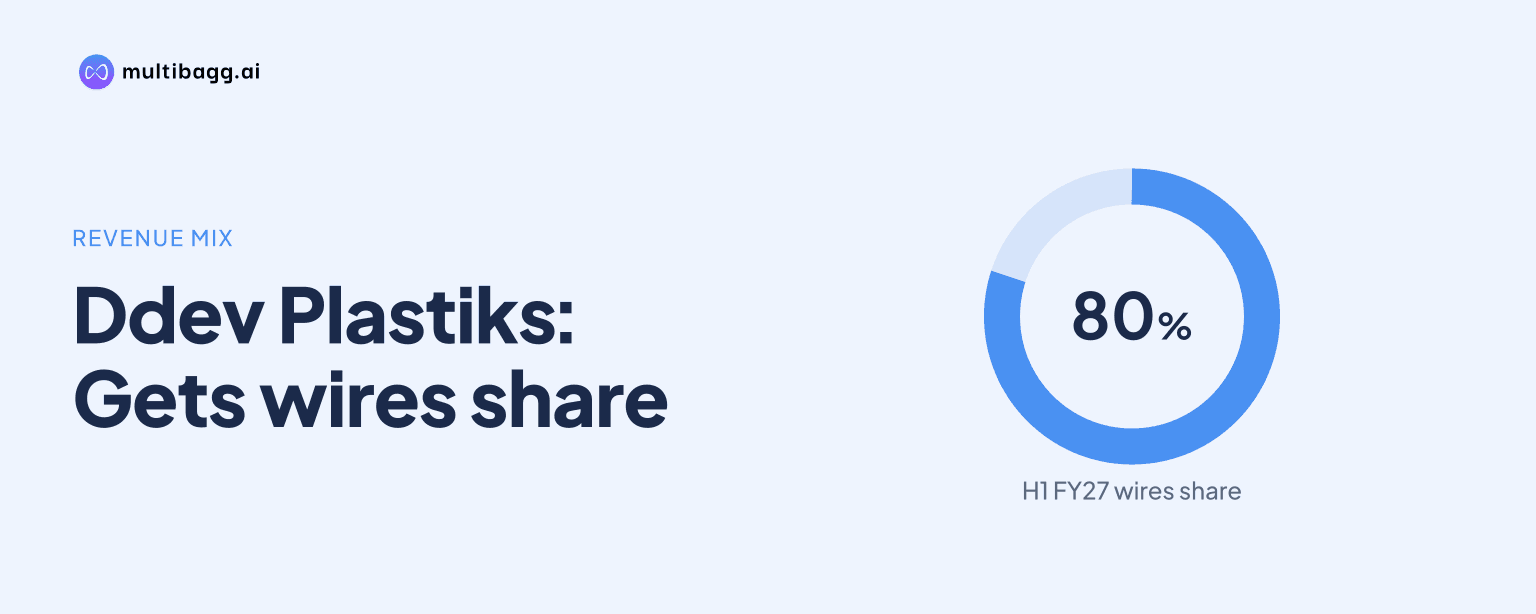
Ddev Plastiks reported Rs 1,968 crore of revenue in H1FY27, with the wires and cable industry contributing 80% and polyethylene, or PE, products contributing 88%. The disclosures show that Ddev Plastiks’ sales were concentrated by both end-market and product category, despite its portfolio spanning five categories and more than 200 stock-keeping units.
Know DDev Plastiks Industries inside out
Results, valuation, peers and who's buying, in one view.
How concentrated was Ddev Plastiks’ H1FY27 revenue?
Ddev Plastiks’ H1FY27 revenue was concentrated in the wires and cable industry, which contributed 80% of Rs 1,968 crore in revenue. Packaging contributed 2%, while the presentation groups the remaining 18% as other sectors. This makes wires and cables the largest disclosed end-market exposure across Ddev Plastiks’ five product categories.
The product split was more concentrated, with PE representing 88% of H1FY27 revenue, compared with 11% for polyvinyl chloride, or PVC, and 1% for other products. The sector and product disclosures are different measures of sales, so the 80% wires-and-cable share cannot be combined with the 88% PE share. They nevertheless show that PE and cable-related demand are the two dominant dimensions of the reported revenue mix.
Which products and sectors does Ddev Plastiks serve?
Ddev Plastiks serves five categories: Antifab, filled compounds and master batches; PVC compounds; Sioplas, cross-linked polyethylene, or XLPE, compounds and semiconducting compounds; engineering plastic compounds; and halogen-free flame-retardant, or HFFR, compounds. However, the H1FY27 product split shows that 88% of revenue came from PE products, while products classified as other supplied 1%.
PVC compounds are used in wires and cables, construction and footwear, while Antifab, filled compounds and master batches are used in packaging applications including woven bags and cement bags. Engineering plastic compounds are mainly used in white goods and fast-moving electrical goods, or FMEG. These stated applications provide context for the 2% packaging contribution and the 18% contribution from sectors outside wires and cables in H1FY27.
Ddev Plastiks identifies Sioplas, XLPE compounds and semiconducting compounds as a major revenue contributor, with about 50% market share in Sioplas and about 33% in XLPE compounds. It also states that it is the only player in India offering products from 66 kilovolt to 132 kilovolt. These claims relate to Ddev Plastiks’ position in higher-voltage cable-compound applications, although the presentation does not disclose H1FY27 revenue for those products separately.
How diversified are Ddev Plastiks’ geography and customer exposures?
Ddev Plastiks generated 71% of H1FY27 revenue in India and 29% overseas. The split indicates that India remained its principal market, while overseas markets accounted for nearly three-tenths of the Rs 1,968 crore reported for the half year. The presentation does not provide country-level revenue, export revenue by product category, or an earlier-period geography comparison.
Apar, Havells, KEC, KEI, Paramount and Polycab together contributed about 22% of total revenue. This figure covers six named customers rather than one account, and Ddev Plastiks does not disclose each customer’s individual share. It also does not identify whether their purchases were in India or overseas, or whether they bought PE, PVC, XLPE or HFFR compounds.
The six named customers’ combined contribution of about 22% provides a customer concentration measure alongside the 80% wires-and-cable sector exposure. Ddev Plastiks describes itself as India’s largest supplier of cable compounds, but the presentation does not quantify cable-industry revenue from the six named customers or identify the purchasers behind the remaining roughly 78% of total revenue.
Got a follow-up? Ask IRIS
Which Ddev Plastiks categories have the highest stated margins?
Ddev Plastiks reports the highest stated earnings before interest, taxes, depreciation and amortisation, or EBITDA, margin range for engineering plastic compounds, at about 10% to 15%. HFFR is stated at about 10% to 12%, followed by Sioplas, XLPE compounds and semiconducting compounds at about 8% to 12%. These are category-level ranges rather than reported consolidated EBITDA margins for H1FY27.
The lower stated ranges are about 3% to 5% for Antifab, filled compounds and master batches and about 4% to 6% for PVC compounds. Ddev Plastiks says it is among two HFFR producers in India, and identifies HFFR as a potential replacement for conventional PVC house-wiring cables in public infrastructure. It also identifies HFFR use in solar cables but does not disclose the category’s H1FY27 revenue contribution.
What demand outlook and capacity plan does Ddev Plastiks disclose?
Ddev Plastiks links its cable-compound exposure to projected growth in the Indian wires and cables market from Rs 80,000 crore in FY24 to Rs 1,20,000 crore in FY27. The presentation characterises this as about 11% compound annual growth rate, or CAGR. It separately forecasts transmission-line additions rising from 15,000 kilometres in FY23 to 41,000 kilometres by FY30E, implying about 16% CAGR.
The presentation cites India’s 817-gigawatt power requirement by 2030, with 50% of cumulative installed electric power expected to be green by that date. It puts the transmission market at about Rs 60,000 crore and estimates India’s cable-compounding industry at about 2.5 lakh tonnes per annum. Ddev Plastiks states that it has about one-third market share in cable compounding, though it does not disclose a date or volume basis for that estimate.
Ddev Plastiks’ plan shows installed capacity rising from 233,400 metric tonnes per annum in FY25 to 268,400 metric tonnes per annum in FY26, a stated 15% increase. It targets about 332,400 metric tonnes per annum in FY27E, with planned capital expenditure of about Rs 175 crore, compared with Rs 96 crore in FY26 and Rs 55 crore in FY25. The FY27E topline target is about Rs 3,800 crore, compared with Rs 2,948 crore in FY26 and Rs 2,603 crore in FY25.
Conclusion
Ddev Plastiks’ disclosures describe a business with a broad product offering but concentrated reported revenue: PE accounted for 88% of H1FY27 sales and wires and cables contributed 80%. India supplied 71% of revenue, while six named customers together accounted for about 22%, providing further context for the company’s cable-compound exposure.
The next disclosed milestones are the FY27E plan for about Rs 3,800 crore of topline, 332,400 metric tonnes per annum of installed capacity and about Rs 175 crore of capital expenditure. Whether capacity additions, new product approvals and entry into newer segments alter the current 88% PE and 80% wires-and-cables mix is the matter to watch in later disclosures.