










Dev Plastiks Ltd plans debt-free expansion backed by Rs 1,116 crore
Key highlights
- Dev Plastiks reported total equity of Rs 1,116 crore at H1FY27, up from Rs 1,013 crore at FY26.
- Dev Plastiks reported zero non-current borrowings at H1FY27, while current borrowings were Rs 67 crore.
- Dev Plastiks says it will maintain net debt-free status through FY27 and beyond.
- Installed capacity reached 3,16,400 MTPA as of September 2026, versus 2,68,400 MTPA in FY26.
powered by IRIS
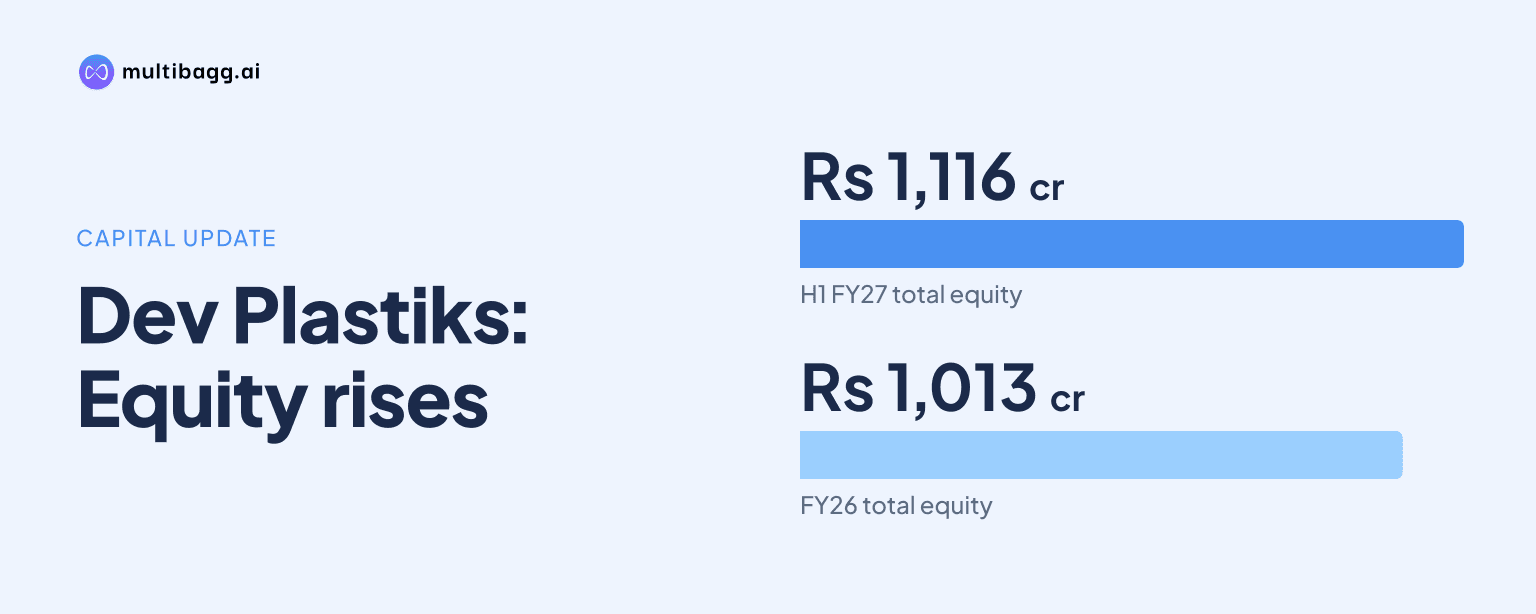
In H1FY27, Dev Plastiks said it would preserve its net debt-free status through FY27 and beyond while funding staggered expansion, supported by total equity of Rs 1,116 crore. The company reported zero non-current financial borrowings, and its net debt-to-equity and net debt-to-EBITDA ratios were both zero in FY26.
Know DDev Plastiks Industries inside out
Results, valuation, peers and who's buying, in one view.
What does Dev Plastiks’ balance sheet show at H1FY27?
Dev Plastiks’ total equity reached Rs 1,116 crore at H1FY27, up Rs 103 crore from Rs 1,013 crore at FY26 and Rs 281 crore from Rs 835 crore at FY25. Equity consisted of Rs 10 crore of share capital and Rs 1,106 crore of other equity at H1FY27, indicating that the increase was principally in accumulated reserves rather than share capital.
The balance sheet expanded to Rs 1,617 crore at H1FY27 from Rs 1,444 crore at FY26. Non-current assets increased to Rs 404 crore from Rs 373 crore, including tangible assets of Rs 349 crore versus Rs 279 crore, while current assets rose to Rs 1,213 crore from Rs 1,071 crore. Trade receivables were Rs 668 crore and inventories were Rs 373 crore at H1FY27.
Is Dev Plastiks already debt-free?
Dev Plastiks became net debt-free in the fourth quarter of FY24 and says it is committed to retaining that status through FY27 and beyond. Its reported net debt-to-equity and net debt-to-EBITDA ratios, where EBITDA means earnings before interest, tax, depreciation and amortisation, were each zero in FY24, FY25 and FY26, compared with 0.1 times and 0.3 times, respectively, in FY23.
Net debt-free does not mean the absence of every borrowing line in the balance sheet. Dev Plastiks reported zero non-current financial borrowings at H1FY27, but current borrowings were Rs 67 crore, against Rs 52 crore at FY26 and Rs 42 crore at FY25. The company also recorded Rs 56 crore of cash and cash equivalents and Rs 37 crore of investments at H1FY27; its presentation does not provide a separate H1FY27 net-debt calculation.
Interest expense was Rs 23 crore in H1FY27, compared with Rs 12 crore in H1FY26, while revenue from operations rose 36% year on year to Rs 1,968 crore. The H1FY27 balance sheet also included Rs 8 crore of non-current lease liabilities and Rs 2 crore of current lease liabilities, separate from the zero non-current borrowing figure.
Got a follow-up? Ask IRIS
How does Dev Plastiks plan to fund its next expansion cycle?
Dev Plastiks says its capital expenditure, or capex, plan will be undertaken in a staggered manner over the next three years through brownfield expansion at existing manufacturing facilities. The stated framework is to preserve net debt-free status, rather than a disclosed capex budget or a specified external-borrowing programme.
The company had already added capacity in FY26 and in April 2026. Its installed capacity stood at 3,16,400 metric tonnes per annum, or MTPA, as of September 2026, compared with 2,68,400 MTPA in FY26. The new cross-linked polyethylene, or XLPE, compounds facility in Rajasthan was commissioned in April 2026 and will be recorded from the first quarter of FY27.
Management’s stated FY27 capacity actions include increasing halogen-free flame-retardant, or HFFR, capacity to 20,000 MTPA and adding 6,000 MTPA of XLPE compound capacity in eastern India. The company also lists commissioning of 48,000 metric tonnes of new greenfield XLPE capacity in Bhiwadi, Rajasthan, in 2027, alongside its presentation’s description of brownfield expansion.
What operating performance supports the expansion plan?
Dev Plastiks reported Rs 2,948 crore of revenue from operations in FY26, up from Rs 2,603 crore in FY25, while profit after tax, or PAT, rose to Rs 202 crore from Rs 185 crore. EBITDA was Rs 320 crore in FY26 versus Rs 287 crore in FY25, although the EBITDA margin remained 11% in both years. The company’s FY30 revenue target is Rs 5,000 crore.
In H1FY27, revenue reached Rs 1,968 crore, up from Rs 1,449 crore in H1FY26, and PAT increased to Rs 116 crore from Rs 99 crore. EBITDA rose to Rs 187 crore from Rs 154 crore, but the EBITDA margin declined to 10% from 11%. Management attributed the half-year performance to capacity ramp-up from facilities commissioned in the second half of FY26 and demand from the wires and cables industry.
Capacity utilisation shows the immediate effect of additions. Total utilisation was 64% in H1FY27, down from 75% in FY26, while total installed capacity increased by 48,000 MTPA. In the Sioplas, XLPE and semicon segment, capacity expanded to 2,14,500 MTPA from 1,66,500 MTPA, and utilisation declined to 67% from 87%, leaving additional installed capacity to be absorbed.
Conclusion
Dev Plastiks increased total equity from Rs 660 crore in FY24 to Rs 1,116 crore at H1FY27 while reporting no non-current borrowings throughout that period. Its zero net debt ratios through FY26 and management’s stated commitment provide the basis for its plan to finance a staged expansion cycle without giving up net debt-free status, even as H1FY27 current borrowings rose to Rs 67 crore.
The next measures to watch are the FY27 HFFR expansion to 20,000 MTPA, the additional 6,000 MTPA of eastern XLPE capacity, and utilisation of the 3,16,400 MTPA installed base. Management’s FY30 revenue target of Rs 5,000 crore and the planned 2027 commissioning of 48,000 metric tonnes of greenfield XLPE capacity in Bhiwadi set the disclosed milestones for that expansion path.