










Dev Plastiks lifts EBITDA per tonne nearly threefold
Key highlights
- Dev Plastiks' EBITDA per tonne rose to Rs 16,978 in Q2FY27 from Rs 5,819 in FY21.
- Dev Plastiks reported FY26 EBITDA of Rs 320 crore, compared with Rs 74 crore in FY21.
- Dev Plastiks' FY26 PAT was Rs 202 crore versus Rs 21 crore in FY21.
- Dev Plastiks reported 3,16,400 metric tonnes of installed capacity and 64% utilisation in 1HFY27.
powered by IRIS
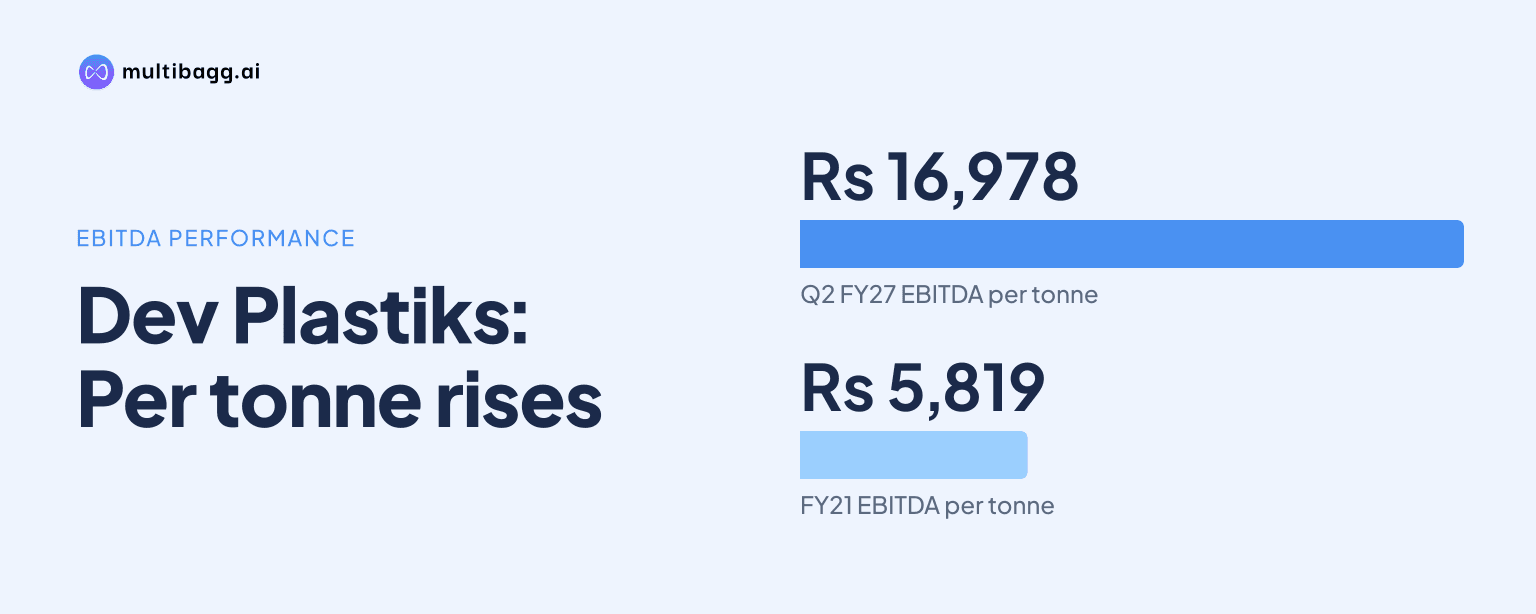
Dev Plastiks Ltd lifted earnings before interest, tax, depreciation and amortisation (EBITDA) per tonne to Rs 16,978 in Q2FY27 from Rs 5,819 in FY21, nearly threefold, while FY26 profit after tax reached Rs 202 crore versus Rs 21 crore. Management attributes the profitability change to better realisations and a move towards value-added, high-growth products.
Know DDev Plastiks Industries inside out
Results, valuation, peers and who's buying, in one view.
What drove Dev Plastiks' EBITDA per tonne increase?
Dev Plastiks' EBITDA per tonne increased by Rs 11,159 between FY21 and Q2FY27 as revenue per tonne rose to Rs 192,626 from Rs 119,980. The company describes better realisations as the mechanism for enhanced profitability. This comparison uses a full financial year and a quarterly period, so it compares reported unit economics at two points rather than annual totals.
The movement was uneven across the reported periods. EBITDA per tonne rose from Rs 5,819 in FY21 to Rs 9,309 in FY22, Rs 12,931 in FY23 and Rs 16,878 in FY24, before falling to Rs 15,137 in FY25. It then recovered to Rs 15,905 in FY26 and Rs 16,978 in Q2FY27, while revenue per tonne fell from its FY23 level of Rs 174,344 to Rs 137,318 in FY25 before rising again.
FY24 showed a different relationship between realisations and unit profitability: revenue per tonne declined by Rs 28,788 from FY23, but EBITDA per tonne increased by Rs 3,947. EBITDA margin also expanded to 12% in FY24 from 7% in FY23. That outcome is consistent with management's stated shift to value-added products, although the presentation does not quantify the separate effects of mix, pricing and input costs.
How did Dev Plastiks' profits outpace revenue growth?
Dev Plastiks reported FY26 net revenue of Rs 2,948 crore, up from Rs 1,534 crore in FY21, while EBITDA rose to Rs 320 crore from Rs 74 crore. Profit after tax (PAT) increased to Rs 202 crore from Rs 21 crore over the same period, a rise of more than nine times. Earnings therefore expanded faster than revenue over the six financial years shown.
EBITDA margin was 11% in FY26 compared with 5% in FY21, after reaching 12% in FY24. PAT margin rose to 7% from 1%, and gross margin reached 18% in FY26 versus 13% in FY21. The presentation says EBITDA and EBITDA margin include other income, which is relevant when comparing the reported operating figures across periods.
The partial-year FY27 figures show lower margins than FY26 but absolute earnings above FY21's full-year amount. In 1HFY27, Dev Plastiks reported net revenue of Rs 1,968 crore, EBITDA of Rs 187 crore at a 10% margin, and PAT of Rs 116 crore at a 6% margin. The Rs 116 crore first-half PAT was more than five times FY21 PAT of Rs 21 crore, though the periods are not like-for-like.
Got a follow-up? Ask IRIS
How did Dev Plastiks' production mix change?
Dev Plastiks' reported production volume rose to 1,89,374 metric tonnes in FY25 from 1,24,094 metric tonnes in FY21, while Sioplas and cross-linked polyethylene (XLPE) increased to 73% of volume from 55%. In 1HFY27, Sioplas and XLPE accounted for 71% of reported volume, compared with 19% for polyvinyl chloride (PVC) compounds and 8% for Antifab.
Antifab's share declined from 22% in FY21 to 10% in FY25 and 8% in 1HFY27. PVC compounds represented 19% in both FY21 and 1HFY27, after falling to 13% in FY22 and reaching 17% in FY26. HFFR represented 0.49% of production in FY23, 2% in FY25 and 2% in 1HFY27, while engineering products were 0.21% in 1HFY27.
Capacity additions accompanied the changing mix. Total installed capacity reached 3,16,400 metric tonnes in 1HFY27, compared with 2,68,400 metric tonnes in FY26, while total utilisation declined to 64% from 75%. Sioplas, XLPE and semiconducting compounds had capacity of 2,14,500 metric tonnes at 67% utilisation in 1HFY27, versus 1,66,500 metric tonnes and 87% utilisation in FY26.
Which products and capacity plans could affect Dev Plastiks next?
Dev Plastiks has started manufacturing polyethylene compounds for 66-72 kilovolt cables and is producing polyethylene compounds for 132 kilovolt cables. Its stated next focus is products for up to 220-kilovolt applications. The company also received third-party approval for locally produced water-tree-retardant XLPE insulation compounds and introduced an XL HFFR compound for solar cables.
The water-tree-retardant XLPE compound, intended for 72-kilovolt cable insulation, passed a two-year cable test at a VDE laboratory in Germany, according to the presentation. Dev Plastiks also started making anti-track compound suitable for 36-kilovolt medium-voltage covered conductors. These launches identify management's product priorities, but the presentation provides no revenue, volume or margin contribution for any individual product.
Dev Plastiks commissioned an XLPE compounds facility in Rajasthan in April 2026, which it says will be recorded from Q1FY27 onward. The company also added PVC and HFFR capacity, contributing to the 3,16,400-metric-tonne capacity base in 1HFY27. Group utilisation of 64% in 1HFY27 leaves the ramp-up of the new capacity measurable alongside the specialised-product programme.
Conclusion
Dev Plastiks' reported transformation combines EBITDA per tonne rising from Rs 5,819 in FY21 to Rs 16,978 in Q2FY27, EBITDA margin increasing from 5% to 11% by FY26, and PAT climbing from Rs 21 crore to Rs 202 crore. Production also became more concentrated in Sioplas and XLPE, whose share increased from 55% in FY21 to 71% in 1HFY27.
The next disclosed markers are management's FY30 net-revenue target of Rs 5,000 crore, brownfield expansion planned in stages over the next three years, and its commitment to remain net debt-free through FY27 and beyond. Dev Plastiks became net debt-free in Q4FY24; utilisation of the 3,16,400-metric-tonne capacity base and the ramp-up of capacity commissioned in April 2026 are the operating measures to watch next.