










Ddev Plastiks Targets Q1 FY28 BESS Start After Incentive Review
Key highlights
- Ddev Plastiks expects a Q1 FY28 BESS product start after reviewing a newly announced state incentive policy.
- Ddev Plastiks said it will not secure BESS orders before plant readiness because selling-price cycles are volatile.
- Ddev Plastiks said BESS revenue would be additional to its Rs 5,000 crore FY30 compounding-business target.
- Ddev Plastiks reported H1 FY27 revenue of Rs 1,968 crore, up 36% year on year.
powered by IRIS
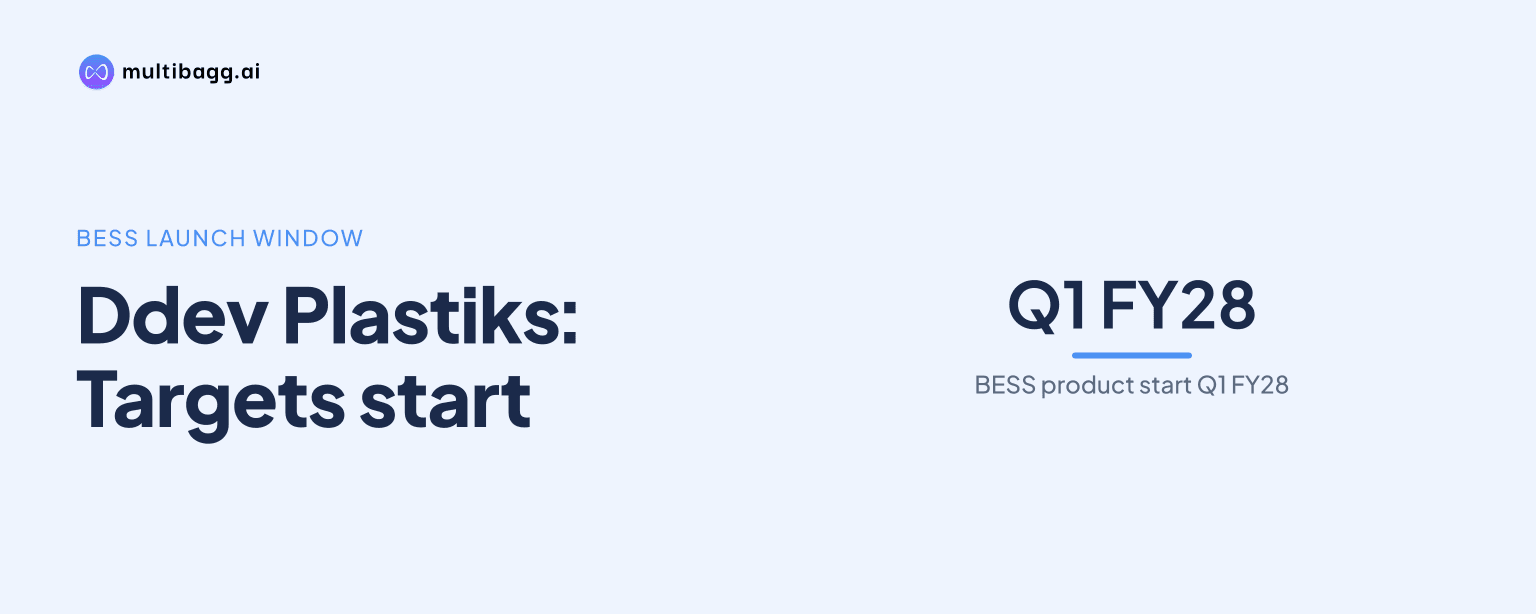
Ddev Plastiks Industries Limited expects to start its battery energy storage system, or BESS, product in Q1 FY28 after reviewing a state incentive policy announced in the week before its Q2 FY27 call. Management said the project remains under construction and that Ddev Plastiks will not secure BESS orders until the plant is ready.
Know DDev Plastiks Industries inside out
Results, valuation, peers and who's buying, in one view.
Why is Ddev Plastiks moving its BESS start to Q1 FY28?
Ddev Plastiks is moving toward a Q1 FY28 BESS product start because it is assessing a newly announced state government incentive policy before proceeding with full execution. Chief Financial Officer Arihant Bothra said the company had been waiting for the policy and would go ahead after its review, rather than giving a firm execution schedule before that assessment.
An analyst referred on the Q2 FY27 call to an earlier H2 FY27 expectation, making the Q1 FY28 indication a later timetable. Management did not disclose the policy’s terms, a project location, BESS capacity or a revised project cost. It said only that the “next financial year, first quarter” would probably be the right time to start the product.
What is the current status of Ddev Plastiks' BESS plant?
Ddev Plastiks said the BESS facility is at the construction stage and that the full project has not yet been completed. Management said it would be in a better position to confirm important milestones once the plant goes live, leaving commissioning progress beyond the Q1 FY28 expectation undisclosed.
The BESS project is separate from Ddev Plastiks’ polymer compounding expansion. In compounding, management said it added PVC and XLPE, or cross-linked polyethylene, capacity during the prior fiscal year and through May FY27. The new compounding capacity was operating at roughly 25% to 30% utilisation at the time of the call, with management targeting close to 50% by the end of FY27.
Ddev Plastiks also said it planned to double HFFR, or halogen-free flame-retardant, capacity to 20,000 tonnes by the end of FY27. Management said customer approval processes were already under way for existing HFFR capacity, while the added capacity would produce compounds already approved by customers. No equivalent BESS product mix or approval timetable was disclosed.
Will Ddev Plastiks take BESS orders before the plant is ready?
Ddev Plastiks said it will not secure BESS orders until the plant is ready because selling-price cycles in the industry are volatile. Management’s stated sequence is to complete the plant first and then pursue orders, rather than commit an order book while construction and price movements remain unresolved.
Consequently, the Q2 FY27 call disclosed no confirmed BESS orders, revenue backlog, segment margin target or FY28-to-FY30 sales contribution. Management also said it had not decided the BESS product mix and was still working on it. By comparison, XLPE was identified as the core compounding product that drives most revenue and overall margins.
Management described the wider BESS market rather than issuing a Ddev Plastiks forecast. It said annual demand in India was more than 50 gigawatt-hours, while available BESS capacity was below 10 gigawatt-hours. It also cited government guidance for close to 222 gigawatt-hours by FY30 and prevailing China and India prices of about Rs 4 crore to Rs 4.5 crore for a delivered 5-megawatt-hour container.
Got a follow-up? Ask IRIS
Is BESS included in Ddev Plastiks' FY30 revenue target?
Ddev Plastiks said BESS revenue would be over and above its Rs 5,000 crore FY30 revenue ambition, which management said covers only the existing compounding business. Management added that the Rs 5,000 crore objective used average realisations below those achieved in FY27, after assuming prices normalise following the Middle East conflict.
The compounding business reported Rs 1,968 crore of revenue in H1 FY27, up 36% year on year, and earnings before interest, tax, depreciation and amortisation, or EBITDA, of about Rs 187 crore, up 22%. Profit after tax reached Rs 116 crore, up 17%, while exports represented 29% of H1 FY27 sales, compared with about 25% in the previous fiscal year.
Management revised its FY27 revenue estimate to about Rs 3,800 crore from about Rs 3,340 crore, citing higher average realisations. It retained an EBITDA estimate of about Rs 360 crore. Ddev Plastiks guided for total capital expenditure of about Rs 175 crore in FY27 and a further Rs 50 crore to Rs 70 crore in FY28, without allocating those amounts between BESS and compounding projects.
What conditions could affect Ddev Plastiks' BESS rollout?
Ddev Plastiks’ BESS timetable depends on completing the incentive-policy review and then finishing construction, while order intake depends on plant readiness. Management specifically cited volatile selling-price cycles as the reason to defer orders. The incentive review and the absence of disclosed project-cost details leave the financial effect of the timing change unspecified.
In its compounding operations, management linked pricing and margins to Middle East disruption. Q2 FY27 EBITDA per tonne was close to Rs 17,000, compared with about Rs 15,500 in the September quarter of the previous year and a last-full-year average of about Rs 15,700. Management attributed part of the recent increase to an export-market war-risk premium and described Rs 14,000 to Rs 17,000 per tonne as its benchmark range.
Ddev Plastiks said H1 FY27 volume growth was only about 1% to 2%, as longer transit times, higher export freight and movement restrictions affected shipments. It nevertheless retained its 10% to 15% volume-growth guidance, saying the second half normally benefits from post-monsoon cable laying and demand after the festive period.
Conclusion
The revised Q1 FY28 BESS timetable places incentive assessment, construction completion and pricing discipline ahead of early order booking. Ddev Plastiks has not presented BESS as part of its Rs 5,000 crore FY30 compounding target, and the project currently has no disclosed orders, capacity figure, revenue forecast or margin target.
The next items to watch are management’s assessment of the state incentive policy, construction progress toward the indicated Q1 FY28 product start and any order-book details after the plant is ready. Before then, management plans to lift new compounding-plant utilisation to close to 50% by the end of FY27 while pursuing its revised FY27 revenue estimate of about Rs 3,800 crore.