










Ddev Plastiks export freight jumps to $300-350 per tonne
Key highlights
- Ddev Plastiks said freight on certain export routes rose to $300-$350 a tonne from $10-$20 a tonne.
- Exports accounted for about 29%-30% of Ddev Plastiks' first-half sales.
- Ddev Plastiks retained 10%-15% volume-growth guidance after first-half growth of about 1%-2%.
- Ddev Plastiks maintained targets of Rs 3,800 crore revenue and about Rs 360 crore EBITDA.
powered by IRIS
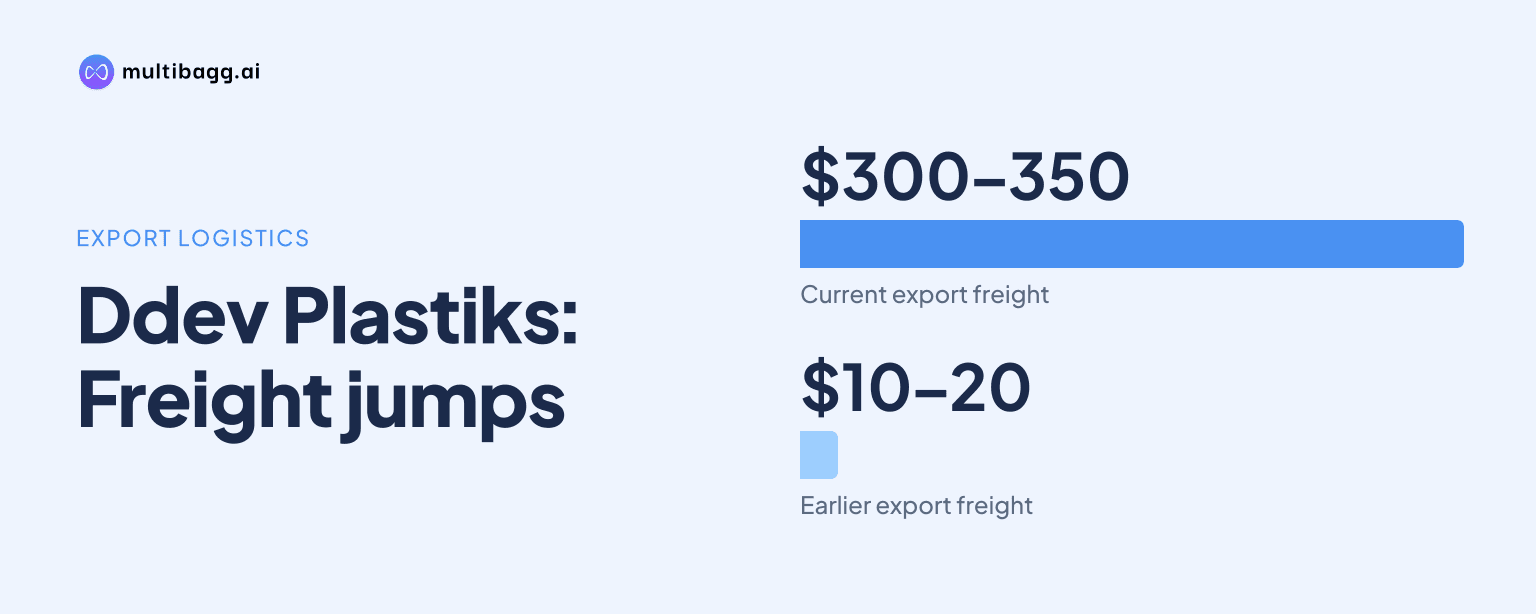
Ddev Plastiks Industries Limited said Middle East disruption raised freight on certain export routes to $300-$350 a tonne from $10-$20 in the first half, disrupting delivery timing and limiting volume growth to about 1%-2%. Exports represented about 29%-30% of first-half sales, making vessel availability and freight a material execution issue.
Know DDev Plastiks Industries inside out
Results, valuation, peers and who's buying, in one view.
How did Middle East disruption affect Ddev Plastiks exports?
Ddev Plastiks said the disruption increased transit times, freight costs and movement restrictions, limiting first-half volume growth to about 1%-2%. Management retained its 10%-15% volume-growth guidance, but identified the Middle East conflict as a major reason growth did not advance faster in the first half.
The freight increase was particularly steep on some routes. Ddev Plastiks said export freight that had been $10-$20 a tonne reached $300-$350 a tonne, and management described the increase as the largest component of other expenses in both the September quarter and the preceding quarter.
Delivery timing also became unpredictable. Rajesh Kothari said a shipment to a particular destination could take two weeks on one occasion and four weeks on the next, because routes were unstable and the frequency of connecting vessels had declined.
Why did higher freight reduce Ddev Plastiks export netbacks?
Higher sea freight reduced Ddev Plastiks' netback when customers compared delivered-duty-paid, or DDP, prices. Management said that higher freight lowers the free-on-board, or FOB, price and net sales proceeds available to Ddev Plastiks when buyers assess the delivered cost of material.
The first and second quarters showed different customer responses to that cost. Management said export buyers paid a premium in the first quarter despite higher freight and lending costs because they wanted to secure material, while the second quarter became a wait-and-watch period for export customers.
Domestic conditions added to the pressure in the second quarter. Management said monsoon restricted cable-laying activity and weakened domestic demand, while longer transit time and freight costs affected exports, leaving both markets less supportive of volume during that period.
Can Ddev Plastiks maintain its profitability benchmark?
Ddev Plastiks said earnings before interest, tax, depreciation and amortisation, or EBITDA, of Rs 14,000 to Rs 17,000 per tonne is the appropriate benchmark to track. Management said quarterly EBITDA per tonne can move within or beyond that range depending on geopolitical developments, freight and selling-price movements.
Management cited about Rs 16,000 per tonne as the average benchmark achieved last year. It asked investors to focus on EBITDA per tonne rather than EBITDA margin percentage because changes in polymer prices can alter revenue and percentage margins without necessarily reflecting the underlying per-tonne outcome.
Domestic price pass-through provides some protection from raw-material volatility. Ddev Plastiks said it is generally a cost-plus supplier and faces a maximum domestic pass-through lag of five to seven days, while export business is generally sold through spot contracts with price exposure of about 15-20 days.
Got a follow-up? Ask IRIS
What is Ddev Plastiks doing to support export growth?
Ddev Plastiks is pursuing new geographies and customers while retaining its presence in existing export markets. Management said export growth comes from both channels, although it did not quantify additions because customer relationships and shipment flows change continuously.
The company said some Middle East customers were unable to receive foreign material during the disruption, while customers in other regions continued to take deliveries. Management also said cable customers in newer markets were seeking alternative suppliers and that Ddev Plastiks had certifications and products available to serve those opportunities.
Management maintained its annual revenue target of Rs 3,800 crore, revised from Rs 3,340 crore after first-half average realisation reached about Rs 190 versus its earlier estimate of about Rs 150. It also maintained an EBITDA target of about Rs 360 crore and said the revised revenue target includes higher prices as well as its volume assumptions.
How are freight disruption and working capital linked at Ddev Plastiks?
Ddev Plastiks said higher prices increased the rupee value of receivables and inventory, alongside the disruption in export movement. Debtors rose to more than Rs 650 crore from about Rs 400 crore, while inventory increased to about Rs 400 crore from roughly Rs 250 crore-Rs 260 crore.
Inventory had exceeded Rs 500 crore at one stage before beginning to decline, according to management. It said average selling price increased to about Rs 192 in the first half from roughly Rs 145 in the prior-year average, and that this price increase, rather than a change in the cash-conversion cycle, was the main driver of higher working-capital balances.
Management said lower prices, if they occur, should reduce both working-capital deployment and finance cost. It also said higher unit costs increased the funding needed for inventory and debtors, particularly while export transit time remained extended.
Conclusion
Ddev Plastiks' freight increase from $10-$20 to $300-$350 a tonne shows how shipping disruption can narrow the normal export-margin advantage and delay revenue conversion. The effect coincided with a monsoon-affected domestic quarter, leaving first-half volume growth at about 1%-2% even though exports accounted for about 29%-30% of sales.
The next development to watch is whether freight rates, routes and vessel connections normalise by the end of the quarter or early in the next year, as management expects. Management has retained its 10%-15% volume-growth guidance, Rs 3,800 crore revenue target and Rs 14,000-Rs 17,000 EBITDA-per-tonne benchmark, while expecting the second half to contribute more heavily to annual volume.