










NPST Converts Telecom SuperApp LOI Into Confirmed Revenue Deal
Key highlights
- NPST converted a telecom SuperApp LOI into a confirmed, revenue-contributing deal in Q2 FY27.
- NPST reported 3+ international deals across product lines in Q2 FY27.
- A second, larger opportunity with the same telecom operator was advancing in Q2 FY27.
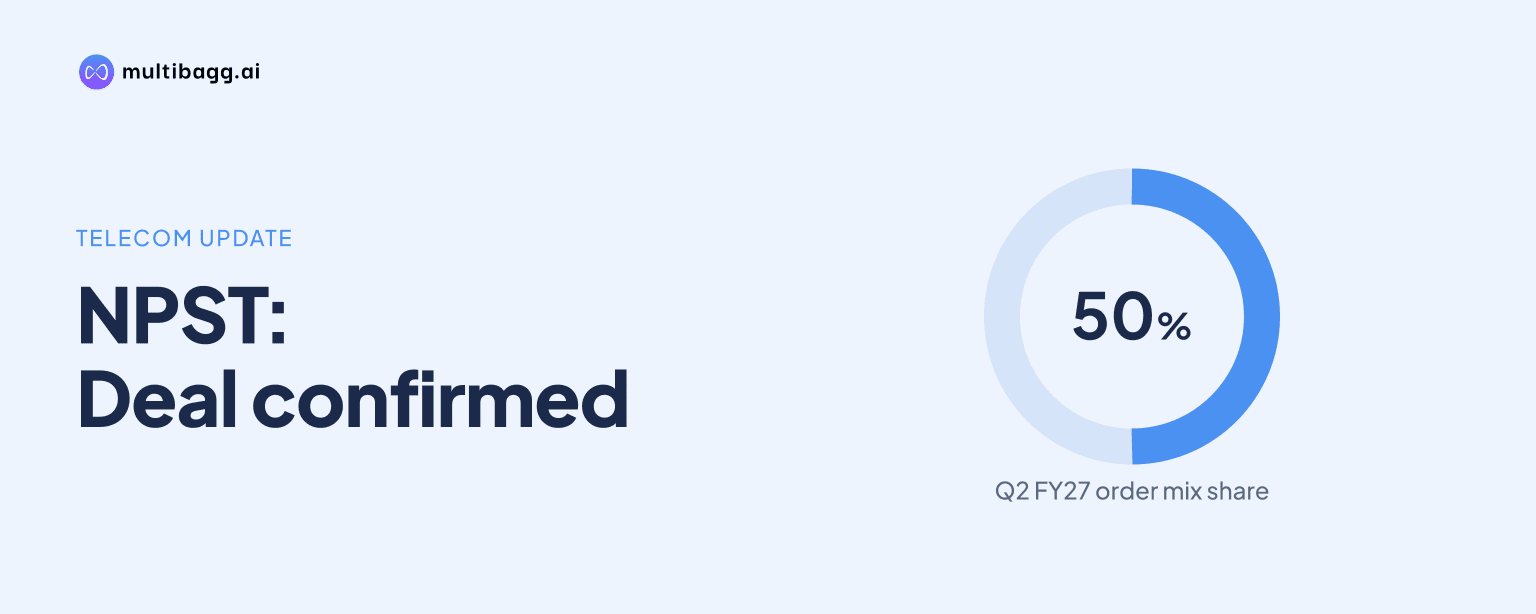
- NPST reported 10+ new orders, and 50% of new orders came from bundles, repeat customers or renewals.
powered by IRIS
In Q2 FY27, Network People Services Technologies Ltd said it converted a SuperApp letter of intent with one of the largest telecom operators into a confirmed, revenue-contributing deal with licence and Software-as-a-Service revenue. NPST also reported 3+ international deals across product lines and said a second, larger opportunity with the operator was advancing.
Know Network People Services Technologies inside out
Results, valuation, peers and who's buying, in one view.
What exactly did NPST confirm in Q2 FY27?
NPST confirmed that the SuperApp letter of intent, or LOI, with one of the largest telecom operators had become a revenue-contributing deal in Q2 FY27. The company classified the engagement under its global Technology Service Provider, or TSP, vertical, and described its revenue model as licence plus Software-as-a-Service, or SaaS.
The Q2 FY27 update does not disclose the contract value, operator name, start date or expected annual revenue from the deal. It nevertheless moves the opportunity beyond the LOI stage in NPST's reporting: the company labelled global TSP as revenue contributing and described the international telecom SuperApp as a confirmed deal.
NPST's Omnichannel SuperApp is part of its customer-experience product portfolio, which includes 400+ banking services. The product sits within the TSP category alongside banking and payments products such as UPI Switch, IMPS Switch and Banking Connect, giving the international contract a disclosed product and revenue classification rather than presenting it only as a market-entry initiative.
How did NPST's international status change from Q1 to Q2 FY27?
The disclosed SuperApp contract milestone moved from a purchase order in Q1 FY27 to a confirmed deal in Q2 FY27, although NPST had already described its international subsidiary as revenue-contributing in its Q1 view. Its Q2 materials say the LOI converted into a confirmed deal, while a separate global-TSP label states revenue contribution since Q1 FY27.
The change matters because NPST's Q2 FY27 materials separate completed commercial progress from pipeline activity. Global TSP was listed as revenue-contributing, while global Payments Platform-as-a-Service, or PPaaS, was identified as purchase-order or pipeline activity expected in FY27, and global RegTech was described as a funnel expected across FY27-FY28.
NPST also reported 3+ international deals across product lines in its Q2 FY27 business update. That count provides wider international context, but it does not establish that all 3+ deals have the same contractual status, revenue model or customer type as the telecom SuperApp deal.
What additional business is NPST pursuing with the telecom operator?
NPST said a second, larger opportunity with the same telecom operator was advancing in Q2 FY27. The company did not specify the product, commercial value, geography or timing of a possible conversion, so it remains an opportunity rather than a reported order or revenue-contributing contract.
Within the global PPaaS vertical, NPST described merchant acquiring, quick-response, or QR, and consumer-app opportunities with the same operator as progressing through purchase-order or pipeline stages. The company marked this PPaaS work as expected in FY27, distinguishing it from the SuperApp's disclosed revenue-contributing TSP status.
NPST also said it was in talks in multiple regions and was pursuing new account acquisition and turnkey-project opportunities. These statements point to a wider international sales effort, but NPST has not reported a country-by-country revenue breakdown, an international order-book value or a conversion schedule for the additional telecom opportunity.
Got a follow-up? Ask IRIS
How does the telecom contract fit NPST's revenue mix?
NPST said its Q2 FY27 revenue mix had widened across implementation, licence, hardware and recurring SaaS. The telecom SuperApp deal is assigned to the licence-and-SaaS category, whereas its Bank-in-a-Box programme is expected to generate implementation and recurring platform fees, and its HSM bulk order is associated with near-term hardware and implementation revenue.
The company reported that 50% of new orders in Q2 FY27 came from bundles, repeat customers or renewals. This measure covers the broader new-order mix rather than the telecom agreement alone, but it shows that NPST presented bundled and repeat-customer business as part of the period's commercial execution.
NPST's domestic TSP activity provides a contrast with the international contract. In India, it reported an LOI for a Bank-in-a-Box programme covering 300+ banks and 7 product deployments, while internationally the telecom SuperApp was specifically identified as a confirmed deal with revenue contribution.
What does the Q2 FY27 update show beyond the SuperApp deal?
NPST reported 10+ new orders in Q2 FY27 across international business, Bank-in-a-Box, payment security devices, RegTech and central bank digital currency, or CBDC. The company described the period as moving from pipeline to commercial execution, while stating that the next step was turning new orders into revenue.
In RegTech, NPST reported 5 proof-of-concepts, or POCs, in progress and said its Risk Intelligence and Decisioning Platform, or RIDP, was under evaluation at 5 banks. It also reported data-protection requests for proposals, or RFPs, with banks and insurers, which remained conversion pipeline rather than revenue-contributing orders in the Q2 FY27 disclosure.
NPST separately disclosed a closed CBDC order from a private-sector bank and a bulk HSM, or hardware security module, order from the national payments institution. These orders broaden the product set outside the telecom contract, but the presentation does not give contract amounts or quantify revenue expected from the orders.
What milestones should readers watch after Q2 FY27?
The immediate disclosed milestone is conversion of the second telecom-operator opportunity and other regional discussions into contracts or revenue. NPST says the PPaaS opportunity with the same operator is expected in FY27, while the global RegTech funnel is expected across FY27-FY28.
A separate planned milestone is the commercial launch of Compliance-in-a-Box in 2027, with an initial ambition to reach 100+ banks by March 2028. The platform combines five modules, including RIDP, enterprise fraud risk management, DPDP compliance, HSM and early-warning signals, and is intended to generate implementation, licence and recurring platform fees.
Conclusion
NPST's Q2 FY27 disclosure records a specific international commercial advance: a telecom SuperApp LOI became a confirmed, revenue-contributing TSP deal rather than remaining an initial market-entry opportunity. The company places the agreement in a licence-and-SaaS revenue stream within a wider mix of implementation, hardware and recurring-platform activity, while reporting 10+ new orders and 3+ international deals across product lines.
The next evidence point is whether the second, larger telecom opportunity and the FY27 PPaaS pipeline become orders and then reported revenue. Readers can also watch NPST's planned 2027 Compliance-in-a-Box launch and its stated ambition of 100+ bank customers by March 2028, noting that Q2 FY27 disclosed no contract values for the telecom deal or related pipeline.