








National Stock Exchange of India Wins RBI Nod for Bond Futures
MAX Plan at ₹4,999/yr

Find your next multibaggerBe a Pro Investor
Research stocks and track your picks on the go. Download the app.
Key highlights
- NSE received RBI approval to introduce futures contracts on corporate bond indices in November 2026.
- India’s outstanding corporate debt was ₹59.1 lakh crore at the end of March 2026.
- Foreign investment of ₹1.3 lakh crore in corporate bonds in FY26 used 15% of the permissible limit.
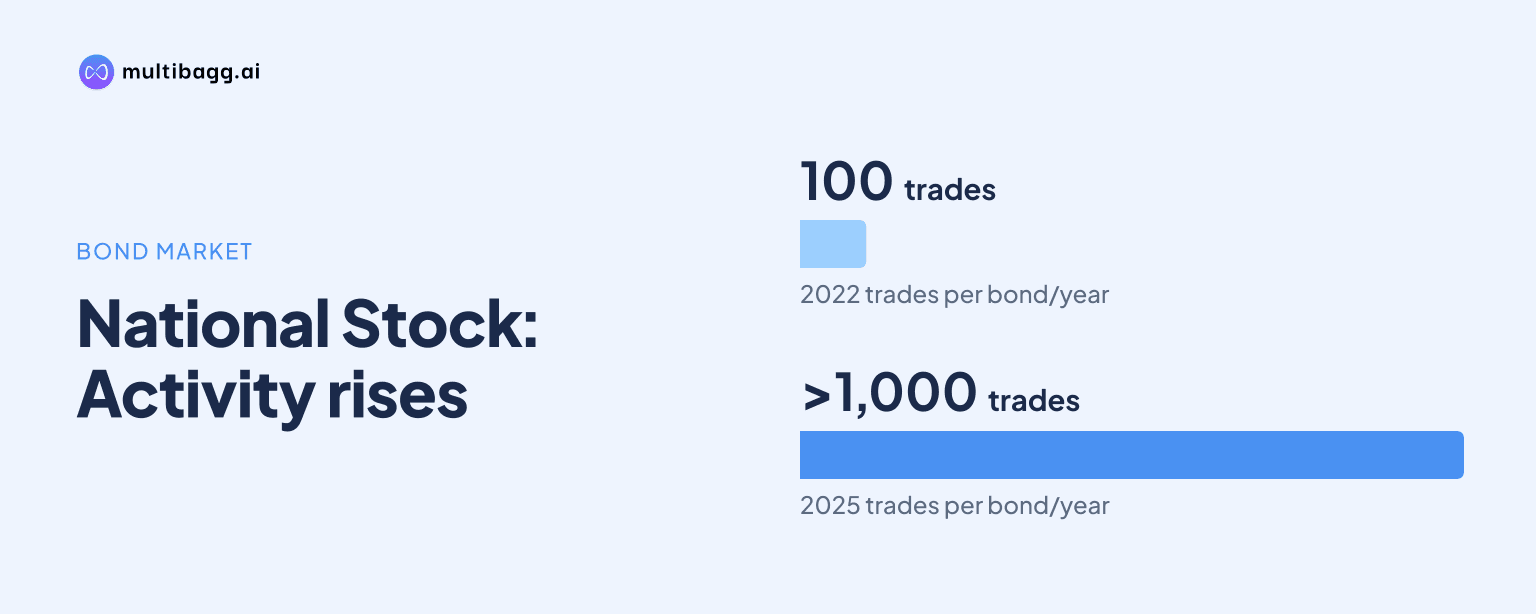
- NSE bond-platform activity rose from roughly 100 trades per bond per year in 2022 to more than 1,000 in 2025.
powered by IRIS
In November 2026, National Stock Exchange of India, or NSE, received RBI approval to introduce corporate bond index futures, adding a potential hedging tool for a corporate debt market with ₹59.1 lakh crore outstanding at the end of March 2026. The approval follows an earlier SEBI no-objection certificate.
What has NSE received approval to introduce?
NSE has received RBI approval to introduce futures contracts linked to corporate bond indices. These would be exchange-traded derivatives tied to movements in corporate bond valuations, rather than individual bonds, and would operate under the prescribed regulatory framework after the earlier SEBI clearance.
The proposed contracts expand NSE's fixed-income derivatives offering beyond its conventional equity derivatives business. The exchange has said the instruments are designed to give market participants a transparent and standardised way to manage exposure to corporate bond price movements.
A futures contract can be used by an investor seeking to offset changes in the value of a bond portfolio. It can also be used to take a directional view on the corporate debt market. The available context does not disclose a launch date, contract specifications, eligible indices, lot sizes or margin requirements.
How could corporate bond index futures manage risk?
Corporate bond index futures could help investors manage risks arising from interest-rate moves and changes in credit spreads. Corporate bond valuations can shift when broader borrowing costs move or when the spread demanded by investors over safer instruments changes, and an index-linked derivative is intended to provide a tradable tool for addressing that exposure.
For portfolio holders, the product could make hedging more accessible through an exchange-traded format. It could also support portfolio management by allowing investors to adjust broad corporate debt exposure without necessarily trading each underlying bond in a portfolio.
NSE expects the contracts to improve transparency, participation and efficiency in the corporate bond market. The products are also expected to complement the developing ecosystem of fixed-income exchange-traded funds and other passive debt investment products. Their eventual usefulness, however, will depend on market participation and liquidity after launch.
How large is India’s corporate debt market?
India’s outstanding corporate debt stood at ₹59.1 lakh crore at the end of March 2026, according to the RBI’s June 2026 Financial Stability Report. That size highlights the potential addressable market for a broad corporate bond hedging product, while also underlining the importance of deeper trading and risk-management infrastructure.
Foreign portfolio investor participation remains a gap despite a recovery in flows. NSE Managing Director and Chief Executive Officer Ashish Kumar Chauhan said ₹1.3 lakh crore of foreign investment in corporate bonds in FY26 represented only 15% utilisation of the permitted limit. He identified operational complexity, tax treatment and hedging availability as structural constraints.
Got a follow-up? Ask IRIS
What other policy changes could deepen bond-market liquidity?
Regulators and market participants are considering measures that could address secondary-market liquidity alongside the proposed futures contracts. SEBI is considering requests from online bond platform providers to support direct secondary-market trading, while reports have also pointed to a possible corporate bond market-making framework.
Dedicated market makers would continuously quote buy and sell prices in corporate bonds, with the aim of narrowing spreads. Such a framework would address a different part of market functioning from index futures: market makers support trading in the underlying bonds, while futures can give participants a way to hedge broader market exposure.
NSE has said its bond-platform activity rose from roughly 100 trades per bond per year in 2022 to more than 1,000 in 2025 after SEBI introduced the online bond platform provider framework. Chauhan has also argued that the debt market will need to double in size to support the country’s long-term financing needs under the Viksit Bharat 2047 ambition.
What should investors watch before NSE launches the contracts?
Investors should watch for NSE's product specifications and the eventual launch timetable before assessing how the contracts may be used. Key disclosures would include the underlying corporate bond index, contract maturity, settlement process, position limits, margins and the market-participant categories that can trade the product.
Liquidity will be a central practical consideration. A futures contract may provide a standardised hedge, but its effectiveness depends on trading depth, pricing quality and how closely its index tracks the bond holdings an investor wants to manage. Broader reforms around market making, direct secondary trading and institutional participation could influence that outcome.
Market participants are also awaiting the monetary policy decision scheduled for December 4. Interest-rate expectations are relevant because they are one of the factors that can affect corporate bond valuations and the demand for tools that manage such exposure.
Conclusion
The RBI approval gives NSE a regulatory path to add corporate bond index futures to India’s fixed-income market. Alongside the earlier SEBI no-objection certificate, the move may broaden the available tools for hedging interest-rate and credit-spread risks in a corporate debt market valued at ₹59.1 lakh crore at end-March 2026.
The next milestones are NSE's contract details and launch plan, as well as progress on proposed liquidity measures such as corporate bond market makers and direct secondary-market trading through online bond platforms. The December 4 monetary policy decision is another near-term event for investors tracking interest-rate conditions in the debt market.

