










Nucleus Software says AI talent costs precede efficiency gains
Key highlights
- Nucleus Software said AI talent costs are rising as competition for those skills increases.
- An analyst cited a 15% year-on-year and 8% sequential increase in employee cost in Q2 FY27.
- Nucleus Software added five customer logos in the first six months of FY27, including two in Q2.
- Nucleus Software said project implementation ranges from three to 18 months and can extend to two years.
powered by IRIS
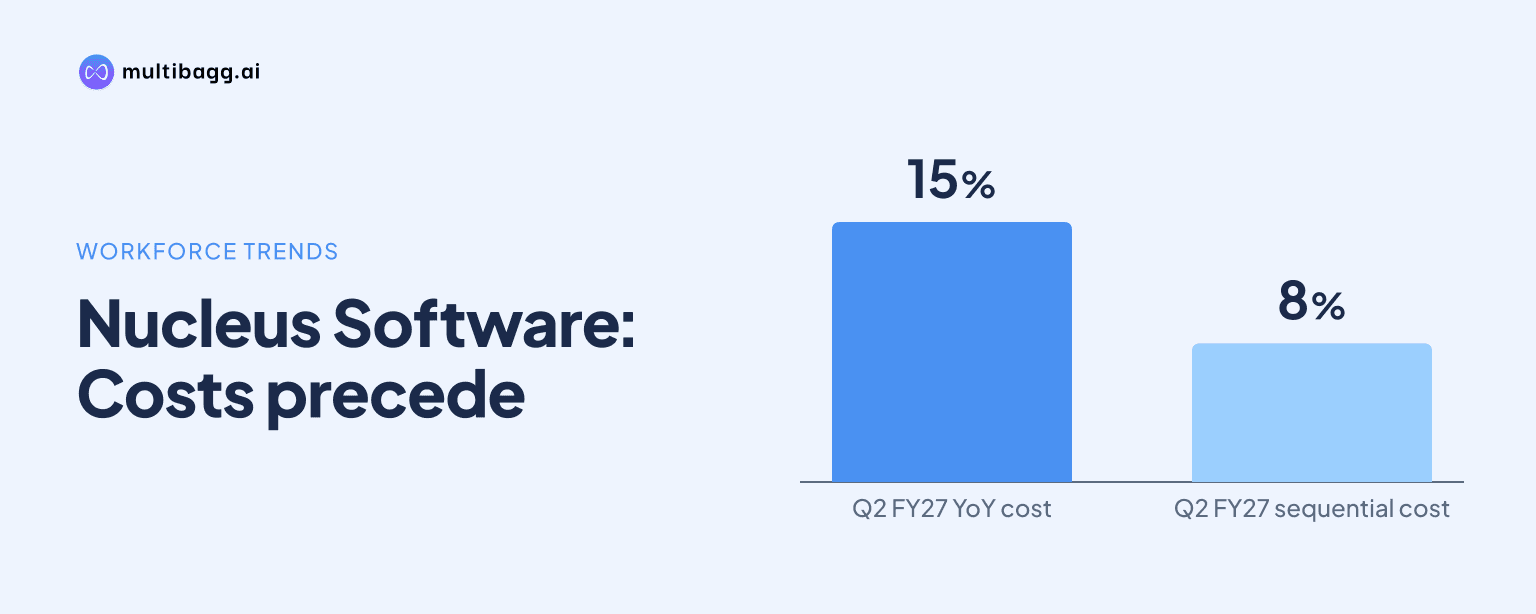
Nucleus Software Exports Ltd. said in Q2 FY27 that its AI programme is lifting personnel expense through costlier AI talent, while management said the first benefits should come from higher-quality releases, greater delivery agility and wider operational efficiency; an analyst cited employee-cost increases of 15% year on year and 8% sequentially.
Know Nucleus Software Exports inside out
Results, valuation, peers and who's buying, in one view.
How is Nucleus Software using AI?
Nucleus Software is using AI in its product-development process and as an embedded extension to its software for customers, rather than as a standalone revenue line. Abhishek Pallav said the company’s internal strategy includes transforming its software development lifecycle, or SDLC, streamlining and maturing those processes, and making work materials available through a structured platform.
Management said the immediate product objective is high-quality releases with agility. Pallav also identified operational efficiency beyond the product organisation as the second intended outcome. The call did not disclose an AI-specific product price, revenue target or order category, and management instead described AI as an embedded software capability that can help customers serve their own customers better.
Nucleus Software said it is continuing to enrich products, invest in AI and upgrade employees to become AI-native. Ashok Kumar Bhura linked those investments to the order book, while saying financial effects would emerge as projects are implemented. The company said implementation cycles range from three to 18 months, and can extend to two years in some cases, creating a timing gap between investment, delivery and reported revenue.
Why are Nucleus Software’s employee costs increasing?
Nucleus Software said employee costs are increasing because it is investing in AI-skilled workers, while labour-code changes and new employee policies have also added costs. During the Q2 FY27 call, investor Sanjay K said employee cost had risen about 15% from Q2 FY26 and about 8% from Q1 FY27. Bhura said competition for AI talent had intensified, resulting in costs above prevailing rates for other resources.
The percentages were cited by the analyst, while management explained the cost drivers and did not provide a separate employee-cost amount. Bhura also cited labour-code effects and employee policies launched during the year. He said annual increments had already occurred, but management did not quantify the contributions from increments, labour-code changes, AI recruitment or employee policies.
Management distinguished Nucleus Software from companies that sell AI as a separate revenue stream. Bhura said Nucleus Software embeds AI in its existing software and uses it internally, rather than directly monetising AI as an independent offering. As a result, management did not identify AI-related revenue that could be matched directly against its current AI talent expense.
Got a follow-up? Ask IRIS
When could Nucleus Software’s AI spending affect margins?
Nucleus Software said AI-related margin effects should emerge after its technology use and related processes stabilise, without providing a target date, margin range or cost-saving estimate. Bhura said the company expects margin reflection in coming quarters once its internal AI strategy and customer-product enrichment have stabilised. He did not say that margins would improve in the second half of FY27.
Management described two possible mechanisms: higher-quality, more agile releases in product development and improved operating efficiency across the organisation. In response to a question on whether AI would first reduce delivery costs or improve order-win rates, Pallav emphasised release quality, agility, process maturation and efficiency. He did not rank revenue gains against cost savings or quantify either potential benefit.
The order book’s conversion schedule is another factor in the margin outlook. Bhura said projects are running in India, Southeast Asia and the Middle East, with products at different stages of revenue conversion. He said the quarter under discussion was among the highest-revenue quarters of the previous six, following revenue of Rs 228 crore seven quarters earlier, but declined to provide forward revenue guidance.
What business indicators accompany Nucleus Software’s AI plan?
Nucleus Software added five new customer logos in the first six months of FY27, comprising three in Q1 and two in Q2. The additions show commercial activity alongside AI investment, but management did not say how many of these customers were won because of AI capabilities. Bhura’s broader statement was that investments in product enrichment, AI and AI-trained talent were reflected in the order book.
An analyst estimated that orders won over the preceding three quarters were worth Rs 1,200 crore to Rs 1,300 crore. Apurva Chamaria said their geographic composition was broadly in line with the current revenue mix, while management expects gradual change as it invests more in overseas markets. The call did not disclose country-level order values, AI-related order values or a timetable for a shift in geographic mix.
Pricing depends on competition, geography, customer needs and strategic decisions to enter particular markets, according to Bhura. He said blended pricing should remain range-bound and that management saw no unusual competitive stress. Those delivery economics matter because projects can take from three months to two years to implement, delaying the point at which order wins, staffing costs and process efficiency appear in reported margins.
Conclusion
Nucleus Software’s Q2 FY27 comments position AI as a product and operating-model investment rather than a separately monetised business. Its immediate cost effect is higher personnel expense, partly from scarce AI talent, alongside labour-code and employee-policy costs. Management’s intended benefits are better release quality, greater agility and broader efficiency, but it did not quantify savings or identify an AI revenue stream.
The next indicators are order-book conversion across implementation cycles of three to 18 months, progress in the FinnOne Neo transformation that management said remains a focus for coming quarters and the next financial year, and whether AI-process stabilisation begins to affect margins. Management also said overseas investment should gradually change the geographic order mix, without setting a date or target proportion.