










Nucleus Software Q2 EBITDA doubles but remains below year ago
Key highlights
- Nucleus Software reported Q2 FY27 EBITDA of Rs 15.4 crore, up from Rs 7.6 crore in Q1 FY27.
- Q2 FY27 EBITDA margin rose to 6.8% from 3.6% sequentially but was below 10.8% a year earlier.
- Nucleus Software’s order book increased to Rs 1,317 crore on September 30, 2026 from Rs 1,244 crore on June 30, 2026.
- Receivables increased to Rs 220.4 crore and DSO rose to 80 days at September 30, 2026.
powered by IRIS
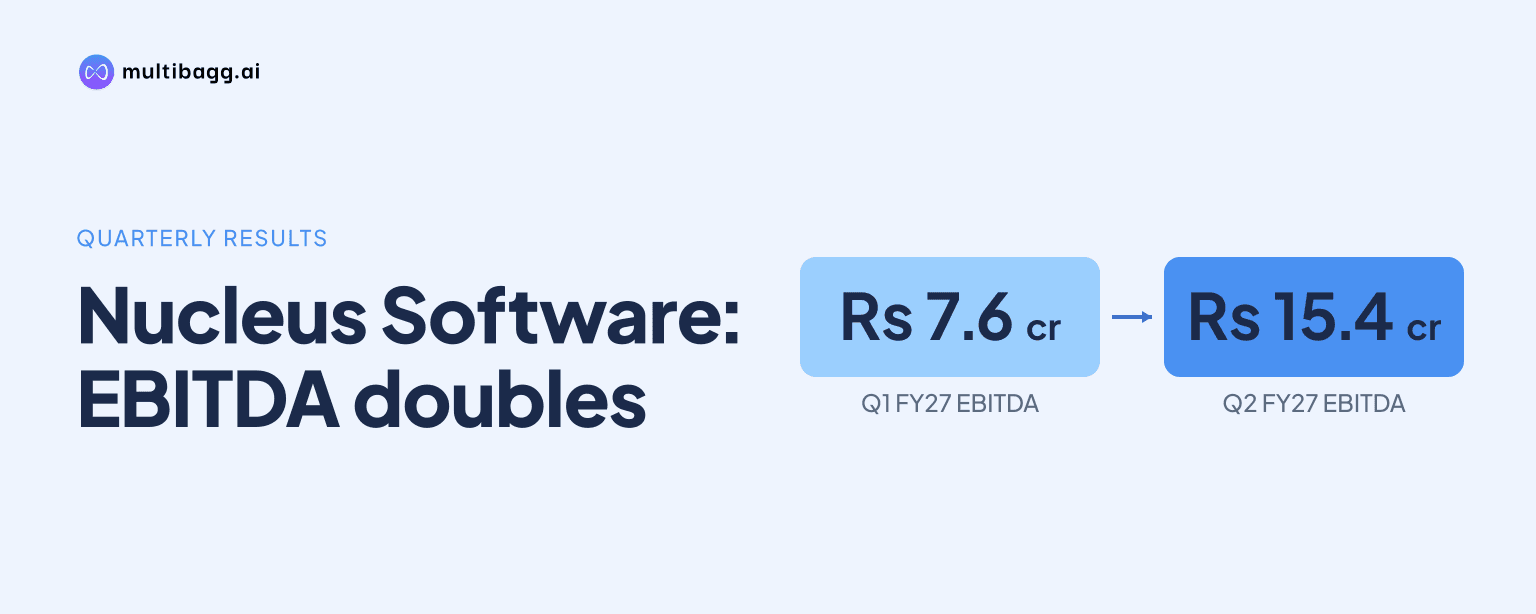
Nucleus Software Exports Limited reported Q2 FY27 EBITDA of Rs 15.4 crore, more than double the Rs 7.6 crore recorded in the preceding quarter but 33% below Rs 23.1 crore a year earlier. Revenue rose 8.2% sequentially to Rs 227.7 crore, while sales, marketing and delivery-related spending continued to affect year-on-year profitability.
Know Nucleus Software Exports inside out
Results, valuation, peers and who's buying, in one view.
Why did Nucleus Software’s Q2 EBITDA recover sequentially?
Nucleus Software’s Q2 FY27 EBITDA recovered sequentially because revenue grew faster than delivery and product-development costs. Consolidated revenue reached Rs 227.7 crore, up 8.2% quarter on quarter and 6.7% year on year, while cost of delivery including product development rose 4.7% sequentially to Rs 167.9 crore. EBITDA consequently increased to Rs 15.4 crore from Rs 7.6 crore in Q1 FY27.
The improvement was also visible in the delivery-cost ratio. Delivery and product-development cost represented 73.8% of Q2 revenue, down from 76.2% in the previous quarter, a decline of 2.4 percentage points. EBITDA margin rose to 6.8% from 3.6% in Q1 FY27, although it remained below the 10.8% recorded in Q2 FY26.
Nucleus Software does not provide specific revenue or earnings guidance, and management said the order book includes long implementation projects that take time to convert into revenue. Management said project cycles range from three to 18 months and can, in some cases, extend to two years because of data migration, correction and customer go-live requirements.
Why was Nucleus Software’s EBITDA lower than a year earlier?
Nucleus Software’s Q2 FY27 EBITDA was lower than a year earlier as higher sales and marketing spending offset revenue growth. EBITDA of Rs 15.4 crore was Rs 7.7 crore below the Rs 23.1 crore reported in Q2 FY26, while the margin fell by 4 percentage points to 6.8% from 10.8%. Revenue increased 6.7% year on year, but profitability did not rise at the same pace.
Marketing and sales expense was 11% of Q2 FY27 revenue, compared with 7.3% a year earlier and 10% in Q1 FY27. Delivery and product-development cost rose 6.5% year on year to Rs 167.9 crore, broadly in line with the 6.7% revenue increase. The delivery-cost ratio was therefore close to the 73.9% reported in Q2 FY26, while the higher marketing and sales ratio reduced the margin.
Profit after tax was Rs 21.3 crore in Q2 FY27, down 11% sequentially and 19.2% year on year, despite the EBITDA recovery from Q1 FY27. Other income was Rs 16 crore, down 10% quarter on quarter and 0.8% year on year. Management attributed lower investment income to lower mark-to-market gains on net mutual funds after interest rates increased during Q2.
What do Nucleus Software’s half-year results show?
Nucleus Software’s first-half FY27 results show that the Q2 improvement did not offset the weaker first quarter. Revenue for the half year ended September 30, 2026 was Rs 438.1 crore, up 1.6% year on year, while EBITDA was Rs 23 crore versus Rs 56.8 crore in the prior half year. Half-year EBITDA margin was 5.3%, compared with 13.2% in the prior half year.
Delivery and product-development cost for the half year was Rs 328.4 crore, up 5.8% from the prior half year. That growth exceeded the reported 1.6% increase in half-year revenue, contributing to the lower EBITDA margin. The quarter’s Rs 15.4 crore EBITDA also accounted for more than half of the Rs 23 crore reported for the six-month period.
Product revenue remained the main component of the business. It represented 84.4% of Q2 FY27 revenue, compared with 83.9% in Q1 FY27, while the half-year proportion was 84.2%, compared with 84.9% in the prior half year. Nucleus Software did not disclose absolute product-revenue figures, but the percentages show a sequential increase in product mix and a lower half-year share than a year earlier.
Got a follow-up? Ask IRIS
How are Nucleus Software’s orders, customers and cash moving?
Nucleus Software’s order book increased to Rs 1,317 crore on September 30, 2026 from Rs 1,244 crore on June 30, 2026. Products made up 90% of the September order book, compared with 88.1% at June-end, while projects accounted for 10%, down from 11.9%. Management said the order book reflected customer preference for its products, while implementation timing varies by project.
Management said its order-book methodology had not changed. In response to an analyst’s question, it said some customer contracts include five years of annual maintenance contract value, while others include one year. It did not provide a split between new customer licences, implementations and annual maintenance contract renewals.
Top-five-client concentration declined sequentially, with those customers contributing 27% of Q2 revenue versus 28.1% in Q1 FY27. India supplied 57.3% of quarterly revenue, followed by the Middle East at 12.4%, Southeast Asia at 11% and Europe at 5.7%. India’s share was 56.1% in the preceding quarter, while the reported Middle East and Europe shares also increased.
Cash and cash equivalents fell to Rs 942.1 crore on September 30, 2026 from Rs 977.9 crore on June 30, 2026. Receivables rose to Rs 220.4 crore from Rs 174.7 crore, and days sales outstanding, or DSO, increased to 80 days from 63 days. Headcount rose by seven employees to 2,066 over the same period.
What investments is Nucleus Software making for growth?
Nucleus Software is investing in artificial intelligence, product enrichment, talent and global market positioning, according to management. During Q2 FY27, it continued workforce upskilling intended to make artificial intelligence a capability across functions and launched FinnOne Neo 9.0 and FinnAxia 9.0 in Vietnam with strategic partner FPT at its first Nucleus Synapse customer event in that market.
Management said it continues to invest in artificial intelligence-trained people and resources alongside product development. When asked when profitability could return to previous levels, management did not provide a target or timetable. It said the impact of these investments should be reflected as the order book is implemented in respective quarters.
Nucleus Software also appointed Sudhanshu Tripathi as chief marketing officer during the quarter, with a stated focus on global market positioning and growth across key geographies. The marketing and sales expense ratio rose to 11% in Q2 FY27 from 7.3% a year earlier, providing the reported financial context for this market-development activity.
Conclusion
Nucleus Software’s Q2 FY27 showed a sequential margin recovery, with EBITDA rising from Rs 7.6 crore in Q1 to Rs 15.4 crore as revenue reached Rs 227.7 crore and delivery cost consumed a smaller share of sales. The year-on-year comparison remained lower, however, with EBITDA 33% below Q2 FY26 and margin at 6.8% versus 10.8%, alongside a higher marketing and sales expense ratio.
The next reported quarters should show whether the Rs 1,317 crore order book begins converting into revenue and margin, particularly because management says implementations can last from three to 18 months or up to two years. Readers can also track receivables and DSO after they reached Rs 220.4 crore and 80 days on September 30, 2026, and assess whether artificial intelligence and market-expansion investments are reflected in later results.