










Nucleus Software says implementations can take up to two years
Key highlights
- Nucleus Software's order book was Rs 1,317 crore on September 30, 2026, up from Rs 1,244 crore on June 30, 2026.
- Nucleus Software said implementations can range from three months to 18 months and may extend to two years.
- Nucleus Software reported quarterly revenue of Rs 227.7 crore, up 8.2% quarter on quarter and 6.7% year on year.
- Nucleus Software's September 2026 quarterly EBITDA was Rs 15.4 crore, compared with Rs 23.1 crore a year earlier.
powered by IRIS
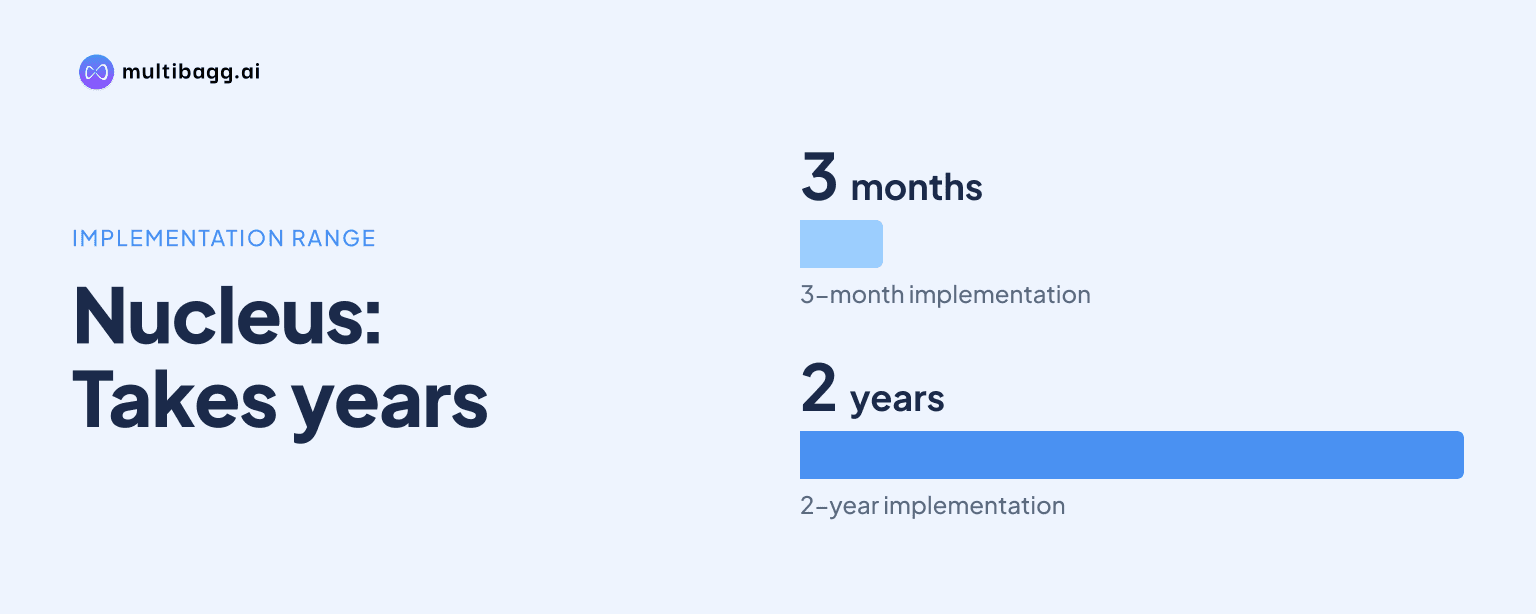
For the quarter ended September 30, 2026, Nucleus Software Exports Ltd. said its Rs 1,317 crore order book will convert unevenly because implementations span three months to 18 months and can in some cases extend to two years. Management cited high-volume data migration, data correction and the work required to make enterprise systems operational for customers.
Know Nucleus Software Exports inside out
Results, valuation, peers and who's buying, in one view.
Why can Nucleus Software's order book take two years to convert?
Nucleus Software said implementation timing depends on the individual project, with cycles ranging from three months to 18 months and, in some cases, extending to two years. Chief Financial Officer Ashok Kumar Bhura said these are complex projects involving high-volume data migration, correction and making the system operational, rather than simple product deliveries that can be recognised in a single period.
The company did not provide a split of its order book between new-customer licence and implementation work, or annual maintenance contract, or AMC, renewals. It also said its contract treatment varies: some customers have five years of AMC included in the order book, while others have one year. Mr Bhura said the company had always maintained this practice, rejecting the suggestion that its order-book methodology had changed.
This means the Rs 1,317 crore balance at September 30, 2026 is not a timetable for quarterly revenue. Projects are running in parallel across India, Southeast Asia and the Middle East, and each product is at a different stage of conversion. Management said revenue should begin to reflect this work in subsequent quarters but did not give a date for crossing a particular quarterly revenue level.
What is in Nucleus Software's Rs 1,317 crore order book?
Nucleus Software's order book was Rs 1,317 crore at September 30, 2026, of which products represented 90% and projects 10%. The balance increased by Rs 73 crore from Rs 1,244 crore at June 30, 2026, while the product share rose by 1.9 percentage points from 88.1% and the project share fell from 11.9%.
The product-heavy composition does not establish a near-term revenue schedule because product contracts can still require enterprise deployment and migration work. Management described the higher order book as evidence of customer preference for its products, but did not disclose the proportion that was already under implementation, back-ended, or ready for near-term recognition.
Management also said the geography of orders won over the preceding three quarters was broadly in line with the existing revenue mix. India supplied 57.3% of quarterly revenue, the Middle East 12.4%, Southeast Asia 11.0% and Europe 5.7% in the quarter ended September 30, 2026. Chief Business Officer Apurva Chamaria said a geographic shift may emerge gradually as Nucleus Software invests more in overseas markets.
Got a follow-up? Ask IRIS
Is Nucleus Software's rising order book lifting revenue yet?
Nucleus Software's quarterly revenue rose to Rs 227.7 crore in the quarter ended September 30, 2026, up 8.2% quarter on quarter and 6.7% year on year, but management did not link a specified portion of that revenue to the latest order-book increase. It described the quarter as one of its highest revenue quarters in the past six quarters and noted that revenue had previously reached Rs 228 crore seven quarters earlier.
For the half year ended September 30, 2026, consolidated revenue was Rs 438.1 crore, a 1.6% increase year on year. In US-dollar terms, quarterly revenue was USD 24 million, up 6.9% quarter on quarter but down 1.9% year on year, while half-year revenue was USD 46.5 million, down 6.9% year on year. These differing rupee and dollar comparisons show that reported rupee growth has not translated into comparable dollar growth.
Profitability remained below the prior-year level as revenue rose. Earnings before interest, tax, depreciation and amortisation, or EBITDA, were Rs 15.4 crore in the September 2026 quarter, compared with Rs 7.6 crore in the preceding quarter and Rs 23.1 crore a year earlier; the EBITDA margin was 6.8%, versus 3.6% quarter on quarter and 10.8% year on year. Profit after tax was Rs 21.3 crore, down 11.0% quarter on quarter and 19.2% year on year.
Can Nucleus Software's AI work shorten implementation timelines?
Nucleus Software said artificial intelligence is being used for analysis, but it has not yet reached the stage where end-to-end agents can execute transformation work without substantial human involvement. Vice President Abhishek Pallav said enterprise platforms require considerable care before deployment, so human-in-the-loop investment remains significant despite the use of AI tools.
The company is investing in AI-trained talent, product enrichment and workforce upskilling. Management said the market for AI talent is heated, contributing to higher employee costs, alongside labour-code changes and a new restricted stock unit policy. Cost of delivery, including product development, was Rs 167.9 crore in the September 2026 quarter, up 4.7% quarter on quarter and 6.5% year on year, although it fell to 73.8% of revenue from 76.2% in the prior quarter.
Management's stated AI strategy has two directions: improving software-development processes and operational efficiency beyond the product organisation. It said the intended operational outcome is high-quality releases with greater agility, rather than presenting AI as a separate revenue stream. Nucleus Software launched FinnOne Neo 9.0 and FinnAxia 9.0 in Vietnam during the quarter, but it did not quantify any AI-driven reduction in deployment duration.
Conclusion
Nucleus Software's larger Rs 1,317 crore order book indicates more contracted business than the Rs 1,244 crore reported three months earlier, but it does not imply an immediate step-up in revenue. Data migration, correction and enterprise deployment can stretch projects from three months to 18 months and occasionally two years, while variable AMC inclusion means the balance is not a uniform measure of near-term sales.
The next issue to watch is whether parallel implementations across India, Southeast Asia and the Middle East convert into revenue in subsequent quarters, as management said they should. Management has also identified customer transformations as a key initiative for the coming quarters and the next financial year, while its AI programme remains dependent on continued human oversight rather than fully automated implementation.