










Om Power says 45% of September receivables is retention money
Key highlights
- Om Power said 45% of its Rs 237.06 crore September 2026 receivables was retention money.
- Trade receivables rose about 7% from Rs 221.42 crore in March 2026 while H1 FY27 revenue grew 46.3% to Rs 249.93 crore.
- H1 FY27 operating cash outflow was Rs 38.20 crore, mainly reflecting a Rs 35.98 crore reduction in trade payables.
- Om Power held Rs 38.34 crore in cash and liquid investments against Rs 24.06 crore of gross borrowings at September 2026.
powered by IRIS
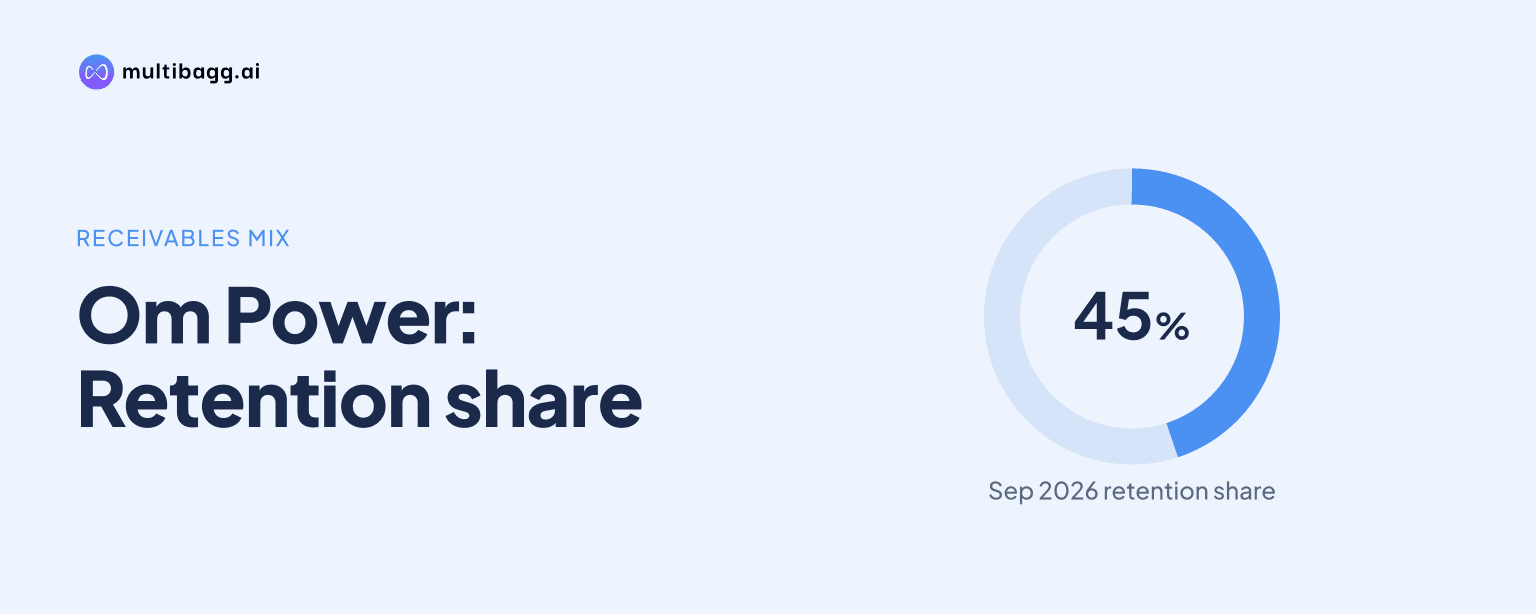
Om Power Transmission Limited said 45% of its Rs 237.06 crore trade receivables at September 30, 2026 was retention money accumulated on projects in their final three to four billing cycles. Management said the balance should normalise as projects close and retention is released, while receivables were up about 7% from March 2026.
Know Om Power Transmission inside out
Results, valuation, peers and who's buying, in one view.
Why did Om Power's receivables rise in H1 FY27?
Om Power's receivables rose because projects were at advanced execution stages, causing retention balances to build before final closure. Trade receivables were Rs 237.06 crore at September 30, 2026, versus Rs 221.42 crore at March 2026, an increase of about 7% during H1 FY27.
The increase occurred while revenue expanded faster than receivables. Revenue from operations grew 46.3% year on year to Rs 249.93 crore in H1 FY27 from Rs 170.88 crore in H1 FY26, and management said this relationship indicated better control over cash flows on a larger revenue base.
Om Power's collection cycle follows project execution, which generally takes 12 to 24 months for its public-sector undertaking customers. Management said receivable days had fallen from about 176 days in March 2023 to 140 days in March 2024, 120 days in March 2025 and 118 days in March 2026; it again cited 118 days for the current pattern.
How much of Om Power's receivables is retention money?
Om Power said retention money represented 45% of total receivables at September 2026. Management linked that share to a large number of project sites in their last three to four billing patterns, when retention accumulates before it is released at project closure.
Retention is released after completion under the company's project arrangements, management said, so it described the September increase as temporary. The explanation also means the Rs 237.06 crore balance contains amounts tied to late-stage milestone completion rather than only normal billing awaiting payment.
The issue matters because Om Power had a Rs 565.99 crore order book at September 30, 2026, with typical execution lasting 12 to 24 months. Orders worth Rs 273.21 crore won during October lifted the indicative order book to about Rs 839 crore before adjusting for October execution, extending the base of projects that will require working-capital management.
What caused Om Power's negative operating cash flow?
Om Power's H1 FY27 operating cash outflow was mainly caused by a reduction in trade payables rather than the rise in receivables alone. Net cash used in operating activities was Rs 38.20 crore, while trade payables fell Rs 35.44 crore to Rs 88.11 crore at September 2026 from Rs 123.55 crore at March 2026.
Management said the payable reduction coincided with the use of initial public offering, or IPO, proceeds for working capital, cash discounts and procurement where appropriate. It separately described the Rs 35.98 crore reduction in trade payables as the main factor behind the H1 operating cash outflow, with the difference from the closing-balance comparison reflecting the cash-flow presentation.
Of Rs 119.32 crore in net IPO proceeds, Om Power had used Rs 108.56 crore by September 30, 2026. The deployment included Rs 55 crore for long-term working capital, Rs 25 crore for prepayment of borrowings, Rs 28.11 crore for general corporate purposes and Rs 46 lakh for capital expenditure.
The remaining Rs 10.75 crore earmarked for machinery and equipment was to be deployed in line with project requirements. Management said operating cash flow would turn positive as collections arrive within the 12-to-24-month project cycle, but it did not provide a quarter-specific target for that change.
Got a follow-up? Ask IRIS
Is Om Power net cash positive after the IPO?
Om Power said it was in a net cash position at September 30, 2026, with Rs 38.34 crore of cash, bank balances and liquid investments against Rs 24.06 crore of gross borrowings. Gross debt had declined from Rs 47.67 crore at March 2026 after the company used Rs 25 crore of IPO proceeds for borrowing prepayment.
Net worth increased to Rs 283.43 crore at September 2026 from Rs 136.94 crore at March 2026, reflecting IPO proceeds and H1 profit. Debt to equity declined to 0.08 times from 0.35 times, alongside H1 FY27 profit after tax of Rs 24.37 crore, up 65.3% year on year.
Finance costs can still move with contract activity even as borrowings decline. Management said these costs include bank-guarantee commissions, because Om Power provides performance bank guarantees equivalent to 10% of contract value when it wins customer tenders.
How do project mix and execution affect Om Power's cash conversion?
Om Power said transmission lines generated 79% of H1 FY27 revenue and substations generated 17%, making these the principal contributors to the period's business mix. Management said these verticals have higher contribution margins, helping Q2 FY27 earnings before interest, tax, depreciation and amortisation margin reach 15.25%, compared with 11.29% in Q2 FY26.
Q2 FY27 revenue rose 56.4% year on year to Rs 128.29 crore, while earnings before interest, tax, depreciation and amortisation increased 111.3% to Rs 19.56 crore. Management attributed part of the margin movement to transmission-line mix and fast-track specialised work at Dholera, while maintaining an annual margin range of about 12% to 13% at that earnings level.
Om Power commissioned a 400 kilovolt gas-insulated switchgear substation at Dholera, while associated 400 kilovolt transmission lines were in final completion stages. These completion milestones align with management's explanation that retention has accumulated at late-stage sites and that its release depends on project closure.
Conclusion
Om Power's Rs 237.06 crore September 2026 receivables balance reflects a reported 45% retention component on projects nearing final billing, alongside a 46.3% increase in H1 revenue. The Rs 38.20 crore operating cash outflow was also shaped by the company's use of IPO-funded working capital to reduce supplier balances, with trade payables declining to Rs 88.11 crore.
The next measure to watch is whether retention is released as projects complete their final three to four billing cycles. Management also plans to deploy the remaining Rs 10.75 crore of capital-expenditure proceeds according to project requirements, while maintaining its objective of 50% year-on-year growth in FY27 and executing projects over 12 to 24 months.