










Pace Digitek targets C&I at 30% of energy revenue next year
Key highlights
- Pace Digitek targets C&I storage at about 30% of energy revenue in the next financial year.
- Pace Digitek developed 261-kilowatt-hour C&I cabinets and expects larger orders at the end of Q3 or in Q4.
- Energy contributed about 80% of Pace Digitek’s Rs 1,364 crore H1 FY27 revenue.
- Pace Digitek produced about 844 MWh of BESS capacity in H1 FY27, about 94% of full-year FY26 output.
powered by IRIS
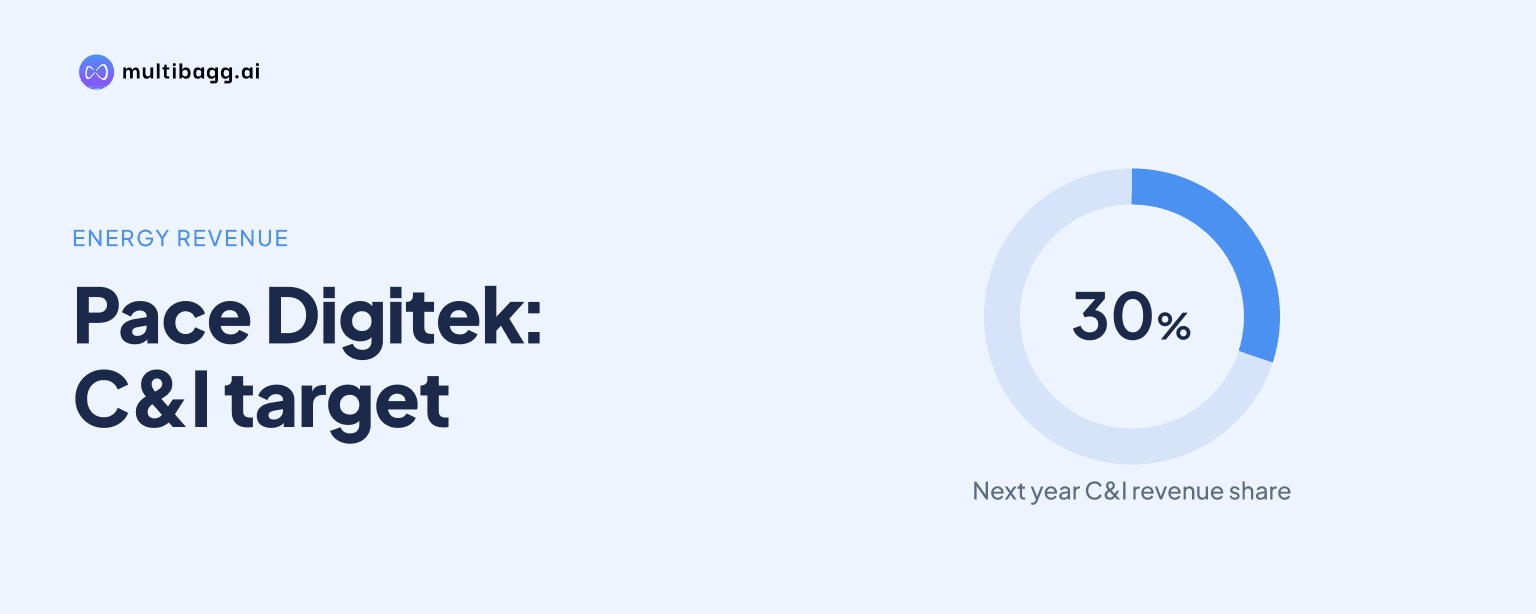
Pace Digitek is targeting commercial-and-industrial, or C&I, storage to contribute 30% of energy revenue in the next financial year, after developing 261-kilowatt-hour cabinets and supplying sample quantities in India and abroad. Management said larger production orders could arrive at the end of Q3 or in Q4.
Know Pace Digitek inside out
Results, valuation, peers and who's buying, in one view.
What is Pace Digitek’s C&I revenue target?
Pace Digitek is targeting C&I products to account for about 30% of energy revenue in the next financial year. Management confirmed in the H1 FY27 call that this target applies to energy revenue rather than the company’s consolidated revenue.
The target would alter the mix within a business where energy already generated about 80% of H1 FY27 revenue of Rs 1,364 crore, with telecom contributing the other 20%. Total H1 revenue rose 51.4% year on year, supported by energy-segment battery energy storage system, or BESS, supplies and engineering, procurement and construction, or EPC, project deployment.
Pace Digitek did not disclose C&I revenue in rupees, a dedicated C&I order book or capacity reserved for these cabinets. Its executable order book was Rs 10,735 crore as of September 30, 2026, including Rs 8,528 crore in energy and Rs 2,208 crore in telecom, without a C&I split.
When could Pace Digitek receive C&I production orders?
Pace Digitek expects bigger C&I production orders at the end of Q3 or in Q4, while current supplies are sample quantities. Management said the 261-kilowatt-hour cabinet had been supplied to customers in India and in certain overseas countries and was ready for production.
This places C&I at an earlier stage than Pace Digitek’s utility-scale BESS work. In H1 FY27, the company cited BESS EPC orders from NLC India and DVC, a BESS build-own-operate-transfer order from BSES Rajdhani Power, and BESS supply orders from NGSL and other customers. The call did not identify any of those orders as C&I business.
The near-term sales outcome depends on customer conversion from samples to commercial orders. Pace Digitek did not disclose the number of customers in the trials, the sample volumes or the expected value of prospective C&I orders, so the 30% revenue share remains a management target rather than an order-backed forecast.
How is Pace Digitek expanding output for C&I and utility BESS?
Pace Digitek expanded BESS capacity from 2.5 gigawatt-hours, or GWh, to 5 GWh in August 2026 and said it was operating at the 5 GWh level. Management also said it planned to complete an additional 5 GWh expansion during the current quarter, taking total capacity to 10 GWh.
The company produced about 844 megawatt-hours, or MWh, of BESS capacity in H1 FY27, equal to about 94% of its production in the full previous financial year. That comparison shows that H1 output nearly matched FY26 production after the expansion, although Pace Digitek did not say how much of the 844 MWh related to C&I cabinets.
In Q2, Pace Digitek sold 91 containers and held another 10 containers in stock, which management characterised as about 100 containers. Commercial production from the expanded capacity began only in September, after the August expansion, and management therefore expected a higher container count in the following quarter, targeting slightly fewer than 200 containers in Q3.
Got a follow-up? Ask IRIS
Why does management expect C&I to affect margins?
Pace Digitek’s management said C&I product margins are much better than those of grid-scale BESS products. It added that a rising C&I contribution could improve blended margins by at least 1% to 2%, but did not disclose a standalone C&I margin or quantify the expected benefit in rupees.
The disclosed segment comparison explains the focus on product mix. Energy EBITDA margins were in the 12% to 13% range, compared with around 20% for telecom, and management said the overall EBITDA margin could be 16% to 17% as energy gains revenue share. H1 FY27 margins benefited from a larger telecom services contribution, including ongoing operations and maintenance work.
Container backward integration is a separate lever in the energy business. Pace Digitek said its container fabrication facility had been commissioned and was being tested, with commercial production planned from November 2026 and full-scale production from January 2027. Management expects in-house fabrication to meet about 50% of container requirements, reduce container cost by about 25%, lower total BESS cost by 4% to 5%, and improve EBITDA by about 1.5% to 2%.
How does the C&I plan fit Pace Digitek’s financial outlook?
Pace Digitek raised FY27 revenue guidance to Rs 3,300 crore to Rs 3,500 crore from Rs 3,200 crore to Rs 3,400 crore, citing 51.4% H1 growth and the Rs 10,735 crore executable order book. For FY28, management retained its earlier revenue expectation of Rs 4,000 crore to Rs 4,200 crore.
Management said FY28 profit-after-tax margin was expected at about 10% to 11%, versus the 11% to 12% range raised by an analyst for H1 FY27. It said higher C&I sales and more backward integration could improve profit numbers and margins, but maintained that its stated guidance reflected the energy business taking a larger role.
Funding needs are increasing alongside BESS and build-to-own-operate projects. Borrowings stood at Rs 1,371 crore on September 30, 2026, up Rs 410 crore from the end of FY26, while build-to-own-operate assets were Rs 1,311 crore. Management attributed the increase to those assets and working capital, not specifically to the C&I programme.
Conclusion
Pace Digitek is seeking to make C&I storage a material component of its energy business, with a target of 30% of energy revenue next financial year. The plan follows the 261-kilowatt-hour cabinet’s sample stage and sits alongside a larger utility-scale BESS operation, where energy supplied about 80% of H1 FY27 revenue.
The next disclosed milestones are potential larger C&I orders at the end of Q3 or in Q4, commercial container-facility production from November 2026, and full-scale production from January 2027. Pace Digitek’s completion of the additional 5 GWh expansion and progress against FY27 revenue guidance of Rs 3,300 crore to Rs 3,500 crore will also indicate how its broader energy ramp is developing.