










Pace Digitek raises FY27 revenue guidance to Rs 3,500 crore
Key highlights
- Pace Digitek raised FY27 revenue guidance to Rs 3,300-3,500 crore from Rs 3,200-3,400 crore.
- Pace Digitek reported first-half FY27 revenue of Rs 1,364 crore, up 51.4% year on year.
- Pace Digitek's executable order book was Rs 10,735 crore at September 30, 2026, including Rs 8,528 crore in energy.
- Pace Digitek expanded BESS capacity to 5 GWh in August 2026 and plans 10 GWh by the next quarter.
powered by IRIS
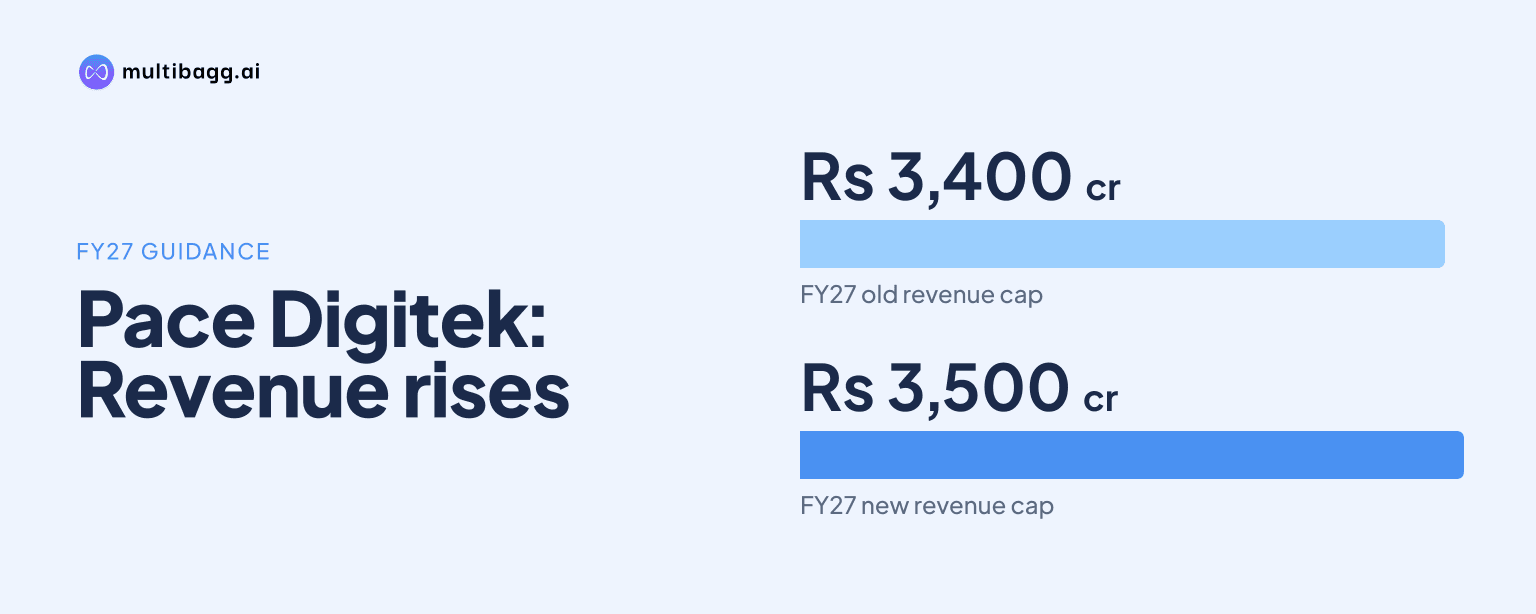
Pace Digitek Limited raised its financial year 2027 (FY27) revenue guidance to Rs 3,300-3,500 crore on November 2, 2026, after first-half revenue rose 51.4% year on year to Rs 1,364 crore and its executable order book reached Rs 10,735 crore at September 30, 2026. The earlier range was Rs 3,200-3,400 crore.
Know Pace Digitek inside out
Results, valuation, peers and who's buying, in one view.
Why did Pace Digitek raise FY27 revenue guidance?
Pace Digitek raised the lower and upper ends of its FY27 revenue range by Rs 100 crore, citing first-half execution and its Rs 10,735 crore executable order book. Management gave the revised Rs 3,300-3,500 crore range during the November 2 call on results for the quarter and half year ended September 30, 2026.
Revenue from operations was Rs 1,364 crore in the first half of FY27, 51.4% above the prior-year period. In the second quarter (Q2) of FY27, revenue was Rs 808 crore, up 51.5% year on year and 45.5% quarter on quarter, meaning the second quarter contributed more revenue than the first quarter.
Management retained its earlier FY28 revenue expectation of Rs 4,000-4,200 crore. That is management guidance rather than a reported result, and depends on delivery of battery energy storage system (BESS) supply, engineering, procurement and construction (EPC), and build-to-own-operate projects.
What drove Pace Digitek's first-half revenue growth?
Pace Digitek said the energy business was the principal driver, contributing about 80% of first-half FY27 revenue, versus 20% from telecom. Energy revenue reflected BESS supplies, project deployment and EPC activity, while telecom revenue was supported mainly by BSNL supplies and operations and maintenance (O&M) work on its 4G network.
The company commissioned about 875 megawatt-hours (MWh) of BESS capacity at project sites during the first half. As of the November 2 call, Pace Digitek had delivered about 1.8 gigawatt-hours (GWh) of BESS to customers and commissioned about 1 GWh at its own project sites across supply, EPC and developer contracts.
Telecom added a longer-duration service component after more than 8,000 BSNL sites entered a five-year O&M phase. Pace Digitek also said it had won additional BSNL and BharatNet optical fibre cable projects in the first half, while prospective awards later in FY27 had not been quantified.
How much order-book support does Pace Digitek have?
Pace Digitek had an executable order book of Rs 10,735 crore at September 30, 2026, comprising Rs 8,528 crore in energy and Rs 2,208 crore in telecom. The energy order book was nearly four times the telecom component, matching energy's approximately 80% revenue contribution in the first half.
First-half order inflows were about Rs 2,437 crore, with Rs 2,173 crore from energy and Rs 265 crore from telecom. Management cited BESS EPC orders from NLC India and DVC, a BESS developer order from BSES Rajdhani Power, and BESS supply orders from NGSL and other customers.
The order book includes different mechanisms, including BESS supply, EPC and build-to-own-operate projects. Those models have different timing for manufacturing, installation, asset creation and revenue recognition, and management did not provide a project-by-project schedule for converting the Rs 10,735 crore backlog into revenue.
Got a follow-up? Ask IRIS
Can Pace Digitek's BESS capacity support its order book?
Pace Digitek increased BESS manufacturing capacity from 2.5 GWh to 5 GWh in August 2026 and produced about 844 MWh in the first half. Management said that output equalled about 94% of BESS capacity produced in the entire previous financial year, and current production was running at the 5 GWh capacity level.
The chief financial officer said the company planned to expand BESS capacity to 10 GWh by the next quarter, with most capital requirements already addressed. Management said capital deployment would be aligned with project execution, commissioning schedules and expected cash flow from the related assets.
Pace Digitek has commissioned an in-house BESS container fabrication facility, with commercial production planned from November 2026 and full-scale production from January 2027. Management expects the facility to supply about 50% of container requirements, reduce container cost by about 25%, lower total BESS cost by 4% to 5%, and improve EBITDA by about 1.5% to 2%.
How are margins, borrowings and collections changing at Pace Digitek?
Pace Digitek reported first-half EBITDA of Rs 245 crore and profit after tax of Rs 160 crore, up 40.5% and 30.4%, respectively, from a year earlier. Employee expense rose to Rs 70 crore from Rs 44 crore as the company added manpower across energy projects and manufacturing operations.
Management said recent EBITDA margins had been about 17% to 19%, aided in the first half by a larger telecom-services contribution. It put energy EBITDA margins at 12% to 13% and telecom margins at about 20%, while expecting the combined margin to be about 16% to 17% as energy becomes a larger share of revenue.
Borrowings increased to Rs 1,371 crore at September 30 from Rs 961 crore at March 31, 2026, while cash and bank balances were Rs 515 crore and net debt was Rs 856 crore. Net debt to equity rose to 0.35 times from 0.09 times, which management attributed to build-to-own-operate funding and working capital; receivables declined to Rs 2,177 crore from Rs 2,442 crore as collections improved.
What execution milestones should Pace Digitek meet next?
Pace Digitek's build-to-own-operate asset was Rs 1,311 crore at September 30, 2026, and management said about 60% of that project asset was commissioned. It expects the project to be completed by December 2026 or January 2027, after which it expects annual revenue of about Rs 197 crore from the asset.
The company has also developed 261 kilowatt-hour commercial and industrial (C&I) cabinets and supplied samples to customers in India and overseas. Management said larger C&I orders could arrive in late Q3 or Q4 FY27 and is targeting C&I to contribute about 30% of energy revenue in the next financial year, subject to orders that had not been received at the call date.
Conclusion
Pace Digitek's revised FY27 outlook is supported by 51.4% first-half revenue growth, an Rs 8,528 crore energy order book and a 5 GWh BESS manufacturing base. The business mix is increasingly led by energy execution, while telecom provides BSNL-linked supply and five-year O&M work across more than 8,000 commissioned sites.
The next disclosed milestones are full-scale container production in January 2027, the planned expansion to 10 GWh by the next quarter, and completion of the build-to-own-operate project by December 2026 or January 2027. Management also expects about Rs 1,100 crore of additional borrowings by March 2027 for three newly commenced build-to-own-operate projects, backed by about Rs 1,600 crore of assets.