










Pace Digitek targets 90-120-day net working-capital cycle
Key highlights
- Pace Digitek targets receivables of about 150 days, compared with approximately 286 debtor days cited by an analyst for March 2026.
- Management expects a 90-120-day net working-capital cycle, with receivables at about 150 days and payables at 60-90 days.
- Pace Digitek said consolidated payables declined from about Rs 1,800 crore in March to about Rs 1,500 crore in September.
- Energy-project retention is generally 90-180 days, versus 5%-10% retention clauses in telecom projects.
powered by IRIS
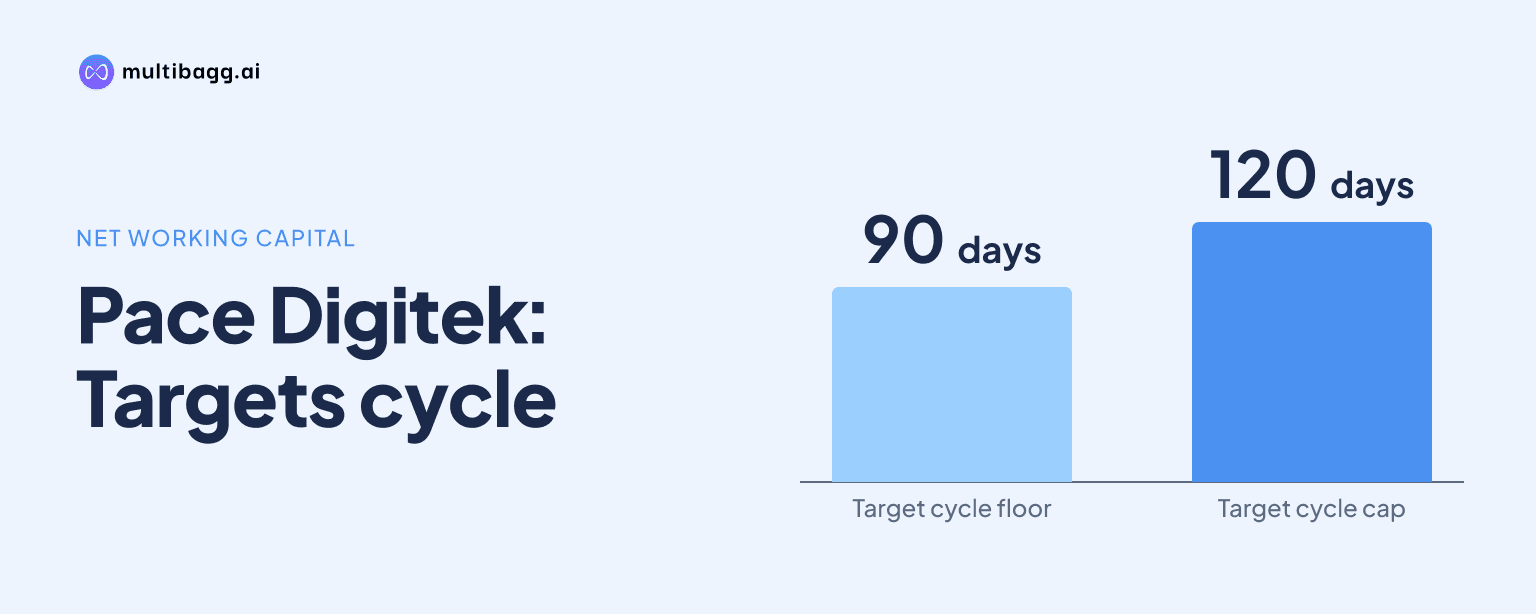
In FY27, Pace Digitek Limited expects its working-capital cycle to improve as energy revenue grows, targeting about 150 receivable days, 60-90 payable days and a 90-120-day net working-capital cycle. Management linked the plan to energy projects’ 90-180-day retention periods, compared with 5%-10% retention clauses in older telecom projects.
Know Pace Digitek inside out
Results, valuation, peers and who's buying, in one view.
How will Pace Digitek shorten its working-capital cycle?
Pace Digitek expects a change in revenue mix toward energy projects to shorten its working-capital cycle. Rajavendhan P said on the call that receivables were elevated at 31 March 2026 mainly because telecom had been a major contributor to revenue during the preceding two years. Telecom contracts included customer retention of about 5% to 10%, depending on the project, for the defect-liability period.
Energy projects have a shorter retention mechanism, according to management. Rajavendhan P said retention on energy projects is generally for 90 to 180 days, rather than the longer retention attached to telecom contracts. As energy becomes the larger revenue contributor and telecom becomes a smaller portion, management expects the cycle to ease over time. It said FY27 should be better than FY26, while FY28 should reflect the energy business’s expected 90-120-day net working-capital cycle.
The improvement depends on both new energy revenue and collections from the older telecom portfolio. Management said telecom projects have started achieving milestones and their retention amounts are progressively coming down. That process should reduce receivables alongside the growing contribution from energy, rather than relying only on newly won projects to improve the cycle.
What receivables and payable targets has Pace Digitek set?
Pace Digitek is targeting a receivables cycle of around 150 days, a payable cycle of 60-90 days and net working capital of about 90-120 days. Rajavendhan P gave those ranges in response to a question about elevated debtors and trade payables. The stated 150-day receivables objective compares with approximately 286 debtor days cited by the analyst for March 2026.
The call included differing references to reported payable balances. The analyst said receivables had declined from Rs 2,067 crore in March to Rs 1,792 crore in September, while payables remained around Rs 2,100 crore at both points. Management asked the analyst to use consolidated payables and stated that these had reduced from about Rs 1,800 crore to Rs 1,500 crore. The transcript does not reconcile the different payable figures.
Management’s Rs 800 crore to Rs 900 crore payable target is a forward-looking objective rather than a reported September balance. When the analyst asked whether 90 payable days could take payables from Rs 1,500 crore to roughly Rs 300 crore, Rajavendhan P instead said payables would come down to about Rs 800 crore to Rs 900 crore. That target is above the analyst’s illustrative Rs 300 crore estimate.
Got a follow-up? Ask IRIS
Why have Pace Digitek’s payables been elevated?
Pace Digitek said payables include materials, services and vendor retention, which management said explains why they have been elevated. Management said it generally retains 10% from vendors when it has a corresponding 10% retention from a customer. Payables also include provisions required under the applicable accounting standard, so they are not solely unpaid material purchases.
This matching of customer and vendor retention links the release of payables to cash collection from customers. Rajavendhan P said that as project retentions start coming in from customers, Pace Digitek also releases retention amounts payable to vendors. The projected move to a 60-90-day payable cycle is consequently tied to project milestones, customer retention collections and the changing mix toward energy contracts.
The analyst described current payables as roughly 600 days, compared with management’s 60-90-day expectation. Management did not validate that 600-day calculation in its response. Instead, it pointed to the decline in consolidated payables from about Rs 1,800 crore at March to about Rs 1,500 crore at September, saying receivables and payables would show similar reductions.
What could determine whether Pace Digitek reaches its targets?
Pace Digitek’s working-capital outcome will depend on the pace at which energy revenue rises and older telecom retentions are collected. Management’s outlook assumes that energy, with its 90-180-day retention period, becomes the larger contributor to revenue while telecom represents only a smaller part. It also expects older telecom milestones to continue being achieved so that retained customer payments are released progressively.
The business mix within energy can also affect funding needs. In discussing its expanded 10 gigawatt-hour battery energy storage system capacity, management said it intends to use a mix of product sales, engineering, procurement and construction projects, and job work because direct product sales carry heavier working-capital requirements. It plans to allocate 20% of capacity to job work, which management said could reduce working-capital needs while maintaining margins.
Management also said it expects to reserve 10% to 15% of capacity for build-to-operate projects once investors are in place. Revenue from engineering, procurement and construction and build-to-operate projects is recognised over a two-year project duration, according to management, rather than immediately as it would be in a 100% direct-product-sale model. Those choices mean reported cash and balance-sheet effects will depend on the eventual mix of contracts, not only on factory capacity.
Conclusion
Pace Digitek’s stated plan is to move from a telecom-influenced cycle to one shaped by energy projects with shorter retention terms. The central numerical objectives are about 150 receivable days, 60-90 payable days and 90-120 net working-capital days, alongside a reduction in payables to Rs 800 crore to Rs 900 crore from the about Rs 1,500 crore consolidated balance management cited for September.
The next evidence point is whether FY27 improves on FY26 as management projected, including further collection of telecom retentions and lower consolidated payables. Readers can also watch the planned start of production at expanded 10 gigawatt-hour battery energy storage system capacity in Q4, which management said could take one quarter to reach full utilisation, and the eventual mix of job work, product sales and build-to-operate projects.