










Page Industries emissions intensity falls 42% from FY20 base
Key highlights
- Page Industries reported a 42% reduction in Scope 1 and 2 emissions intensity from its FY2019-20 baseline in FY25.
- Renewable energy supplied 33% of Page Industries’ total consumption in FY25, versus a 50% target for FY2027-28.
- Page Industries reported 100% recycling of 1,308 metric tonnes of pre- and post-consumption plastic in FY25.
- Women represented 90% of Page Industries’ factory-level associated employees and 13% of people’s leaders in FY25.
powered by IRIS
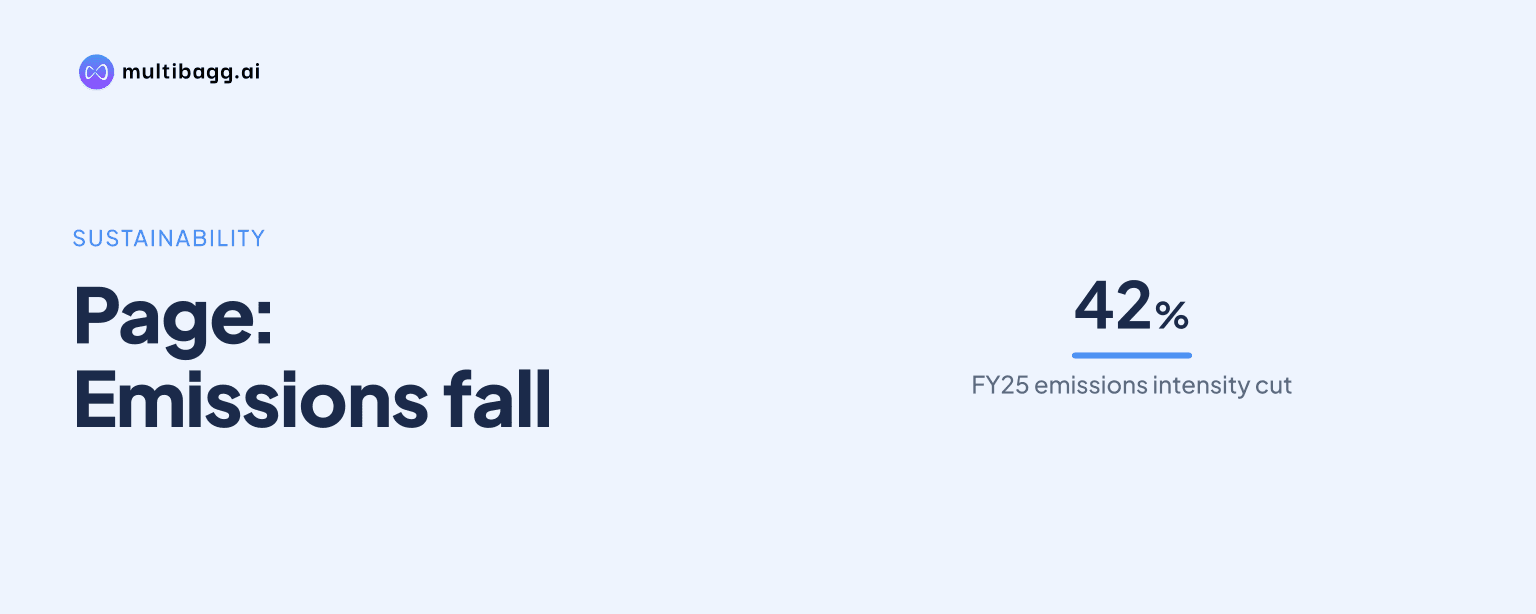
Page Industries Limited reported a 42% reduction in Scope 1 and 2 greenhouse-gas emissions intensity from its financial year 2019-20 baseline in FY25, exceeding its 40% FY2027-28 target. The company recorded emissions intensity of 5.42 tCO₂e, or tonnes of carbon-dioxide equivalent, per million minutes produced and said renewable energy supplied 33% of consumption.
Know Page Industries inside out
Results, valuation, peers and who's buying, in one view.
How far has Page Industries reduced emissions intensity?
Page Industries reduced Scope 1 and 2 emissions intensity by 42% from the FY2019-20 baseline in FY25. The result was 2 percentage points above the company’s stated 40% reduction target for FY2027-28, while its longer-term target remains a 50% reduction by FY2029-30.
The company reported FY25 emissions intensity of 5.42 tCO₂e per million minutes produced. This is an output-linked measure rather than an absolute emissions total, and the presentation does not disclose total Scope 1 and 2 emissions for FY25 or the baseline year.
Page Industries also reported a 19% reduction in energy intensity from the FY2019-20 baseline. That outcome was 1 percentage point short of its 20% energy-intensity reduction target for FY2027-28, showing that the emissions-intensity milestone was reached before the related energy-intensity goal.
What energy target does Page Industries still need to meet?
Page Industries needs to raise renewable energy’s contribution from 33% of total consumption in FY25 to 50% by FY2027-28. The presentation identifies briquettes and solar as the renewable-energy sources, leaving a 17-percentage-point gap to the stated target.
The company does not disclose total energy consumed in FY25 or a split between briquettes and solar within the 33% renewable-energy contribution. It therefore provides a consumption share and intensity-reduction measure, but not a breakdown of energy volumes by source.
Page Industries reported sustainable revenue growth of Rs 4,934 crore in FY25 and set a Rs 8,000 crore revenue target for FY2028-29. It also said an environmental, social and governance (ESG) project-evaluation framework applies to all new project selections and covers safety, energy, environment, water and community impact, without quantifying its expected effect on energy use or emissions.
Got a follow-up? Ask IRIS
How are Page Industries’ water, material and waste outcomes changing?
Page Industries reported a 15.5% reduction in water intensity in FY2024-25, against a 15% target for FY2027-28. The reported result was therefore 0.5 percentage points above that target, although the presentation does not state the baseline year, water volumes or the unit used for the intensity measure.
Rainwater-harvesting catchment increased by 1.5% in FY2024-25, with a 7% target for FY2027-28. The company also completed water-neutrality assessments at two facilities, matching its target of two units by FY2027-28; the presentation does not state that the two facilities have achieved water neutrality.
On materials, Page Industries reported recycling 100% of 1,308 metric tonnes of pre- and post-consumption plastic and receiving 100% of plastic credits from authorised recyclers. Renewable materials made up 82% of fabric and accessories for Jockey, while recycled packaging content was 51% for Jockey and 46% for Speedo, a 5-percentage-point difference.
Page Industries reported zero waste to landfill in FY25, with a yearly target to maintain that outcome. Its sustainability statement says the result was validated through traceability audits covering hazardous and non-hazardous waste recyclers, while fabric, elastic, yarn and label suppliers recorded 100% OEKO-Tex compliance.
What do Page Industries’ supplier and workforce disclosures show?
Page Industries completed sustainability assessments for 100% of upstream value-chain partners in FY25, in line with the stated RSPR-SEBI requirements. The company describes the coverage as applying to vendors representing 2% above business-valued vendors and sets a yearly target of maintaining 100% assessment coverage.
The company also reported 100% compliance for all fabric and yarn vendors, compared with a stated yearly target to maintain a 90% compliance rate. All in-house facilities were certified under WRAP, with a yearly target of maintaining 100%, and Page Industries reported zero data breaches in FY25.
Factory-level women’s representation was 90% in FY25, above the company’s target to sustain more than 85%. Women represented 13% of people’s leaders, compared with a target of 18% by FY2027-28, leaving a 5-percentage-point gap.
Page Industries reported 100% completion of POSH awareness for employees and 7.1 million minutes of employee safety training. It also implemented 12 high-risk management programmes, completed safety assessments for 100% of EBS, and launched ESG Compass for ESG and safety-data management with a FY2025-26 target.
Conclusion
Page Industries’ FY25 disclosures show that its 42% Scope 1 and 2 emissions-intensity reduction has moved beyond the 40% FY2027-28 milestone. Water-intensity reduction reached 15.5%, plastic recycling covered 1,308 metric tonnes and waste to landfill was zero, while renewable energy remained at 33% against a 50% target.
The next disclosed checkpoint is ESG risk integration in FY2025-26. Investors can also watch progress toward FY2027-28 targets for 20% energy-intensity reduction, 50% renewable energy, 7% rainwater-harvesting catchment and 18% women’s representation in people’s leaders, followed by the 50% emissions-intensity reduction target for FY2029-30.