










Paradeep Phosphates Limited acid project on track, Goa cuts energy
Key highlights
- PPL’s Paradeep Phase 1 plan would raise phosphoric-acid capacity by 200,000 tonnes per annum to 700,000 tonnes per annum.
- PPL completed its Goa urea efficiency project, reducing energy consumption by 0.3 gigacalories per tonne.
- PPL produced 217,970 tonnes of phosphoric acid in H1 FY2027, down 6.5% year on year.
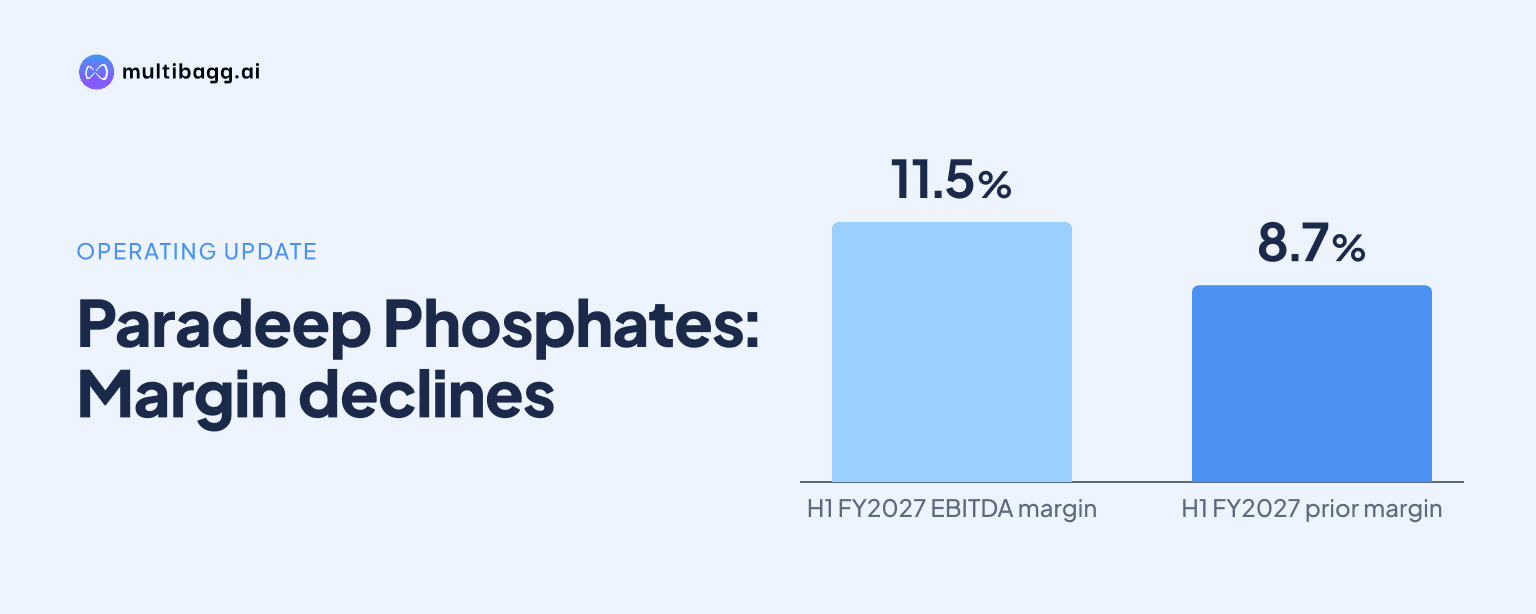
- PPL reported H1 FY2027 EBITDA of Rs 1,173 crore, with margin declining to 8.7% from 11.5%.
powered by IRIS
Paradeep Phosphates Limited said on November 2, 2026 that its Phase 1 Paradeep phosphoric-acid expansion to 700,000 tonnes per annum is on track, while a completed Goa project has reduced urea energy consumption by 0.3 gigacalories per tonne. The update accompanied its Q2 FY2027 results presentation.
Know Paradeep Phosphates inside out
Results, valuation, peers and who's buying, in one view.
What is PPL expanding at Paradeep?
PPL is expanding phosphoric-acid capacity at Paradeep from 500,000 tonnes per annum to 700,000 tonnes per annum under Phase 1. The plan would add 200,000 tonnes per annum, equal to 40% of the existing 500,000-tonne capacity. Management described the project as on track in its Q2 FY2027 commentary, but did not disclose a commissioning date or capital-expenditure amount.
Phosphoric acid is a backward-integration facility at PPL’s Paradeep, Odisha complex, which has 1.8 million tonnes per annum of installed capacity for diammonium phosphate, or DAP, and nitrogen, phosphorus and potassium, or NPK, fertilisers. The same location has 2.0 million tonnes per annum of sulphuric-acid capacity. The presentation does not say that the acid project will expand the 1.8 million-tonne fertiliser capacity; it identifies the project as an increase in an input-production facility.
PPL has 3.7 million tonnes per annum of fertiliser capacity across Paradeep, Goa and Mangalore. Goa has 0.8 million tonnes per annum of NPK and DAP capacity plus 0.4 million tonnes of urea capacity, while Mangalore has 0.3 million tonnes of NPK and DAP capacity plus 0.4 million tonnes of urea capacity. The acid project is therefore specific to the Paradeep site rather than a company-wide finished-fertiliser capacity programme.
Current phosphoric-acid production did not increase during the period covered by the presentation. PPL produced 217,970 tonnes in H1 FY2027, down 6.5% year on year, and 97,600 tonnes in Q2 FY2027, down 18.9%. In contrast, DAP output rose 37.0% to 390,449 tonnes in H1 FY2027 and 29.2% to 151,530 tonnes in Q2 FY2027.
What approval remains for PPL’s Paradeep acid project?
PPL has completed the public hearing required for environmental approval of the Paradeep capital-expenditure programme, and management said it expects environmental approvals shortly. The presentation does not state that final approval has been received, nor does it give a date by which a decision is expected. This is the disclosed next regulatory milestone for the 700,000-tonne-per-year project.
The approval process is taking place while PPL has flagged uncertainty in imported fertilizer raw-material supply chains. The company cited longer procurement lead times for rock phosphate and phosphoric acid, as well as volatility and availability challenges for sulphur and ammonia. It linked these risks to geopolitical tensions in West Asia, security concerns in the Red Sea and Strait of Hormuz, vessel rerouting and higher freight and insurance costs.
Management’s stated response includes diversified sourcing across multiple geographies, optimised inventory planning, flexible procurement and logistics partnerships. These measures address inputs that PPL identified in the presentation, rather than providing a quantified financial impact. PPL did not disclose how much imported phosphoric acid the 200,000-tonne capacity addition could replace or what effect it may have on input costs.
The contrast between Q2 production lines illustrates the operating setting for the project. Q2 FY2027 sulphuric-acid production increased 25.2% year on year to 367,121 tonnes, while phosphoric-acid output declined 18.9% to 97,600 tonnes. The presentation does not explain the operational causes of those differing changes or link either movement directly to the expansion programme.
Got a follow-up? Ask IRIS
How did PPL reduce urea energy use at Goa?
PPL completed its energy-efficiency improvement project at Goa and optimised urea energy consumption by 0.3 gigacalories per tonne. A gigacalorie is a heat-energy unit. Management did not disclose the energy-consumption baseline, the resulting consumption level, project spending, annual savings or a timeline for the reduction before confirming completion in the Q2 FY2027 presentation.
The Goa facility at Zuarinagar has 0.4 million tonnes per annum of urea capacity and 0.8 million tonnes per annum of NPK and DAP capacity. It also has ammonia backward-integration capacity of 290,000 tonnes per annum. PPL says the site serves western, central and southern India, and identifies NPK-19 as a grade unique to the Goa plant in India.
PPL produced 244,534 tonnes of urea in Q2 FY2027, up 3.4% year on year. H1 FY2027 urea production was 452,792 tonnes, down 3.7% year on year. The presentation does not split urea production between Goa and Mangalore, which also has 0.4 million tonnes per annum of urea capacity, so the company has not quantified the output volume to which Goa’s 0.3-gigacalorie improvement applied.
The efficiency measure concerns energy use per tonne rather than total production. PPL reported 294,388 tonnes of ammonia production in H1 FY2027, up 0.6% year on year, while Q2 production was 154,589 tonnes, up 2.9%. The company did not attribute the ammonia or urea volume movements to the completed Goa project.
How do these projects fit PPL’s FY2027 performance?
PPL reported H1 FY2027 revenue from operations of Rs 13,488.3 crore, up 18.6% year on year, while EBITDA, or earnings before interest, tax, depreciation and amortisation, fell 10.7% to Rs 1,173 crore. EBITDA margin was 8.7%, compared with 11.5% in H1 FY2026. The presentation notes that EBITDA includes other income and calculates margins on total income.
The second quarter showed a sharper sequential and annual profitability change. Q2 FY2027 EBITDA was Rs 431.2 crore, down 38.3% year on year from Rs 698.4 crore, and the margin was 5.8% against 10.1%. Reported profit after tax was Rs 122.4 crore, down 64.1% year on year, while revenue from operations increased 7.2% to Rs 7,364.1 crore.
Fertiliser sales volumes were lower in aggregate despite higher DAP sales. H1 FY2027 total fertiliser sales declined 12.9% year on year to 1,999,630 tonnes, while DAP sales, including traded DAP, rose 33.8% to 567,472 tonnes. Total NPK sales, including ammonium sulphate, triple superphosphate, single superphosphate and muriate of potash, fell 29.3% to 988,446 tonnes, and urea sales fell 6.3% to 443,713 tonnes.
Management reported H1 FY2027 EBITDA per tonne of Rs 5,866, compared with Rs 5,716 in H1 FY2026. It also said sulphur pricing and availability remained sources of global uncertainty, while the impact of the Rabi notification was yet to be factored in. PPL did not assign any portion of H1 revenue, EBITDA or per-tonne EBITDA to either the Goa efficiency project or the Paradeep acid expansion.
Conclusion
PPL’s disclosed projects address two different parts of its operating chain: the Paradeep programme would raise phosphoric-acid capacity by 200,000 tonnes per annum to 700,000 tonnes, and the completed Goa programme reduced urea energy use by 0.3 gigacalories per tonne. Their progress was reported alongside higher H1 revenue and DAP production, but lower phosphoric-acid production, lower total fertiliser sales and a 2.8-percentage-point decline in EBITDA margin.
The next item to watch is environmental approval for the Paradeep capital-expenditure programme after completion of its public hearing, which management expects shortly without giving a date. PPL also identifies sulphur availability and pricing, plus shipping disruption affecting rock phosphate, phosphoric acid, sulphur and ammonia, as unresolved supply-chain matters for its procurement and inventory planning.