










Paradeep Phosphates Q1 FY27 Revenue Rises 36% to ₹6,124 Crore
Key highlights
- Paradeep Phosphates reported Q1 FY27 revenue from operations of ₹6,124 crore, up 36% year-on-year.
- Q1 FY27 EBITDA rose 21% year-on-year to ₹742 crore.
- Profit before tax increased 24% year-on-year in Q1 FY27.
- Paradeep Phosphates stated finished-fertiliser capacity of 3.7 MMTPA and reach across 18 states.
powered by IRIS
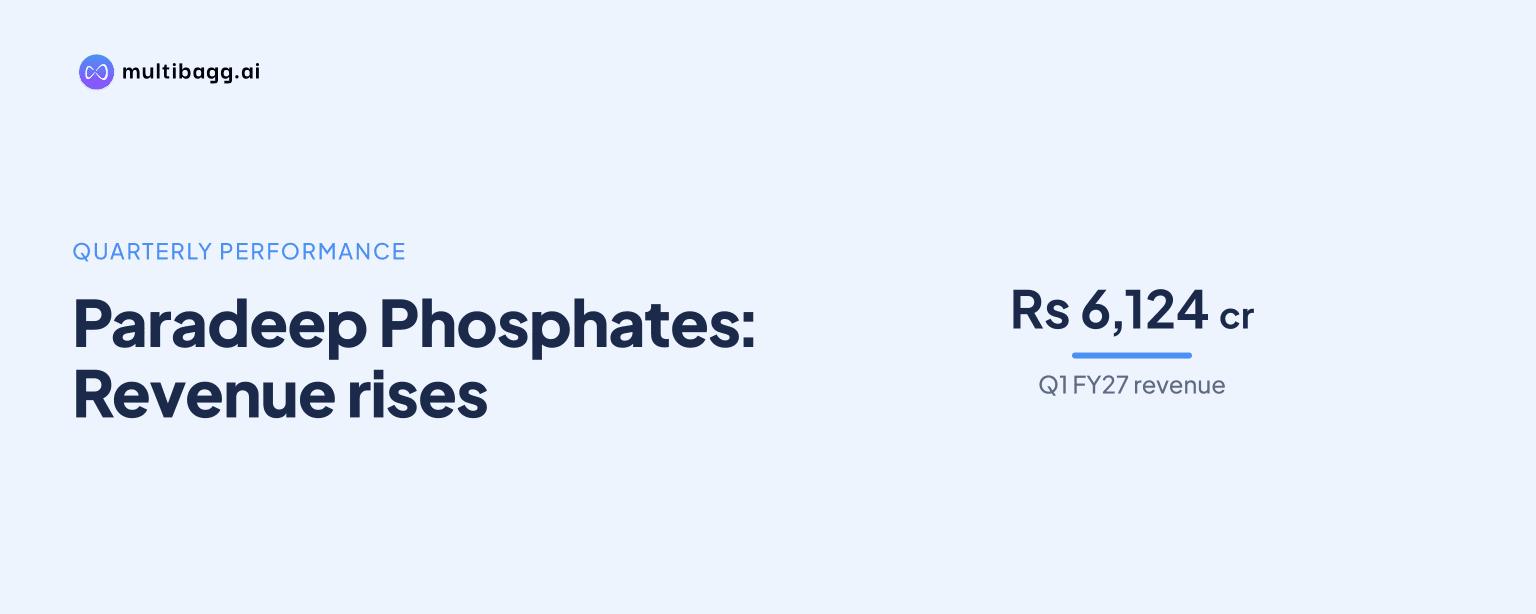
Paradeep Phosphates Limited reported revenue from operations of ₹6,124 crore in Q1 FY27, a 36% year-on-year increase, while EBITDA rose 21% to ₹742 crore. The performance matters because the company has expanded its finished-fertiliser capacity to 3.7 million metric tonnes per annum following the completion of its merger.
Know Paradeep Phosphates inside out
Results, valuation, peers and who's buying, in one view.
What did Paradeep Phosphates report for Q1 FY27?
Paradeep Phosphates Limited, referred to as PPL, said revenue from operations increased 36% year-on-year to ₹6,124 crore during the quarter ended June 30, 2026. EBITDA rose 21% year-on-year to ₹742 crore, while profit before tax increased 24%, according to the company's Q1 FY27 earnings presentation dated July 30, 2026.
The quarterly update presents revenue growth ahead of EBITDA growth. As a result, the EBITDA margin was lower than it would have been if both measures had risen at the same pace, although PPL did not provide a Q1 FY27 margin figure in the supplied presentation extract. The company did not disclose the absolute profit-before-tax figure in the available material.
PPL described itself as India's leading private-sector phosphatic fertiliser company in its Q1 FY27 presentation. It reported a total finished-fertiliser capacity of 3.7 million metric tonnes per annum, or MMTPA, after completion of the merger referenced in its recent investor materials.
Which operating strengths support PPL's fertiliser business?
PPL's operating model combines sourcing of key raw materials, production of di-ammonium phosphate, or DAP, and multiple NPK fertiliser grades, followed by distribution across major farming markets. The company said it sells to more than 12 million farmers through a network of over 100,000 retailers across 18 states.
Its core product basket includes DAP and grades such as NPK 20:20:0:13, 12:32:16, 10:26:26, 19:19:19 and 28:28:0. PPL also stated in earlier presentations that it trades in DAP and muriate of potash, or MOP. This mix places the company across phosphatic fertiliser products used by farmers for different crops and soil nutrient requirements.
The company operates manufacturing sites at Paradeep and Goa. Previous company disclosures described 3.0 MMTPA of finished-fertiliser capacity across the two locations, comprising 1.8 MMTPA of DAP and NPK capacity at Paradeep and 0.8 MMTPA of DAP and NPK capacity plus 0.4 MMTPA of urea capacity at Goa. The later 3.7 MMTPA capacity figure reflects the completed merger cited in FY26 and FY27 investor presentations.
How does Q1 FY27 compare with PPL's recent financial performance?
PPL's Q1 FY27 results followed a FY25 in which it reported revenue of ₹13,931.6 crore and fertiliser sales volume of 3.03 million tonnes. FY25 production rose 14% year-on-year to 2.63 million tonnes, while sales volume increased 20% year-on-year to 3.03 million tonnes.
The company's Q3 FY26 presentation showed total income of ₹5,779.7 crore, EBITDA of ₹503.5 crore and net profit of ₹182.1 crore for the quarter. For the first nine months of FY26, total income was ₹17,231.1 crore, up 34.1% year-on-year. These figures are from different reporting periods and should not be treated as directly comparable with Q1 FY27 revenue from operations, but they provide context on the company's recent scale.
PPL had also reported Q2 FY25 total income of ₹3,843.8 crore and net profit of ₹227.6 crore. Its investor material stated that EBITDA includes other income for that period. Investors comparing reported operating metrics across quarters should therefore note the specific definitions used in each company presentation.
Got a follow-up? Ask IRIS
Why does PPL's capacity and distribution network matter?
PPL's 3.7 MMTPA capacity is material in a fertiliser industry where reliable availability of raw materials, manufacturing throughput and timely delivery influence sales. Phosphatic fertiliser producers depend on procurement of critical inputs, and PPL identifies raw-material sourcing as a core capability alongside manufacturing and distribution.
The company was incorporated in 1981 and is a manufacturer and distributor of phosphatic fertilisers and urea. Its earlier disclosures referred to operations across 15 states, 21 regional offices, 450 stock points and 6,500 dealers. The more recent Q1 FY27 presentation describes a broader reach of more than 100,000 retailers in 18 states and more than 12 million farmers.
PPL's Goa facility includes co-located production of phosphatic fertilisers and urea, according to its earlier investor presentation. The company has also expanded captive phosphoric acid capacity from 300,000 tonnes to 500,000 tonnes, with the expansion completed during Q1 FY24 and scheduled for commissioning in August of that year. Captive acid capacity is relevant because phosphoric acid is a key input for phosphatic fertilisers.
What does the quarterly update mean for investors and the fertiliser sector?
The Q1 FY27 update shows higher revenue and EBITDA for PPL as it operates with a larger stated capacity base. Revenue growth of 36% exceeded EBITDA growth of 21%, making profitability trends, product mix and input-cost management important areas to track in future disclosures. The supplied material does not provide sufficient detail to assign the difference to any one factor.
For investors, the reported 24% increase in profit before tax indicates that PPL's pre-tax earnings also increased during the quarter. However, the presentation extract does not provide net profit, earnings per share, debt figures, quarterly fertiliser volumes or margin data for Q1 FY27. Those measures would be needed for a fuller assessment of profitability and balance-sheet movement.
The company reported an ICRA A+ Stable credit rating and net debt-to-equity of 0.78 times in its FY25 presentation. It also listed more than 1,500 permanent employees and farmer outreach of over 9.5 million in FY25. The latest presentation's wider farmer and retailer figures indicate the importance of its distribution footprint as the company integrates expanded capacity.
Conclusion
PPL began FY27 with revenue from operations of ₹6,124 crore, EBITDA of ₹742 crore and year-on-year growth of 36%, 21% and 24% in revenue, EBITDA and profit before tax, respectively. The figures place the quarter within a broader expansion in which the company has moved from an earlier 3.0 MMTPA finished-fertiliser capacity base to a stated 3.7 MMTPA following merger completion.
The next disclosures to watch are PPL's quarterly fertiliser sales volumes, operating margins, profit after tax, debt metrics and details on how the enlarged capacity base is being utilised. Investors can also monitor updates on distribution reach, raw-material sourcing and performance across DAP, NPK and urea operations as the financial year progresses.