










Paradeep Phosphates working-capital cycle reaches 116 days
Key highlights
- PPL's net working-capital cycle increased to 116 days in H1 FY27 from 86 days in FY26.
- PPL's net debt rose to Rs 9,366.1 crore in H1 FY27 from Rs 6,445.4 crore in FY26.
- PPL's short-term debt reached Rs 8,849.2 crore in H1 FY27, compared with Rs 6,056.5 crore in FY26.
- PPL's H1 FY27 EBITDA declined 10.7% to Rs 1,173 crore and EBITDA margin fell to 8.7%.
powered by IRIS
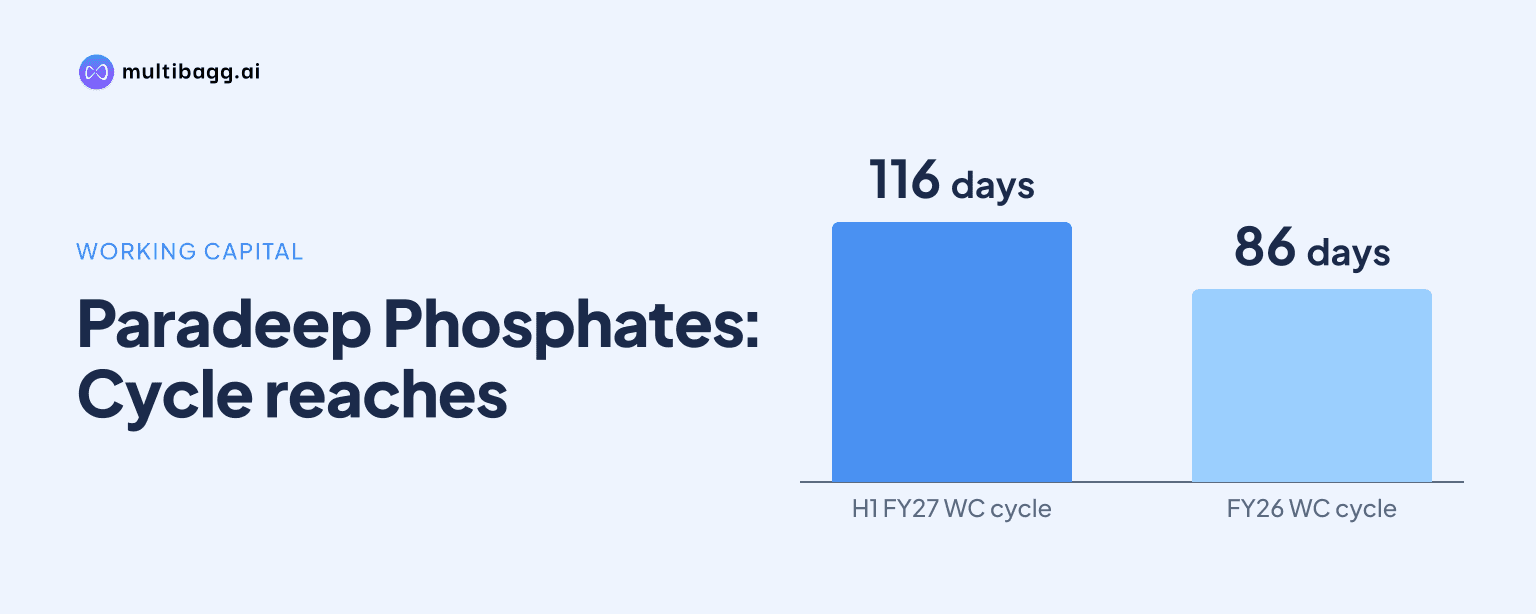
Paradeep Phosphates Limited reported a 116-day net working-capital cycle in H1 FY27, up from 86 days in FY26, while net debt rose to Rs 9,366.1 crore as its presentation linked global uncertainty and supply-chain disruptions to higher inventory, receivables and borrowing.
Know Paradeep Phosphates inside out
Results, valuation, peers and who's buying, in one view.
Why did PPL's working-capital cycle reach 116 days?
PPL's net working-capital cycle reached 116 days in H1 FY27 because receivable days increased to 83 and inventory days to 95, while payable days rose only to 62. The presentation identifies global uncertainties and supply-chain disruptions as drivers of the elongated cycle, compared with 86 days in FY26 and 73 days in FY25.
PPL identified escalating West Asia tensions, security concerns in the Red Sea and Strait of Hormuz, and vessel rerouting through the Cape of Good Hope as supply-chain risks. The presentation says these disruptions can raise ocean freight and war-risk insurance costs, delay sourcing of rock phosphate and phosphoric acid, and create pricing and availability challenges for sulphur and ammonia.
The inventory-payable gap widened across the three disclosed periods. Inventory days rose by 28 days, from 67 in FY25 to 95 in H1 FY27, while payable days increased by four days, from 58 to 62. Receivable days increased by 19 days, from 64 to 83, further extending the cash conversion cycle.
How did PPL's debt and leverage change?
PPL's net debt increased to Rs 9,366.1 crore in H1 FY27 from Rs 6,445.4 crore in FY26 and Rs 3,758 crore in FY25, while net debt-to-equity rose to 1.31 times from 0.95 times in FY26. Total debt increased by Rs 2,974.9 crore from FY26, whereas cash and cash equivalents increased by Rs 72 crore.
Short-term debt comprised most of the H1 FY27 borrowing balance at Rs 8,849.2 crore, compared with long-term debt of Rs 998 crore. Short-term debt rose from Rs 6,056.5 crore in FY26, while long-term debt increased from Rs 815.8 crore, indicating that short-term funding accounted for most of the debt increase.
PPL reported total equity of Rs 7,144.8 crore at H1 FY27, up from Rs 6,782.7 crore in FY26. Net debt increased by Rs 2,920.7 crore over that period, exceeding the Rs 362.1 crore rise in equity and accompanying the reported increase in the net debt-to-equity ratio.
Got a follow-up? Ask IRIS
What operating trends coincided with higher inventory days?
PPL's H1 FY27 total fertilizer production fell 27.5% year on year to 1,347,323 metric tonnes, while total fertilizer sales declined 12.9% to 1,999,630 metric tonnes. Within this volume mix, diammonium phosphate, or DAP, production increased 37.0% to 390,449 tonnes and DAP sales, including traded DAP, increased 33.8% to 567,472 tonnes.
Nitrogen, phosphorus and potassium, or NPK, production declined 54.3% year on year to 504,082 tonnes in H1 FY27, while total NPK sales declined 29.3% to 988,446 tonnes. Urea production fell 3.7% to 452,792 tonnes, and urea sales declined 6.3% to 443,713 tonnes.
PPL also reported H1 FY27 traded-product sales of 506,151 tonnes, up 35.7% year on year. These products include triple superphosphate, DAP, muriate of potash, ammonium sulphate and N-15; muriate of potash sales rose 97.1% to 140,587 tonnes. The presentation does not quantify the inventory-day contribution from any individual product category.
How did PPL's financial performance change in H1 FY27?
PPL's revenue from operations rose 18.6% year on year to Rs 13,488.3 crore in H1 FY27, but earnings before interest, tax, depreciation and amortisation, or EBITDA, declined 10.7% to Rs 1,173 crore. EBITDA margin fell to 8.7% from 11.5% in H1 FY26, while reported profit after tax declined 21.8% to Rs 515.6 crore.
The second quarter recorded a sharper earnings decline. Q2 FY27 revenue from operations was Rs 7,364.1 crore, up 7.2% year on year and 20.2% quarter on quarter, but EBITDA was Rs 431.2 crore, down 38.3% year on year and 41.9% quarter on quarter. EBITDA margin was 5.8%, compared with 10.1% in Q2 FY26 and 12.1% in Q1 FY27.
PPL's purchase of trading goods increased 48.5% year on year to Rs 5,213.5 crore in H1 FY27, while cost of material consumed increased 17.5% to Rs 6,724.8 crore. Management said sulphur pricing and availability remained part of global uncertainty and that the impact of the Rabi notification was yet to be factored in.
Conclusion
PPL's H1 FY27 disclosures show that its operating cash cycle extended as receivables and inventories increased faster than payables, alongside the supply-route risks described in its presentation. The 30-day increase in net working capital from FY26 to H1 FY27 coincided with a Rs 2,920.7 crore increase in net debt and lower EBITDA margin despite 18.6% revenue growth.
The next disclosed development to watch is PPL's Phase 1 phosphoric-acid expansion at Paradeep, intended to raise capacity from 500,000 to 700,000 metric tonnes per annum. Management said the project was on track, its environmental public hearing had been completed and approvals were expected shortly; the presentation does not provide a commissioning date or a working-capital target.