










Paradeep Phosphates DAP sales rise 34% as NPK falls 29%
Key highlights
- PPL’s H1 FY27 DAP sales rose 33.8% year on year to 567,472 MT.
- PPL’s H1 FY27 total NPK sales fell 29.3% to 988,446 MT.
- PPL’s H1 FY27 traded-product sales increased 35.7% to 506,151 MT.
- PPL’s H1 FY27 total fertilizer sales declined 12.9% to 1,999,630 MT.
powered by IRIS
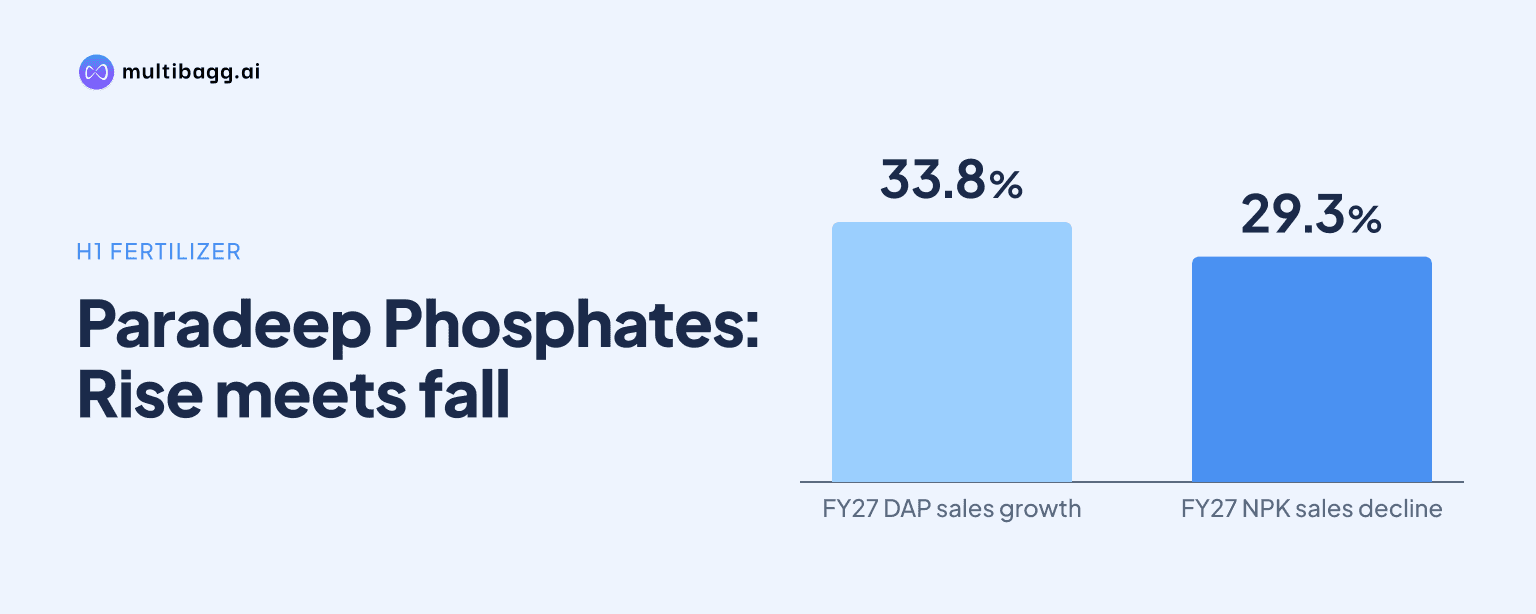
Paradeep Phosphates Limited reported H1 FY27 DAP sales of 567,472 metric tonnes (MT), up 33.8% year on year, while total NPK sales fell 29.3% to 988,446 MT and total fertilizer sales declined 12.9% to 1,999,630 MT. The figures show a clear shift in PPL’s reported product-volume mix.
Know Paradeep Phosphates inside out
Results, valuation, peers and who's buying, in one view.
How did PPL’s H1 FY27 fertilizer sales mix change?
PPL’s H1 FY27 sales mix shifted toward DAP because DAP was the only one of its three headline fertilizer categories to record year-on-year volume growth. DAP sales, including traded DAP, rose 33.8% to 567,472 MT, compared with a 29.3% decline in total NPK sales to 988,446 MT and a 6.3% decline in urea sales to 443,713 MT.
The result was a 12.9% decline in total fertilizer sales to 1,999,630 MT despite DAP growth. Total NPK, which PPL defines as including ammonium sulphate (AS), triple superphosphate (TSP), single superphosphate (SSP) and muriate of potash (MOP), remained the largest reported sales category at 988,446 MT, but its decline was 63.1 percentage points wider than DAP’s growth.
The sales data do not identify the specific commercial or agronomic reasons for the DAP-NPK divergence. They do show that the portfolio did not move uniformly in H1 FY27: a 33.8% expansion in DAP volume coincided with a 29.3% contraction in the broader NPK category and a 12.9% reduction in total fertilizer volume.
What happened to PPL’s fertilizer sales in Q2 FY27?
PPL’s Q2 FY27 sales followed the same broad pattern, with DAP volume rising while total NPK volume fell. DAP sales increased 21.2% year on year to 322,283 MT, whereas total NPK sales fell 47.6% to 445,138 MT; total fertilizer sales declined 25.1% to 1,014,488 MT.
Urea was the exception among the other headline categories in Q2 FY27, increasing 3.0% to 247,066 MT. The quarterly total-sales decline of 25.1% was steeper than the 12.9% H1 FY27 decline, while Q2 DAP growth of 21.2% was lower than the 33.8% growth recorded for the half year.
PPL’s managing director and chief executive officer said the company achieved sales volume of 1 million tonnes in Q2 FY27 and 2 million tonnes in H1 FY27 despite a subdued monsoon. The detailed presentation tables put those rounded volumes at 1,014,488 MT for Q2 FY27 and 1,999,630 MT for H1 FY27.
Did traded products account for more PPL sales volume?
PPL reported traded-product sales of 506,151 MT in H1 FY27, up 35.7% year on year, while its total fertilizer volume fell 12.9%. The traded-products grouping includes TSP, DAP, MOP, AS and N-15, demonstrating growth in volumes sourced or sold within that reported category.
The presentation’s category definitions mean traded-product volumes should not be added to DAP or total NPK sales. DAP expressly includes traded DAP, and total NPK includes AS, TSP, SSP and MOP, so the 506,151 MT traded-products figure overlaps with the 567,472 MT DAP and 988,446 MT total NPK classifications.
Within the traded range, MOP sales rose 97.1% year on year to 140,587 MT in H1 FY27, while TSP sales fell 24.4% to 123,512 MT. In Q2 FY27, traded-product sales grew 12.7% to 380,777 MT, MOP grew 87.6% to 75,872 MT, and TSP declined 37.5% to 99,607 MT.
Got a follow-up? Ask IRIS
How did PPL’s H1 FY27 production compare with sales?
PPL’s H1 FY27 DAP production increased 37.0% year on year to 390,449 MT, broadly matching the direction of its 33.8% increase in DAP sales. In contrast, total NPK production fell 54.3% to 504,082 MT, alongside a 29.3% reduction in total NPK sales.
Total fertilizer production declined 27.5% to 1,347,323 MT, a larger percentage fall than the 12.9% reduction in total fertilizer sales. Urea production fell 3.7% to 452,792 MT, while urea sales decreased 6.3% to 443,713 MT in H1 FY27.
Sales volumes are not a direct plant-output comparison because DAP sales include traded DAP and the total NPK sales category includes AS, TSP, SSP and MOP. PPL also reported H1 FY27 sulphuric acid production of 753,369 MT, up 28.8%, while phosphoric acid production declined 6.5% to 217,970 MT; the presentation does not assign these input changes to any specific sales outcome.
What did the volume mix coincide with in PPL’s financial results?
PPL’s revenue from operations increased 18.6% year on year to Rs 13,488.3 crore in H1 FY27, even as total fertilizer sales volume fell 12.9%. Total income rose 18.1% to Rs 13,527.6 crore, indicating that reported revenue growth and aggregate fertilizer tonnage moved in opposite directions during the half year.
Earnings before interest, tax, depreciation and amortisation (EBITDA), including other income, declined to Rs 1,173 crore in H1 FY27 from Rs 1,313.1 crore in H1 FY26. The EBITDA margin declined to 8.7% from 11.5%, while net profit decreased to Rs 515.6 crore from Rs 658.9 crore and the net profit margin fell to 3.8% from 5.8%.
Management reported EBITDA per tonne of Rs 5,866 for H1 FY27, compared with Rs 5,716 in H1 FY26. Management also cited global uncertainty, particularly sulphur pricing and availability, and said the impact of the Rabi notification was yet to be factored in; the presentation does not quantify the contribution of DAP, NPK or traded products to revenue or profit changes.
Conclusion
PPL’s H1 FY27 figures show that DAP sales growth of 33.8% to 567,472 MT was insufficient to offset declines in total NPK and urea, leaving total fertilizer volume down 12.9% at 1,999,630 MT. Traded-product volume rose 35.7% to 506,151 MT, but overlapping product definitions prevent it from being treated as an additional or separate sales stream.
The next disclosed development is PPL’s Phase 1 phosphoric acid expansion at Paradeep, planned to raise capacity from 500,000 MT per annum to 700,000 MT per annum. The public hearing for environmental approval has been completed, and management said it expected approval shortly, while sulphur availability and pricing and the Rabi notification remain unresolved factors it identified.