










Pearl Global plans Rs 675-725 crore investment through FY30
Key highlights
- Pearl Global plans to invest Rs 675-725 crore from FY27 to FY30.
- Pearl Global’s aspirational FY30 revenue target is Rs 9,000-10,000 crore.
- Pearl Global reported H1FY27 consolidated revenue of Rs 3,330 crore, up 31.1% year on year.
- Pearl Global’s Bangladesh facility is expected to add about 7 million pieces of annual capacity at optimum utilisation.
powered by IRIS
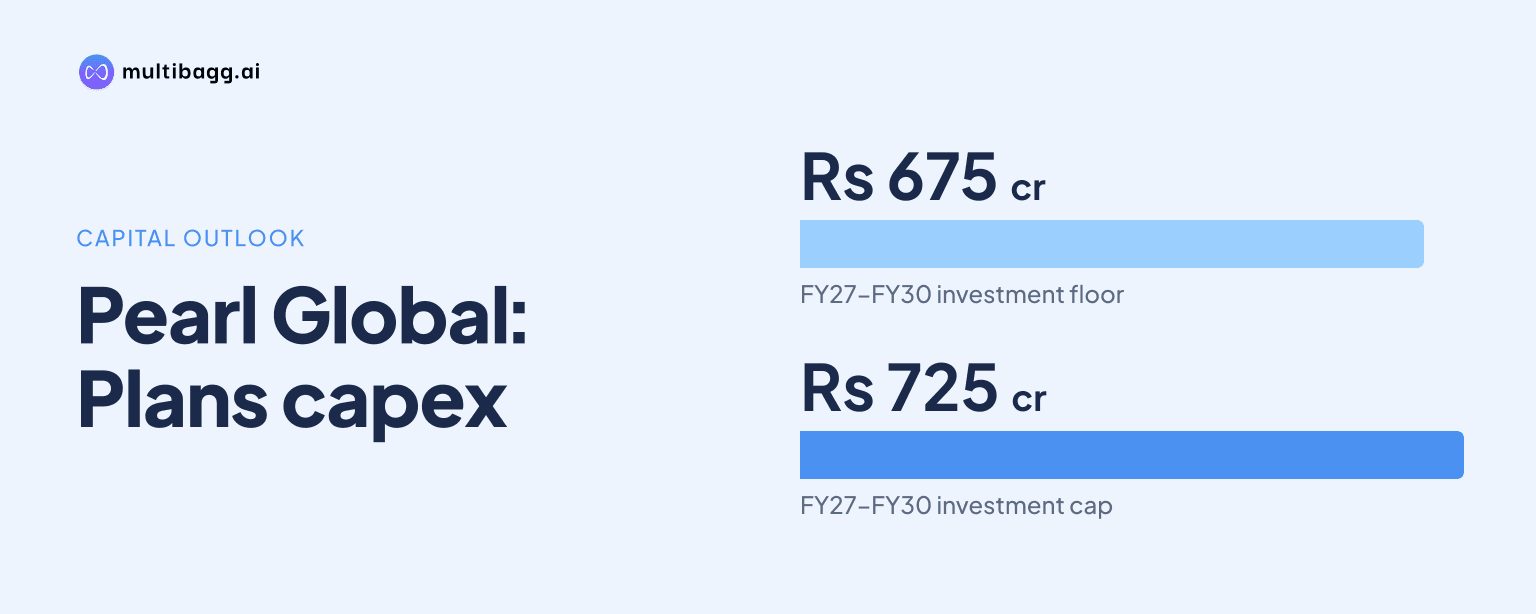
Pearl Global Industries Limited plans to invest Rs 675-725 crore between FY27 and FY30 to support its aspirational Rs 9,000-10,000 crore FY30 revenue target, following record H1FY27 revenue of Rs 3,330 crore. The plan includes a new Bangladesh manufacturing facility expected to add about 7 million pieces of annual capacity at optimum utilisation.
Know Pearl Global Industries inside out
Results, valuation, peers and who's buying, in one view.
What is Pearl Global’s FY27-FY30 investment plan?
Pearl Global plans to invest about Rs 675-725 crore from FY27 to FY30 to strengthen supply-chain integration, improve operational efficiency and support sustainable margin expansion. Vice-Chairman and Non-Executive Director Pulkit Seth linked the multi-year capital programme to Pearl Global’s aspirational Rs 9,000-10,000 crore revenue objective for FY30.
Management did not disclose an annual spending schedule, project-by-project allocation or funding mix for the Rs 675-725 crore programme. The stated mechanisms are supply-chain integration, operational efficiency and margin expansion, rather than a formal annual revenue, earnings or margin forecast through FY30.
The plan follows Pearl Global’s highest-ever half-yearly revenue of Rs 3,330 crore in H1FY27. The FY30 target is substantially above that six-month revenue base, but the presentation does not set out the annual revenue path, capacity additions beyond Bangladesh, or required growth rate to reach Rs 9,000-10,000 crore.
How does Pearl Global’s Bangladesh facility support expansion?
Pearl Global’s newly inaugurated Bangladesh manufacturing facility is expected to add about 7 million pieces of annual capacity at optimum utilisation. Mr. Seth described the facility as a key H1FY27 milestone that expands the group’s sourcing platform and is intended to provide customers with greater flexibility, scalability and supply-chain resilience.
The presentation does not disclose the Bangladesh facility’s capital cost, commissioning date or current utilisation rate. Its stated capacity is therefore an annual potential at optimum utilisation, rather than a disclosed measure of production or revenue already generated in H1FY27.
The Bangladesh addition sits within Pearl Global’s manufacturing network across India, Bangladesh, Vietnam, Indonesia and Guatemala. Management said this five-country footprint helps address evolving sourcing requirements of global brands and supports the FY27-FY30 objective of stronger supply-chain integration across the group.
What operating performance supports Pearl Global’s FY30 ambition?
Pearl Global reported consolidated H1FY27 revenue of Rs 3,330 crore, up 31.1% year on year, and adjusted earnings before interest, tax, depreciation and amortisation (adjusted EBITDA) of Rs 348 crore, up 47.7%. Adjusted EBITDA margin increased by about 120 basis points, or bps, to 10.5% from 9.3% in H1FY26.
Revenue growth in H1FY27 came from all locations and included about Rs 98 crore of incremental revenue from value-added services. The faster 47.7% growth in adjusted EBITDA than the 31.1% rise in revenue coincided with the 120 bps improvement in consolidated adjusted EBITDA margin.
Quarterly revenue reached Rs 1,802 crore in Q2FY27, up 37.2% year on year, while adjusted EBITDA rose 51.1% to Rs 184 crore. Q2FY27 adjusted EBITDA margin was 10.2%, but Pearl Global said quarterly EBITDA included a one-time net tariff adjustment gain and marginal contribution from value-added services totalling about Rs 11.5 crore.
India standalone performance grew more slowly than the consolidated business in H1FY27. Standalone revenue rose 22.1% to Rs 648 crore and adjusted EBITDA increased 4.5% to Rs 32 crore, with a 4.9% margin, compared with consolidated revenue growth of 31.1% and adjusted EBITDA growth of 47.7%; in Q2FY27, standalone adjusted EBITDA fell 13.3% to Rs 9 crore.
Got a follow-up? Ask IRIS
Which growth drivers and risks does Pearl Global identify?
Pearl Global said recently acquired customer programmes continued to scale during H1FY27, contributing to revenue growth and providing additional visibility for future expansion. Management did not quantify revenue from individual customer programmes, customers or geographies, apart from the approximately Rs 98 crore of incremental value-added-services revenue reported for H1FY27.
Managing Director Pallab Banerjee said Pearl Global had started seeing positive customer interest after the conclusion of the India-UK Free Trade Agreement. He also said a proposed India-EU Free Trade Agreement could enhance the competitiveness of Indian apparel manufacturers, but these comments were management views on potential opportunities rather than revenue guidance for FY30.
Pearl Global cited its manufacturing presence in India, Bangladesh, Vietnam, Indonesia and Guatemala as part of its response to changing customer sourcing needs and geopolitical uncertainty. The presentation’s safe-harbour statement also identifies execution of strategy and expansion plans, regulatory changes, technological changes, investment income and cash-flow projections as factors that could cause actual outcomes to differ from forward-looking statements.
Conclusion
Pearl Global has paired a Rs 675-725 crore FY27-FY30 investment plan with an aspirational FY30 revenue target of Rs 9,000-10,000 crore. Record H1FY27 consolidated revenue of Rs 3,330 crore, a 10.5% adjusted EBITDA margin and the Bangladesh facility’s planned annual capacity of about 7 million pieces provide the operating context for that ambition.
The next disclosures to watch are the allocation and timing of the Rs 675-725 crore programme, the utilisation ramp-up of the Bangladesh facility, and the contribution from recently acquired customer programmes. Progress toward the Rs 9,000-10,000 crore FY30 target may also be affected by the management-cited customer interest following the India-UK Free Trade Agreement and the unresolved proposed India-EU Free Trade Agreement.