










PG Electroplast says memory prices inflated electronics sales
Key highlights
- PG Electroplast is targeting about Rs 550 crore of full-year electronics sales within a Rs 500 crore to Rs 600 crore range.
- Management said sharply higher TV motherboard memory prices increased first-half electronics sales value.
- PG Electroplast reported about 22% RAC volume growth in the first half and targets 20% to 25% overall volume growth for the full year.
- The RAC bill of materials rose from about Rs 14,000 per unit two years ago to almost Rs 18,500.
powered by IRIS
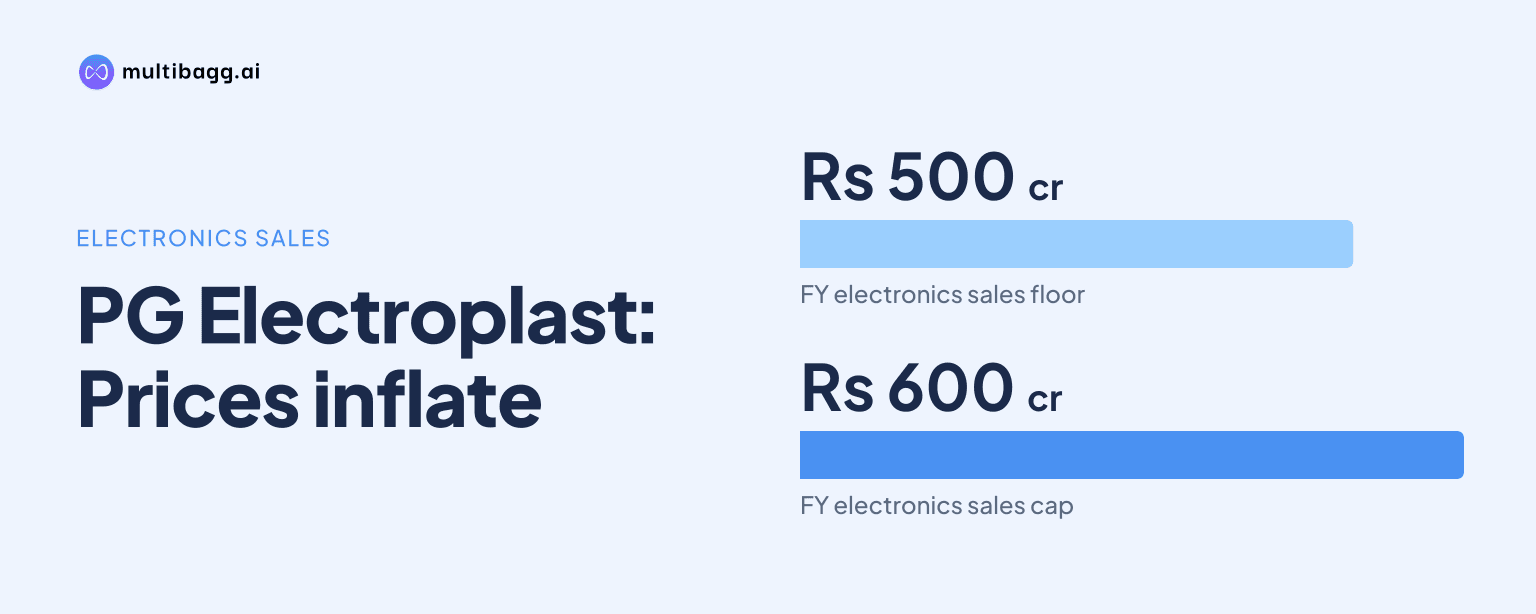
PG Electroplast Limited said sharply higher memory prices in TV motherboards inflated electronics sales value during the quarter and first half, alongside decent volumes, and management is targeting about Rs 550 crore of full-year electronics sales within a Rs 500 crore to Rs 600 crore range. Second-half growth should be more volume-led as AC controllers and cameras take a larger mix.
Know PG Electroplast inside out
Results, valuation, peers and who's buying, in one view.
Why did PG Electroplast's electronics sales rise so sharply in the first half?
PG Electroplast said TV motherboard sales and sharply higher memory prices were the main reasons electronics revenue appeared unusually high in the quarter and first half. Its four principal electronics product lines are TV motherboards, air-conditioner controllers, battery-management systems and closed-circuit television, or CCTV, cameras. Management said all four lines were growing, but TV motherboards made a larger contribution in the latest quarter because of seasonality.
Memory is a significant component of a TV motherboard, and management said memory prices had risen “very significantly.” That change lifted the value of electronics sales reported by PG Electroplast, even though volume was not the only driver of growth. Management described volumes as decent across the four product categories, distinguishing sales-value growth from underlying unit demand.
An analyst on the October 28, 2026 call cited electronics business growth from Rs 80 crore to about Rs 251 crore. PG Electroplast did not provide a product-level revenue split for the Rs 251 crore figure, so the supplied discussion does not quantify how much came from TV motherboards, AC controllers, battery-management systems or CCTV cameras. Management instead identified memory-price inflation as the principal reason the revenue number looked high.
How much electronics sales is PG Electroplast targeting this year?
PG Electroplast is targeting about Rs 550 crore of electronics sales for the full year, within management's stated Rs 500 crore to Rs 600 crore range. Management said the outlook reflects both elevated TV motherboard pricing and decent volumes across its electronics lines. It did not give an FY28 electronics sales target, saying it would update investors after finalising next year's plans.
The first-half figure in the table was cited by an analyst, while the full-year range and target came from management, so this is not a like-for-like growth calculation. The comparison shows that the second half remains material to the annual electronics outcome. Management did not attribute the full-year range exclusively to either volume or price, instead citing both factors.
TV pricing also affected Goodworth, which management said operates largely in the TV business. An analyst cited Goodworth sales rising from Rs 180 crore to Rs 455 crore in the quarter, and PG Electroplast said the increase was largely TV-led because electronics and motherboard prices had moved up sharply. Management guided Goodworth sales of about Rs 800 crore to Rs 900 crore for the full year.
Got a follow-up? Ask IRIS
Why should PG Electroplast's second-half electronics growth normalise?
PG Electroplast said second-half electronics growth should normalise because the mix is typically led by AC controllers and other products such as CCTV cameras, which do not carry the high memory content of TV motherboards. Management therefore expects sales-value growth in those products to track volume growth more closely. This is a statement about product mix and revenue drivers, not a forecast of an electronics sales decline.
The TV business also enters a seasonally slower period in the second half, according to management. PG Electroplast said it does not expect the very high TV growth seen earlier in the year to continue, partly because the TV season is nearing its end. It added that sharp price increases had produced negative price elasticity, with TV volume growth not as high as it might have been without those increases.
The pattern differs from room air conditioners, or RAC, where management reported about 22% volume growth in the first half. PG Electroplast guided full-year overall company volume growth of about 20% to 25%, while saying it had a strong RAC order book. The company described second-half RAC delivery as an execution requirement, making RAC a more volume-led growth driver than first-half electronics revenue.
How do higher component prices affect PG Electroplast's margins and costs?
PG Electroplast said commodity and component inflation can raise sales without increasing percentage margins because it earns a manufacturing amount per unit while passing through a larger bill of materials. In RAC, management said the bill of materials had risen from about Rs 14,000 per unit two years ago to almost Rs 18,500 currently. It said its internal focus is the absolute margin per unit rather than percentage gross margin.
Management said second-half margins are typically slightly better because sales are higher, operating leverage applies, and production-linked incentive, or PLI, booking is usually better in the fourth quarter. However, PG Electroplast also said percentage gross margin may not look high if commodity costs continue to be passed through. The expectation of somewhat better second-half margin was management's stated hope rather than formal margin guidance.
Higher commodity prices also increase working-capital requirements because inventory carries a larger rupee value. PG Electroplast said inventory was slightly higher because of stronger order books in AC, washing machines and electronics, as well as higher raw-material prices. Management expects second-half interest cost not to increase significantly from the first-half level because capital expenditure has been paid, while working-capital optimisation remains a focus.
Other operating expenses were lower year on year partly because foreign-exchange losses declined from about Rs 8 crore last year to about Rs 3 crore this year, a Rs 5 crore benefit. Management also cited about Rs 3 crore of GST-related one-off costs in the prior-year quarter that did not recur. It expects manpower and other operating costs to rise as facilities ramp up, but more in line with its 20% to 25% volume-growth target than with sales growth inflated by commodity pass-through.
Conclusion
PG Electroplast's account of its electronics revenue makes clear that the first-half increase was not solely a volume indicator. Higher memory prices in TV motherboards lifted reported sales value, while volumes across TV motherboards, AC controllers, battery-management systems and CCTV cameras were described as decent. The Rs 500 crore to Rs 600 crore full-year range should therefore be assessed in the context of pricing and a changing second-half product mix.
The next issue to watch is execution against the 20% to 25% overall volume-growth target and the mix between TVs, AC controllers and cameras in the second half. Management has not set an FY28 electronics sales target and said it would provide an update after next year's plans are finalised. Its expectation that second-half interest cost will not rise significantly from the first-half level is also contingent on managing higher-value working capital.