










Piramal Finance funding costs fall below maturing debt costs
Key highlights
- Piramal Finance raised Rs 13,327 crore of H1 FY27 long-term debt at an 8.46% cost.
- H2 FY27 long-term debt maturities total Rs 8,516 crore at a 9.08% cost.
- Piramal Finance's borrowing-stock cost declined from 8.84% in Q4 FY26 to 8.79% in Q2 FY27.
- Piramal Finance reported a 553% consolidated LCR in September 2026 against a 100% NBFC requirement.
powered by IRIS
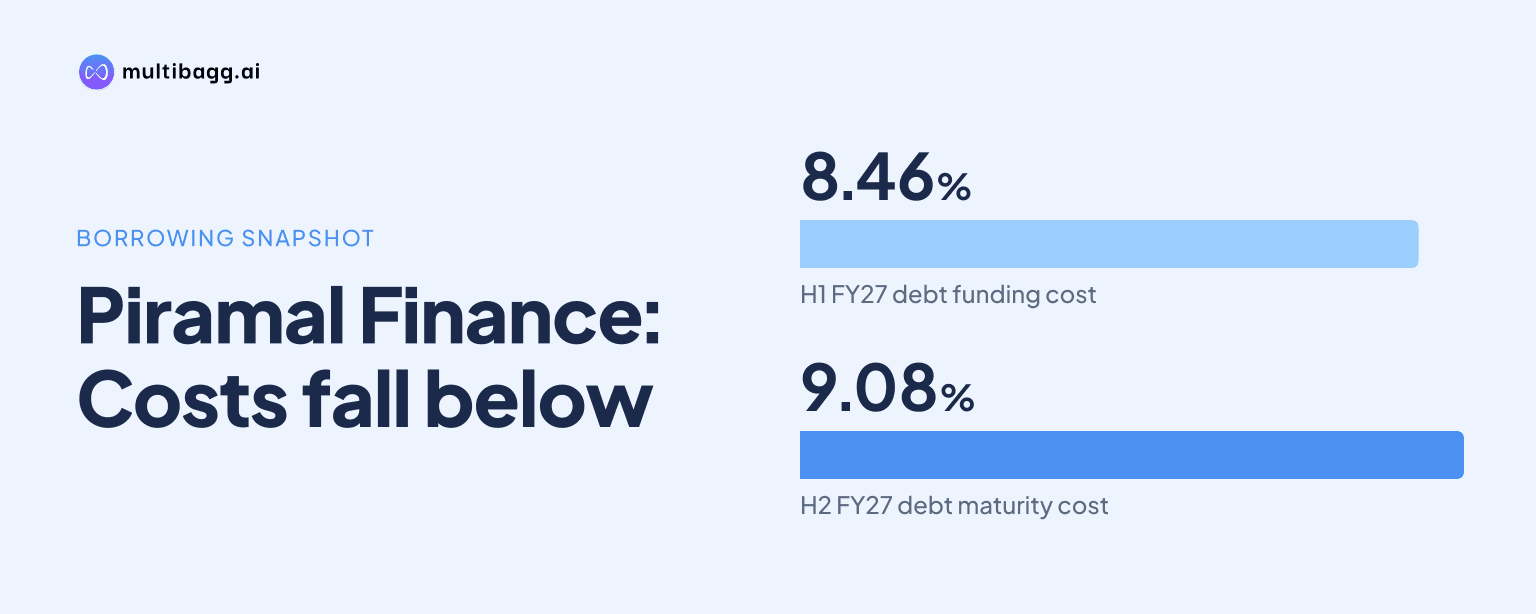
Piramal Finance raised Rs 13,327 crore of long-term debt in H1 FY27 at an 8.46% cost, 62 basis points below the 9.08% cost of Rs 8,516 crore of debt maturing in H2 FY27. Management links the lower incremental cost to rating actions beginning in Q4 FY26 and reported an 8.79% cost on its borrowing stock in Q2 FY27.
Know Piramal Finance inside out
Results, valuation, peers and who's buying, in one view.
How much lower is Piramal Finance's incremental borrowing cost?
Piramal Finance's 8.46% cost on H1 FY27 long-term debt was lower than both near-term and FY28 maturing-debt costs. The rate was 62 basis points below the 9.08% cost on Rs 8,516 crore due in H2 FY27 and 61 basis points below the 9.07% cost on Rs 28,840 crore maturing in FY28. One basis point equals one-hundredth of a percentage point.
The issuance trend improved over the three disclosed fund-raising periods. The cost of debt raised declined from 9.36% in H1 FY26 to 8.67% in H2 FY26 and then 8.46% in H1 FY27, a 90-basis-point reduction between the first and latest periods. The amount raised fell to Rs 13,327 crore in H1 FY27 from Rs 23,082 crore in H2 FY26.
The comparison concerns the cost of fresh long-term debt against the cost attached to scheduled maturities, rather than a forecast of future refinancing rates. The presentation does not state the fixed-rate or floating-rate composition of the Rs 8,516 crore due in H2 FY27 or the Rs 28,840 crore due in FY28.
Which rating actions preceded Piramal Finance's lower funding cost?
Piramal Finance said rating actions beginning in Q4 FY26 lowered its incremental borrowing costs. Crisil Ratings assigned AA+ / Stable in January 2026, S&P Global Ratings upgraded the company to BB in January 2026, CareEdge Ratings upgraded it to AA+ / Stable in February 2026, and ICRA upgraded it to AA+ / Stable in March 2026.
International rating actions continued through September 2026. Moody's Ratings upgraded its outlook to Positive in March 2026, R&I and JCR each assigned BBB / Stable in July 2026, and Moody's Ratings upgraded Piramal Finance to Ba2 / Stable in September 2026. The presentation links the actions to funding costs but does not assign a separate pricing benefit to any individual agency decision.
Management reported that the cost of the outstanding borrowing stock declined by about 5 basis points following the upgrades despite an upward shift in market rates. The reported stock cost moved from 8.84% in Q4 FY26 to 8.80% in Q1 FY27 and 8.79% in Q2 FY27.
The longer series shows that the decline followed an earlier rise. Borrowing-stock cost was 8.64% in Q1 FY24, reached 9.17% in Q3 FY25, and then declined to 8.79% in Q2 FY27. The Q2 FY27 level was also 16 basis points below 8.95% in Q2 FY26.
Got a follow-up? Ask IRIS
How is Piramal Finance's borrowing mix positioned for repricing?
Piramal Finance had Rs 83,800 crore of borrowings as of September 2026, comprising 39% fixed-rate debt, 31% debt linked to the marginal cost of funds based lending rate, or MCLR, and 30% market-rate-linked debt. The fixed-rate portion was therefore Rs 33,000 crore in the presentation's fixed-floating view, while floating-rate liabilities were Rs 51,000 crore.
The company reported Rs 44,000 crore of fixed-rate assets against Rs 33,000 crore of fixed-rate liabilities and Rs 56,000 crore of floating-rate assets against Rs 51,000 crore of floating-rate liabilities. Fixed-rate assets exceeded fixed-rate liabilities by Rs 11,000 crore, while floating-rate assets exceeded floating-rate liabilities by Rs 5,000 crore as of September 2026.
Banks accounted for 45% of borrowings by lender type, followed by external commercial borrowings, or ECBs, at 20%. Individuals, Hindu undivided families and corporates represented 8%, securitisation 6%, and mutual funds and insurance companies 5% each.
Loans represented 42% of borrowings by instrument type, while non-convertible debentures, or NCDs, and bonds represented 31% and securitisation represented 20%. Public issues accounted for 6%, with commercial paper and ECBs each at 1%. Piramal Finance notes that the difference between reported borrowings and gross debt primarily reflects Indian Accounting Standards adjustments and the fair value of ECBs.
How large is Piramal Finance's liquidity buffer?
Piramal Finance reported positive cumulative asset-liability management, or ALM, gaps across every disclosed maturity bucket as of September 2026. In the bucket up to 14 days, cumulative inflows were Rs 5,520 crore against outflows of Rs 1,034 crore, producing a Rs 4,486 crore surplus and a 434% cumulative gap.
The positive surplus remained through longer buckets. Cumulative inflows of Rs 50,695 crore exceeded Rs 34,591 crore of outflows by Rs 16,104 crore up to one year, a 47% gap, while inflows of Rs 167,579 crore exceeded outflows of Rs 144,441 crore by Rs 23,138 crore beyond five years, a 16% gap.
Piramal Finance's disclosed period-end ALM gap was Rs 16,103 crore in September 2026, compared with Rs 15,358 crore in March 2026 and Rs 8,844 crore in September 2025. The corresponding gap percentage declined to 47% in September 2026 from 51% in March 2026, while remaining above the 28% reported a year earlier.
Its consolidated liquidity coverage ratio, or LCR, was 553% at September 2026 period-end, compared with the 100% regulatory requirement for non-banking financial companies, or NBFCs. The LCR was lower than 928% in March 2026 and 702% in September 2025; management also reported a 442% consolidated LCR for Q2 FY27 on a period-average basis.
Conclusion
Piramal Finance's disclosures show that H1 FY27 long-term borrowing was priced below debt maturing in H2 FY27 and FY28, alongside a decline in the borrowing-stock cost to 8.79%. The funding profile combined Rs 33,000 crore of fixed-rate liabilities with Rs 51,000 crore of floating-rate liabilities, while the September 2026 LCR stood at 553% against the 100% NBFC requirement.
The next funding test is the refinancing or repayment of Rs 8,516 crore due in H2 FY27 at a 9.08% cost and Rs 28,840 crore due in FY28 at a 9.07% cost. Investors can also watch whether future borrowing-stock costs continue below the 8.84% reported in Q4 FY26 after the rating actions disclosed through September 2026.