










Piramal Finance legacy AUM falls to 1.5% of total AUM
Key highlights
- Piramal Finance’s legacy AUM fell 96% from Rs 43,175 crore in FY22 to Rs 1,673 crore in Q2 FY27.
- Legacy AUM was 1.5% of Piramal Finance’s Rs 1,01,296 crore total AUM in September 2026.
- Piramal Finance reported Rs 538 crore of growth PBT and Rs 545 crore of company PAT in Q2 FY27.
- Piramal Finance has a Rs 459 crore ECL provision pool against its Rs 1,673 crore remaining legacy book.
powered by IRIS
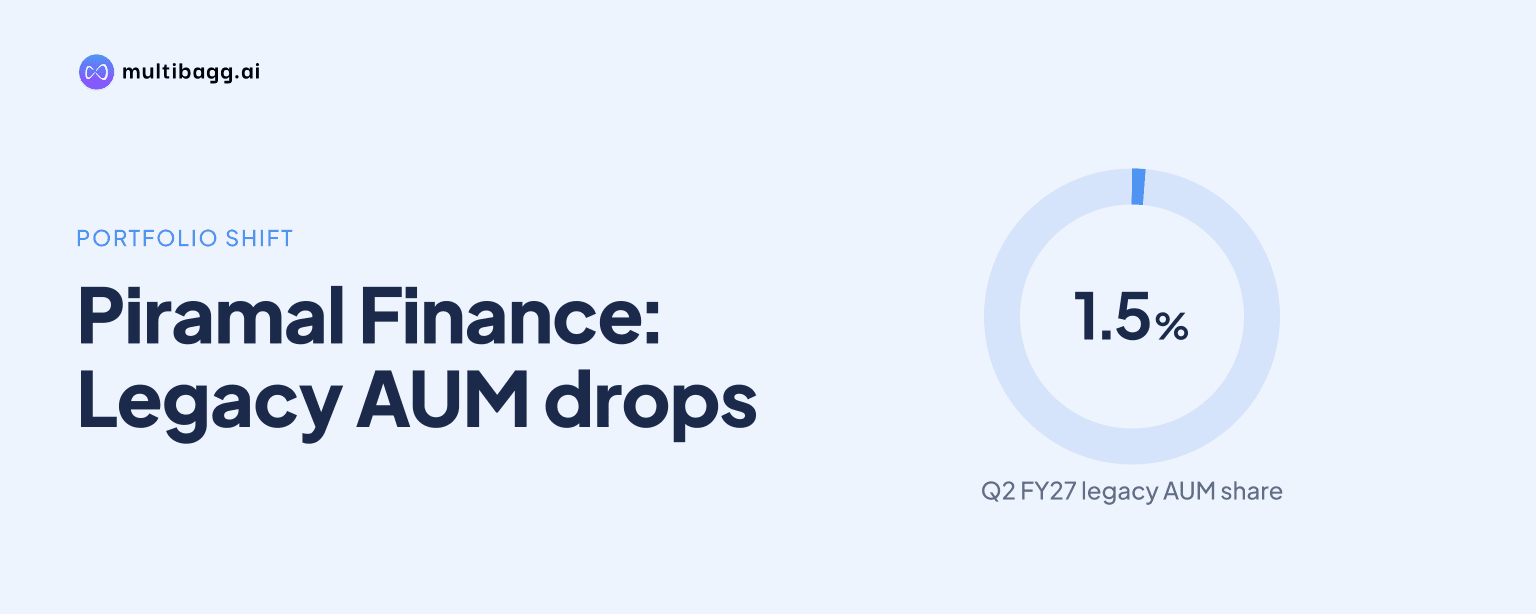
Piramal Finance’s legacy assets under management, or AUM, fell to Rs 1,673 crore, or 1.5% of total AUM, in Q2 FY27 after declining 96% since March 2022. Management said the Rs 1,134 crore legacy reduction in H1 FY27 had no profit-before-tax, or PBT, impact, and expects further run-off to remain PBT-neutral.
Know Piramal Finance inside out
Results, valuation, peers and who's buying, in one view.
How small is Piramal Finance’s legacy book now?
Piramal Finance’s legacy AUM was Rs 1,673 crore in Q2 FY27, compared with Rs 43,175 crore in FY22, reducing its share of total AUM from 66% to 1.5%. The presentation describes the decline as 96% since March 2022, with the legacy book down 69% year on year and 32% quarter on quarter in Q2 FY27.
The run-off has been consistent across the reported periods. Legacy AUM fell from Rs 29,053 crore in FY23 to Rs 14,572 crore in FY24, then declined to Rs 6,920 crore in FY25 and Rs 2,807 crore in FY26. In H1 FY27, it reduced by a further Rs 1,134 crore to Rs 1,673 crore.
Piramal Finance reported total AUM of Rs 1,01,296 crore in September 2026, while growth AUM was Rs 99,624 crore. The reported difference between those two balances broadly corresponds with the Rs 1,673 crore legacy balance, subject to rounding. The AUM figures exclude direct assignment balances of Rs 9,948 crore and co-lending balances of Rs 1,868 crore in Q2 FY27.
How much do growth-book profits explain company earnings?
Piramal Finance reported Rs 538 crore of growth-book PBT and Rs 545 crore of company profit after tax, or PAT, in Q2 FY27. Management’s presentation says company profits have essentially been the same as growth-book profits over the last six quarters, while the two measures remain different because PBT is before tax and PAT is after tax.
The comparison was materially different in FY24, when growth PBT was Rs 1,044 crore while company PAT was negative Rs 1,684 crore. In FY25, growth PBT was Rs 896 crore and company PAT was Rs 485 crore. By FY26, growth PBT reached Rs 1,560 crore and company PAT was Rs 1,506 crore, bringing the reported figures much closer.
The quarterly figures also show the reported alignment in FY27. Growth PBT was Rs 470 crore in Q1 FY27 and Rs 538 crore in Q2 FY27, while company PAT was Rs 461 crore and Rs 545 crore, respectively. Management separately said the Rs 1,134 crore legacy-AUM reduction in H1 FY27 had no PBT impact and expects the remaining run-down to be PBT-neutral.
Got a follow-up? Ask IRIS
Has Piramal Finance’s company margin moved closer to growth-book margin?
Piramal Finance’s company net income margin, or NIM, was 6.5% in Q2 FY27, versus 6.8% for the growth book, a difference of 0.3 percentage points. The presentation defines NIM as lending-book total income as a percentage of average total AUM, and defines AUM as on-book loans plus off-book assets.
The difference was 3.5 percentage points in Q1 FY24, when growth NIM was 8.4% and company NIM was 4.9%. It narrowed to 0.5 percentage points in Q1 FY27, with growth NIM at 6.8% and company NIM at 6.5%, before remaining at 0.3 percentage points in Q2 FY27.
Piramal Finance noted that the decline in growth NIM during FY25 was due to amortisation of retail processing fees. Growth NIM ranged from 6.9% to 7.6% through FY25, compared with company NIM of 5.4% to 6.4%. In FY26, growth NIM ranged from 6.9% to 7.0%, while company NIM increased from 6.1% in Q1 FY26 to 6.5% in Q4 FY26.
Cost-to-income ratios also declined over the periods shown. Piramal Finance’s company cost-to-income ratio was 52% in Q2 FY27, compared with 61% in Q2 FY26 and 65% in Q2 FY25. The growth-business ratio was 48% in Q2 FY27, down from 52% a year earlier and 62% in Q2 FY25.
What provisions and disclosures remain for the legacy portfolio?
Piramal Finance has a Rs 459 crore expected credit loss, or ECL, provision pool available against the remaining Rs 1,673 crore legacy book. The presentation does not provide a separate legacy provision-coverage ratio, but management states that the run-off in H1 FY27 had no PBT impact and that further reduction is expected to remain PBT-neutral.
At the total-company level, Piramal Finance reported provisions of Rs 2,457 crore against total AUM of Rs 1,01,296 crore in September 2026, equal to 2.4% of total AUM. This compared with Rs 2,167 crore, or 2.3% of total AUM, in June 2026 and Rs 1,708 crore, or 2.1%, in September 2025.
Growth assets had Rs 1,997 crore of total provisions against Rs 99,624 crore of AUM in September 2026, or 2.0%. Total Stage 3 assets were Rs 2,386 crore, while growth-book Stage 3 assets were Rs 2,071 crore. Total gross non-performing assets, or GNPA, were 2.4% of AUM and net non-performing assets, or NNPA, were 1.7% in September 2026.
Management expects to discontinue separate legacy disclosures after the December 2026 quarter. That planned reporting change follows the reduction from Rs 2,807 crore at FY26 to Rs 1,673 crore in Q2 FY27. The presentation does not disclose a target balance or a date for complete closure of the legacy portfolio.
Conclusion
Piramal Finance has moved from a legacy book equal to 66% of total AUM in FY22 to a residual book equal to 1.5% in Q2 FY27. The reduction to Rs 1,673 crore, the Q2 FY27 comparison of Rs 538 crore growth PBT with Rs 545 crore company PAT, and the 0.3-percentage-point NIM difference show that reported company financials are increasingly aligned with the growth book.
The next disclosed milestone is the December 2026 quarter, after which management expects to discontinue separate legacy disclosures. Investors can monitor whether the residual Rs 1,673 crore book continues to decline without PBT impact, as management expects, and how the Rs 459 crore ECL provision pool changes alongside the remaining balance.