










PNB Housing Finance Limited targets 45% retail mix by FY27
Key highlights
- Affordable and emerging-market loans represented 41% of PNB Housing Finance's Rs 943.91 arab retail portfolio on September 30, 2026.
- PNB Housing Finance targets a 45% affordable-and-emerging contribution to its retail portfolio by the end of FY26-27.
- PNB Housing Finance launched micro housing in Q2 FY27 and disbursed Rs 71 crore by October 28, 2026.
- Affordable and emerging-market disbursements rose 40% to Rs 11.49 arab and 36% to Rs 28.82 arab, respectively, in Q2 FY27.
powered by IRIS
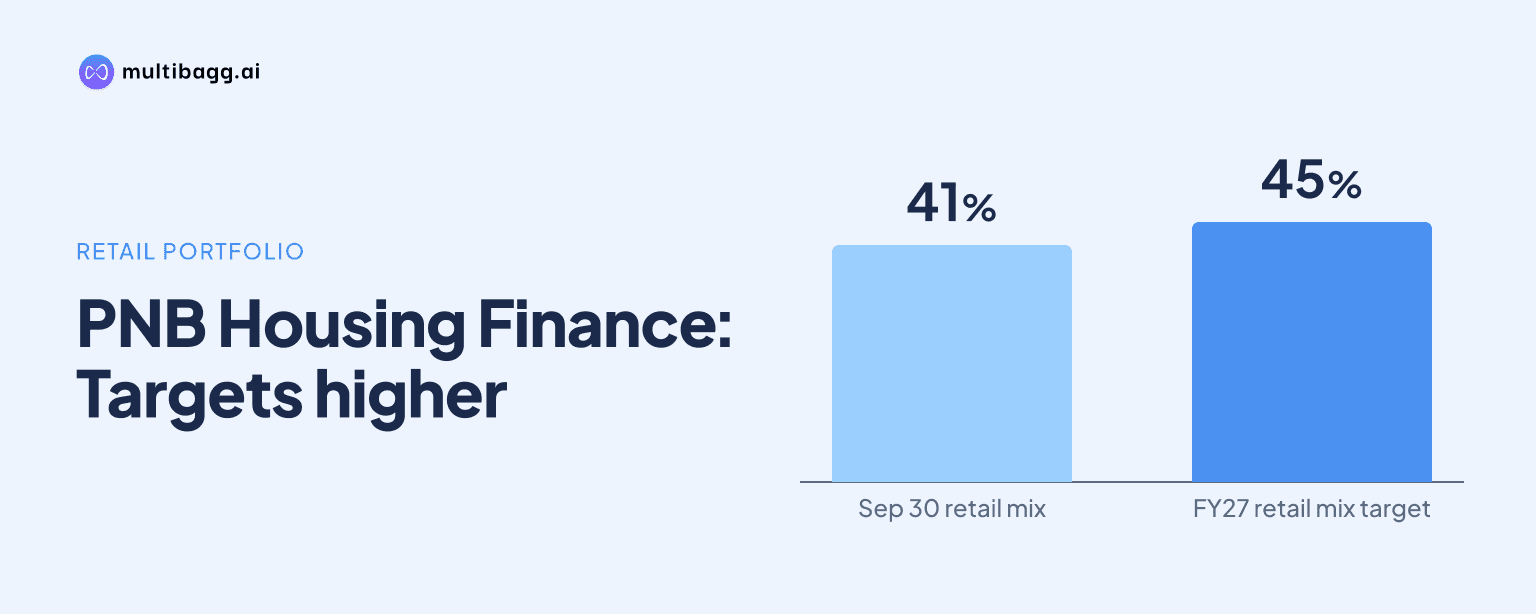
PNB Housing Finance aims to raise affordable and emerging-market lending to 45% of its retail portfolio by the end of FY26-27, from 41% on September 30, 2026. The target follows 45% year-on-year affordable-book growth, 22% emerging-book growth and Rs 71 crore of micro-housing disbursements after the Q2 FY27 launch.
Know PNB Housing Finance inside out
Results, valuation, peers and who's buying, in one view.
How does PNB Housing Finance plan to reach a 45% retail mix?
PNB Housing Finance plans to add 4 percentage points to the combined share of its affordable and emerging-market businesses by the end of FY26-27. The two segments represented 41% of its Rs 943.91 arab retail loan portfolio on September 30, 2026, while the total loan book was Rs 950.79 arab, up 19% year on year. An arab equals Rs 100 crore.
The targeted segments are growing alongside, rather than replacing, the prime business. In Q2 FY27, affordable disbursements increased 40% year on year to Rs 11.49 arab and emerging-market disbursements rose 36% to Rs 28.82 arab. Prime disbursements increased 44% to Rs 43.8 arab, while total retail disbursements reached a record Rs 92.5 arab, up 54% year on year.
What is micro housing contributing to PNB Housing Finance's plan?
Micro housing has contributed Rs 71 crore of disbursements since PNB Housing Finance launched the business in Q2 FY27. Management included the new product among initiatives intended to increase the loan book, enhance portfolio yield and maintain portfolio quality, although the call did not provide a separate micro-housing portfolio balance.
PNB Housing Finance also disbursed Rs 2.41 arab of affordable loans through selected prime and emerging branches in H1 FY27. Its 404-branch network on September 30 included 234 affordable branches, known as Roshni, 88 emerging-market branches and 81 prime branches. This provides a branch-led route for affordable lending outside the dedicated affordable network.
How is housing outreach supporting PNB Housing Finance's retail expansion?
PNB Housing Finance has used Pradhan Mantri Awas Yojana Urban 2.0, or PMAY, outreach to support affordable-housing customer engagement. It said it had facilitated scheme benefits for more than 8,000 beneficiaries and submitted another 1,200 applications to the National Housing Bank for approval by the October 28, 2026 earnings call.
The company conducted PMAY Yatra awareness campaigns in Gujarat, Madhya Pradesh, Maharashtra, Rajasthan, Tamil Nadu and Uttar Pradesh. It also opened PMAY nodal branches in Siliguri and Kanpur, and management said it intended to scale the initiative through its network of more than 400 branches. The disclosure establishes outreach activity, but does not quantify loans originating from PMAY beneficiaries.
Got a follow-up? Ask IRIS
How do developer finance and pool buyouts fit the growth plan?
Emerging Developer Finance contributed Rs 1.07 arab of disbursements in H1 FY27, while corporate disbursements were Rs 3.6 arab in Q2 FY27, compared with Rs 2.15 arab in Q1 FY27. The corporate loan book stood at Rs 6.89 arab on September 30, a small component relative to the Rs 950.79 arab total loan book.
Pool buyouts are also part of PNB Housing Finance's annual growth plan. The company completed Rs 9.86 arab of buyouts in H1 FY27, including Rs 8.38 arab included in Q2 disbursements, against management's budget of about Rs 20 arab for the year. Management said the purchased portfolio combined home loans and loans against property, rather than being confined to one product category.
What financial measures accompanied PNB Housing Finance's retail shift?
PNB Housing Finance reported a 2.43% spread in Q2 FY27, up from 2.12% in Q1 FY27, and portfolio yield rose to 9.74% from 9.48%. Management said these reported measures included a one-time collection of overdue charges and interest from a legacy corporate account that closed in the quarter. Excluding that item, it put yield at 9.56%, spread at 2.24% and net interest margin at 3.49%.
Cost of borrowing declined 5 basis points sequentially to 7.31%, while incremental cost declined 15 basis points to 7.26%. Net interest income grew 15% year on year and profit after tax rose 6% to Rs 6.17 arab. Gross non-performing assets, or GNPA, improved to 0.91% from 0.95% in Q1 FY27 after Rs 75 crore of written-off-pool recoveries generated negative credit cost of 19 basis points.
What could affect PNB Housing Finance's execution?
Interest-rate changes could affect PNB Housing Finance's funding cost and lending-rate actions. Following a 25-basis-point policy-rate increase, management said it expected borrowing cost to rise by about 9 to 10 basis points and was evaluating retail lending-rate increases of 10 to 15 basis points, and corporate rate increases of 15 to 20 basis points, effective November 1, 2026.
Management told analysts that a 50-basis-point rate rise would result in about 20 basis points of additional borrowing cost. It also cited incremental yield of 9.64%, compared with book yield of about 9.54%, as support for its yield outlook. Operating expenses rose 20% year on year to Rs 2.6 arab in Q2 FY27, mainly due to affordable-vertical manpower additions, while pre-provision operating profit increased 16% to Rs 7.49 arab.
Conclusion
PNB Housing Finance is pursuing a larger affordable and emerging-market presence while continuing to expand prime lending. The combined segments' 41% retail-book contribution, their faster loan-book growth and the micro-housing launch show how the company intends to move toward a 45% contribution by the end of FY26-27. Developer finance, selected-branch affordable lending and portfolio purchases add further sources of disbursement.
The next markers are progress toward the 45% target by FY26-27 end, implementation of the proposed lending-rate changes from November 1, 2026, and execution against the roughly Rs 20 arab pool-buyout budget. Management also said the next couple of quarters would focus on moving artificial-intelligence proofs of concept into production deployment, while GNPA performance remains a disclosed measure of portfolio quality.