










PNB Housing steers prime lending toward self-employed borrowers
Key highlights
- PNB Housing said self-employed borrowers made up almost 60% of Q2 prime disbursements.
- Housing represented about 52% of PNB Housing's total Q2 incremental disbursements and about 60% excluding pool buyouts.
- PNB Housing said overall yield appeared 10 to 12 basis points lower while affordable-vertical standalone yield remained unchanged.
- Management is targeting a Rs 3,000 crore construction-finance book during the year, from about Rs 700 crore.
powered by IRIS
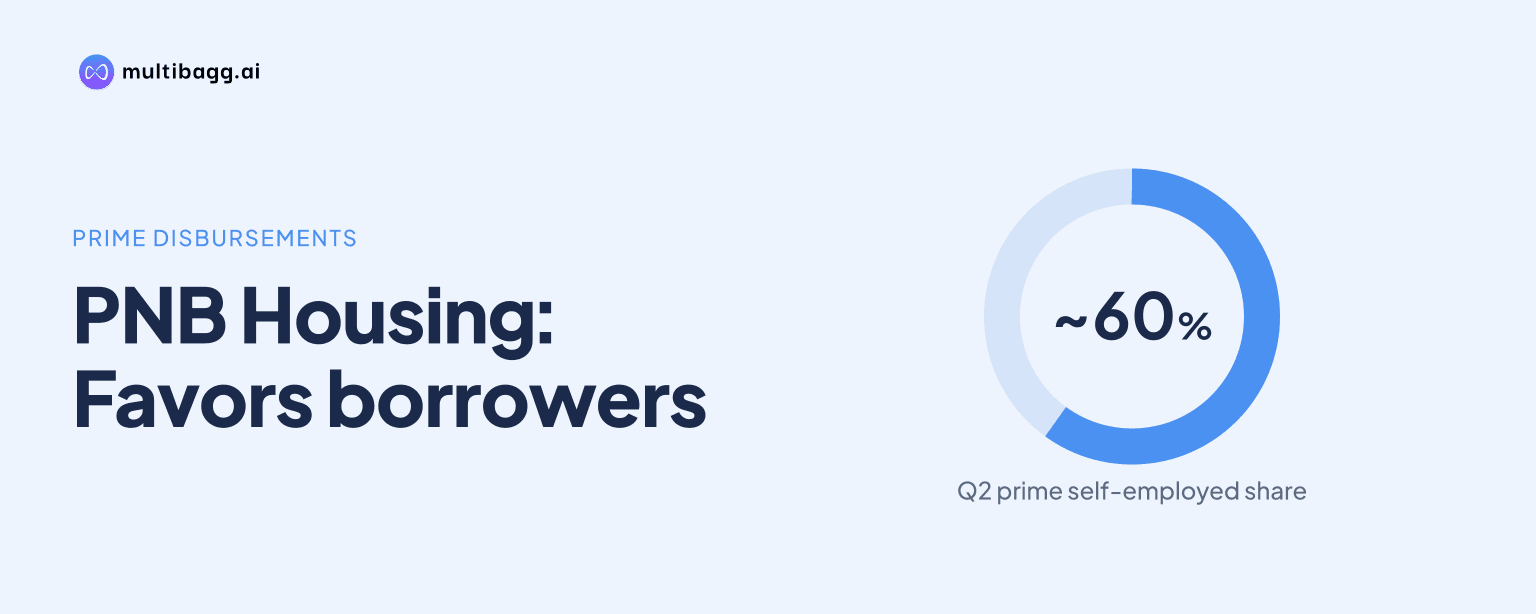
PNB Housing Finance Limited said in Q2 it would avoid competing extensively with nationalized banks for prime salaried home loans, with self-employed borrowers accounting for almost 60% of its prime disbursements. Management said specialised underwriting and a balance between home loans and loan against property are intended to maintain margins and yields.
Know PNB Housing Finance inside out
Results, valuation, peers and who's buying, in one view.
Why is PNB Housing avoiding prime salaried loan competition?
PNB Housing said it does not want to compete much where nationalized banks are active because those banks are more focused on salaried and prime-salaried borrowers. The company did not say it would stop serving salaried customers: salaried borrowers still represented about 40% to 41% of Q2 prime disbursements. Instead, management described the choice as a distribution and underwriting strategy centred on self-employed customers.
The pricing environment provides the backdrop for that choice. Following a 25-basis-point repo-rate increase, management said most housing finance companies had raised customer pricing by around 15 to 20 basis points, depending on their funding mix. PNB Housing said it would pass through a 20-to-30-basis-point increase in borrowing cost to its portfolio, while recognising that competitive conditions can offset part of the pass-through.
A basis point is one-hundredth of a percentage point. Management said the company had purposefully structured teams with expertise in self-employed lending and experienced underwriting personnel. Its stated aim is to preserve a balance between self-employed and salaried borrowers, and between home loans and loan against property, or LAP, rather than compete solely on rates in prime salaried lending.
What was PNB Housing's Q2 prime borrower mix?
PNB Housing said self-employed borrowers made up almost 60% of Q2 prime disbursements, while salaried borrowers accounted for almost 41%. The figures describe loan disbursements during Q2, not the composition of the outstanding loan book. Management did not disclose separate approval rates, pricing or delinquency data for the two prime borrower groups.
The Q2 mix supports management's stated preference to build underwriting capabilities for self-employed applicants, whose income assessment can differ from salaried lending. PNB Housing also said its Delhi National Capital Region distribution is spread across Gurgaon, Delhi, Ghaziabad and Noida, where it has a long-standing branch presence. It said any business linked to Noida's builder market was insignificant.
In that market, management cited independent-house purchase, resale, balance transfer and construction loans as the principal sources of activity. This matters because the company is positioning its prime strategy around customer and product selection, not a single geography. The source did not provide a disbursement amount or a borrower mix specifically for Delhi National Capital Region in Q2.
How is PNB Housing balancing housing loans and LAP?
PNB Housing said housing formed about 52% of total incremental disbursements in Q2 and non-housing represented the remainder. Excluding pool buyouts, management said approximately 60% of incremental disbursements were housing. The difference shows that the reported housing mix depends on whether acquired loan pools are included in the calculation.
PNB Housing said it seeks to maintain a balance of home loans and LAP because that combination supports its stated margin and yield objectives. Management also said it was close to its principal business criteria, or PBC, norms and would maintain compliance. It identified direct-assignment, or DA, sell-downs and pool buyouts as tools that could help manage the reported mix.
The affordable-segment LAP ratio can also reflect loan classification rather than the economic purpose of every loan. Management said that, under the regulation it cited, a self-construction case with construction more than 60% complete must be booked as LAP for the remaining loan balance. It said such lending can still be economically related to housing, even though it is reported as non-housing.
Got a follow-up? Ask IRIS
Why did PNB Housing report lower overall yield?
PNB Housing said the standalone yield of its affordable vertical was unchanged, but overall yield appeared around 10 to 12 basis points lower. Management attributed the reported movement to allowing prime and emerging branches to source affordable loans. Those branches operate mainly in metro areas and state capitals, which management described as price-sensitive markets.
The distinction is important because the source did not say that the affordable vertical itself had reduced its yield. Rather, management said the wider sourcing model changed the overall reported result. PNB Housing did not provide a standalone affordable-yield percentage or a consolidated yield figure for Q2 in the supplied discussion.
Management also differentiated fee income by business line. It said prime and emerging businesses generate larger volumes, so they contribute more fee income in absolute value even if the fee percentage is lower. Roshni, its emerging business, has a higher fee percentage but represented about 12% to 14% of monthly business, according to management.
Fee income in Q2 was driven by disbursements, which management said rose around 50% excluding DA transactions. This links the fee trend to loan origination rather than to a separately disclosed change in fee pricing. The source did not specify the amount of Q2 fee income in management's response, though the analyst referred to approximately Rs 130 crore.
Which actions does PNB Housing say can support margins?
PNB Housing said its focus on emerging and affordable products is one lever for maintaining net interest margin, or NIM. NIM measures net interest income relative to earning assets. Management said most investment during the year in branches and people had been directed toward affordable housing, where it expects the expanded distribution to support its product strategy.
Management said spread and NIM should receive a positive effect from product mix and improved funding terms, but higher leverage would offset some of that effect. It also said the benefits of its rating upgrade would arrive in phases rather than immediately. PNB Housing had started negotiating with banks and repricing older borrowings after the Q4 ratings process, according to management.
Construction finance is another business identified by management as a higher-yielding area. PNB Housing said it had a construction-finance book of about Rs 700 crore and was aiming for Rs 3,000 crore during the year. That is a stated target, not a forecast of completed lending, and management did not provide a date within the year for reaching it.
PNB Housing also said it would start evaluating DA sell-downs from Q3 after hitting its stated book-growth guidance. Management said there was no DA sell-down in the current quarter, only DA pool buying. It described future sell-downs as a sustainable strategy that could support NIM and return on equity, without disclosing a planned transaction value or timetable.
Conclusion
PNB Housing's Q2 strategy was to avoid an extensive rate-led contest with nationalized banks in prime salaried housing loans and build a more differentiated mix. Almost 60% of prime disbursements went to self-employed borrowers, while housing accounted for about 52% of total incremental disbursements and about 60% excluding pool buyouts. The strategy relies on specialised underwriting, affordable and emerging products, and a managed home-loan and LAP mix.
The next disclosed milestone is Q3, when management said it would begin evaluating DA sell-downs after achieving its book-growth guidance. Investors can also watch progress toward the Rs 3,000 crore construction-finance target from about Rs 700 crore, the phased effect of improved funding terms after the rating upgrade, and whether PBC limits require further non-housing pool management.