










PNB Housing Finance plans rate rise to protect margins
Key highlights
- PNB Housing Finance plans a 10-15-basis-point retail lending-rate increase from November 1 after a 25-basis-point repo-rate hike.
- Q2 FY27 adjusted NIM was 3.49%, compared with reported NIM of 3.67% that included a one-time corporate-account recovery.
- Portfolio yield rose to 9.74% in Q2 FY27 from 9.48% in Q1 FY27, while cost of borrowing fell to 7.31% from 7.36%.
- The loan book grew 19% year on year to Rs 95,079 crore as of September 30, 2026.
powered by IRIS
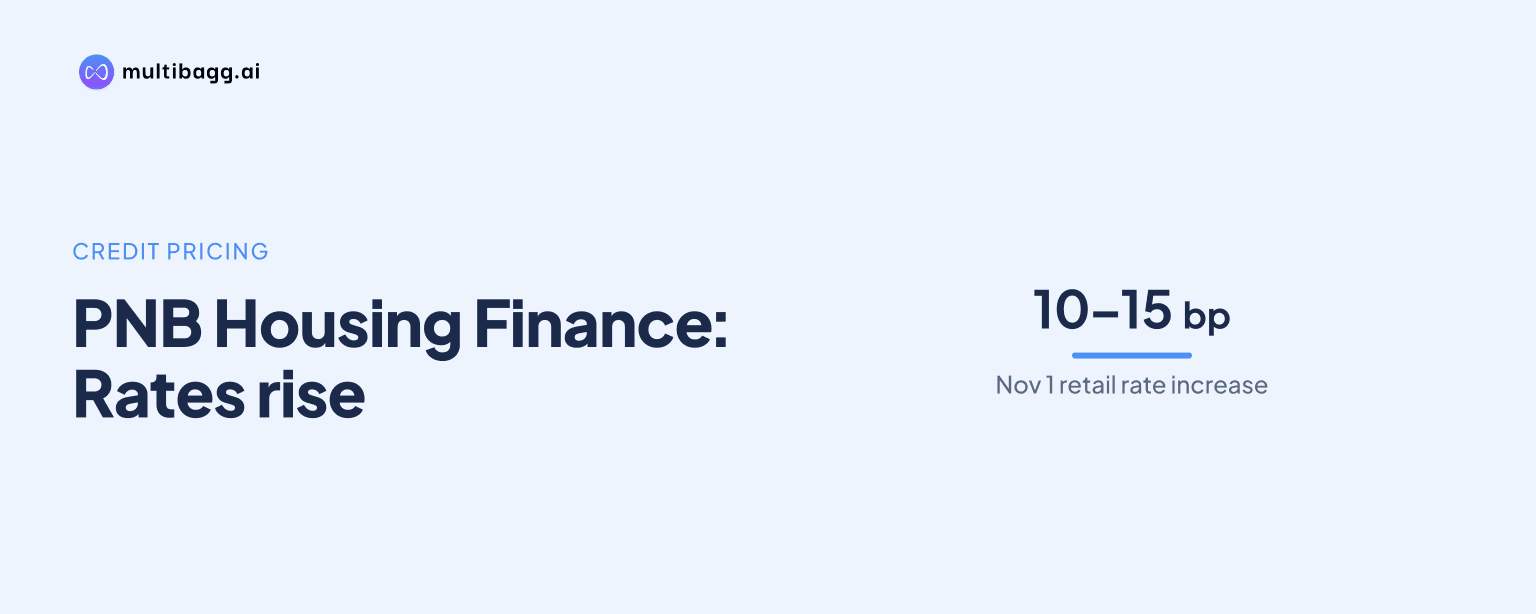
PNB Housing Finance Limited plans to raise retail lending rates by 10 to 15 basis points from November 1 after a 25-basis-point repo-rate hike, and management expects the net interest margin effect to be broadly neutral to positive. Its adjusted Q2 FY27 net interest margin was 3.49%, excluding a one-time legacy corporate-account recovery.
Know PNB Housing Finance inside out
Results, valuation, peers and who's buying, in one view.
How will PNB Housing Finance protect margins after the repo hike?
PNB Housing Finance plans to increase retail lending rates by 10 to 15 basis points and corporate lending rates by 15 to 20 basis points from November 1. Management said the action follows the 25-basis-point policy-rate increase and is intended to offset a projected 9 to 10 basis-point rise in borrowing cost.
Management said the company’s response reflects its funding structure, which includes fixed deposits, National Housing Bank refinance and other borrowings rather than a single direct repo-rate linkage. It also said most housing finance companies had increased pricing by 15 to 20 basis points after the latest repo move, although the extent of pass-through differs by each lender’s cost of funds.
For a 50-basis-point increase in policy rates, management estimated that PNB Housing Finance’s cost of borrowing could increase by about 20 basis points. It said the company would seek to pass on a 20 to 30 basis-point increase in borrowing costs to its lending portfolio, making this a sensitivity estimate rather than a forecast of another rate hike.
Why did PNB Housing Finance report a higher Q2 margin?
PNB Housing Finance reported a 3.67% net interest margin, or NIM, in Q2 FY27, up 17 basis points sequentially, but the result included a one-time recovery from a legacy corporate account. Reported spread rose 31 basis points from Q1 FY27 to 2.43%, while the company said its underlying spread was lower at 2.24% after removing that item.
The one-off consisted of overdue charges and overdue interest collected when the corporate account closed. Management said PNB Housing Finance accounts for such charges on a receipt basis, so the recovery was recognised in Q2 FY27; excluding it, NIM was 3.49%, broadly unchanged from the reported 3.50% in Q1 FY27.
Underlying lending yields still rose during the quarter. Portfolio yield increased by 26 basis points sequentially to 9.74%, while incremental yield increased by 18 basis points to 9.64%; management also cited an approximately 9.54% book yield during the call. It expects incremental loans priced above the existing portfolio yield to support the book-level yield over time.
Funding costs declined before the policy-rate action. Cost of borrowing fell 5 basis points to 7.31% in Q2 FY27, and incremental cost of borrowing declined 15 basis points to 7.26%. Management attributed the movement to better liquidity in July, additional National Housing Bank borrowing and fixed-rate interest-rate-swap transactions.
Which loan segments are supporting PNB Housing Finance’s yields?
PNB Housing Finance is expanding affordable and emerging-market lending, two retail segments that together represented 41% of its retail portfolio in Q2 FY27. The company said these segments’ loan books grew 45% and 22% year on year, respectively, and it aims to raise their combined retail-portfolio share to 45% by the end of FY27.
The overall loan book stood at Rs 95,079 crore on September 30, 2026, up 19% year on year, while the retail loan portfolio also grew 19% to Rs 94,391 crore. Management retained its FY27 loan-book growth guidance of 18% to 20%, despite reporting a 60% year-on-year increase in overall Q2 disbursements to Rs 9,609 crore.
Retail disbursements reached Rs 9,250 crore in Q2 FY27, up 54% year on year. Prime disbursements were Rs 4,380 crore, up 44%; emerging-market disbursements were Rs 2,882 crore, up 36%; and affordable disbursements were Rs 1,149 crore, up 40%. Overall disbursements included a Rs 838 crore pool buyout.
Management said about 60% of incremental disbursements excluding the pool buyout were housing loans in Q2 FY27. Prime and emerging branches sourced more than Rs 100 crore of affordable loans in September using existing infrastructure, although management said this metro and state-capital sourcing lowered the overall affordable-business yield by about 10 to 12 basis points.
Got a follow-up? Ask IRIS
When could PNB Housing Finance see AAA rating benefits?
PNB Housing Finance expects its AAA credit-rating benefit to emerge gradually, rather than immediately. CRISIL upgraded the company to AAA with a stable outlook in Q2 FY27, making it AAA-rated by CRISIL, ICRA, CARE Ratings and India Ratings, according to management.
Management said it had begun negotiating with banks to reprice older borrowings after receiving AAA ratings from all four agencies. It expects measurable benefits next year through repricing and new funding, but noted that its Q2 FY27 cost of borrowing was already 7.31%, close to rates cited for other AAA-rated lenders.
The company reported a capital adequacy ratio of 27.03% and a Tier 1 capital ratio of 26.62% as of September 30, 2026. Net worth was Rs 20,250 crore, while Q2 FY27 profit after tax increased 6% year on year to Rs 617 crore, with return on assets at 2.53% and return on equity at 12.33%.
Asset quality and recoveries also affected the quarter’s reported earnings. Gross non-performing assets declined to 0.91% in Q2 FY27 from 0.95% in Q1 FY27, while Rs 75 crore of recoveries from written-off loans resulted in negative credit cost of 19 basis points. Management said a normalised credit-cost range would be about 10 to 12 basis points.
What could change PNB Housing Finance’s margin outlook?
PNB Housing Finance’s margin outcome will depend on future borrowing-cost changes, the implementation of revised lending rates and competitive pricing. Management said it had seen no change in market momentum after the 25-basis-point repo increase, citing continued loan applications, sanctions and disbursements, but retained its 18% to 20% FY27 growth guidance rather than raising it.
Management said spread should improve from higher incremental yields, rate pass-through and eventual rating benefits. However, it cautioned that NIM may not increase in direct proportion to spread because higher leverage can offset some of the benefit. The relevant Q2 comparison is therefore the 3.49% adjusted NIM, rather than the 3.67% reported figure containing the one-time recovery.
The company is also managing principal business criteria, or PBC, requirements as non-housing lending rises. Management said it was close to the relevant PBC threshold and was considering direct-assignment sell-downs of non-housing pools. In Q2 FY27, around 40% of incremental disbursements excluding the pool buyout were non-housing loans, based on management’s 60% housing-loan disclosure.
Conclusion
PNB Housing Finance’s reported Q2 FY27 margin expansion was partly shaped by a one-time corporate-account recovery, but portfolio yield rose to 9.74% and borrowing cost fell to 7.31%. Management’s planned 10 to 15 basis-point retail-rate increase is designed to protect the 3.49% adjusted NIM as the 25-basis-point repo hike feeds into funding costs.
The next items to watch are the November 1 lending-rate implementation, whether loan-book growth remains within the 18% to 20% FY27 target, and the timing of measurable AAA-related funding savings expected next year. Management also plans to pursue non-housing pool sell-down opportunities and targets a 45% combined retail-portfolio contribution from affordable and emerging-market segments by FY27-end.