










PNC Infratech Pursues Overseas Roads With EPC-Only Model
Key highlights
- PNC Infratech said overseas EPC projects should require working capital rather than significant project investment.
- Kazakhstan has initiated road projects spanning more than 3,000 kilometres, management said.
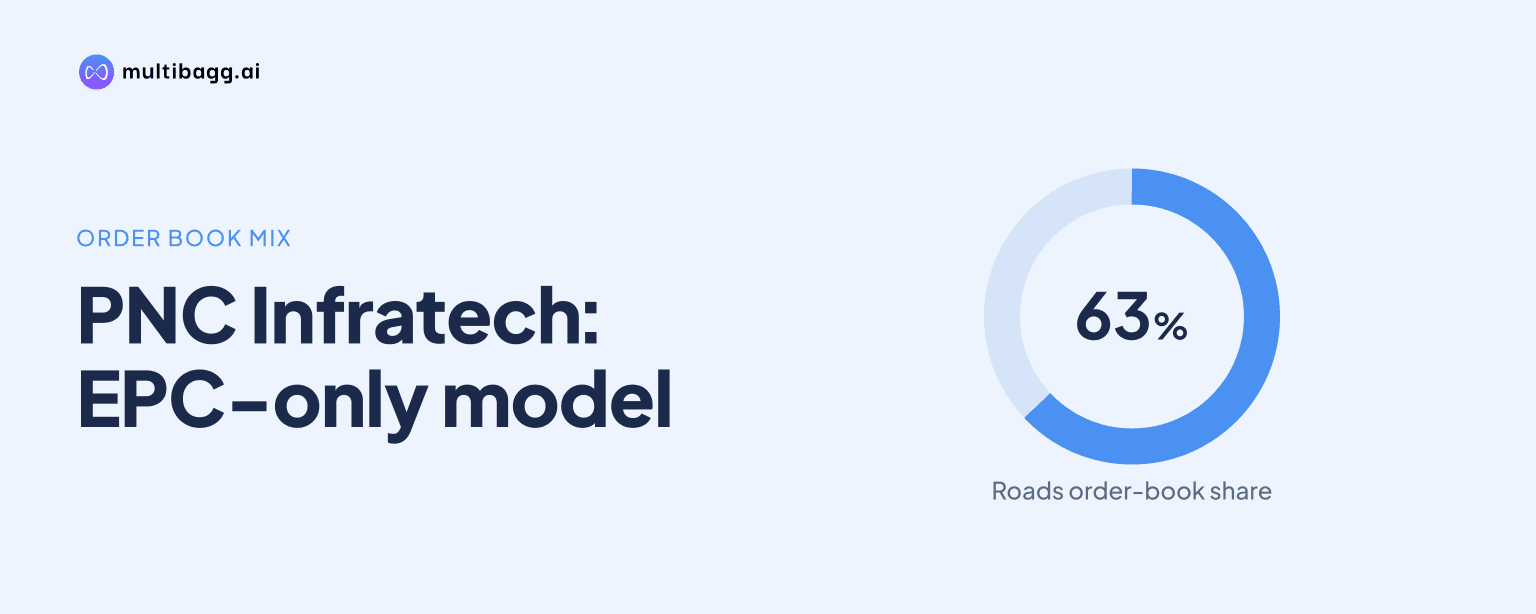
- Roads account for 63% of PNC Infratech’s order book.
- PNC Infratech excludes overseas awards from current financial-year order-inflow guidance of Rs 12,000 crore to Rs 15,000 crore.
powered by IRIS
PNC Infratech Limited is pursuing overseas highway engineering, procurement and construction, or EPC, contracts that management says should require working capital rather than significant project investment. The initial markets are Kazakhstan, Georgia, Uzbekistan and the United Arab Emirates, while Kazakhstan has initiated road projects spanning more than 3,000 kilometres.
Know PNC Infratech inside out
Results, valuation, peers and who's buying, in one view.
Why is PNC Infratech using an EPC-only overseas strategy?
PNC Infratech is initially selecting non-fund-based overseas EPC projects because management does not plan to commit capital to foreign concession-style projects. Management said the expected requirement would be working capital, rather than significant investment, distinguishing the overseas approach from fund-based formats in which a developer must invest in the project.
The company is limiting this first international push to highways, where it cited more than three decades of experience. Roads accounted for 63% of PNC Infratech’s order book at the time of the call, so the proposed overseas work follows its principal domestic capability rather than adding a new construction category.
This approach differs from PNC Infratech’s domestic bidding mix. Of 17 bids under evaluation, management said 13 were EPC bids, three were hybrid annuity model, or HAM, bids and one was a tariff-based competitive bidding, or TBCB, power-transmission bid. The price bids for all 17 had yet to be opened, while management said overseas work would initially avoid fund-based structures such as those requiring investment.
Which overseas road markets is PNC Infratech assessing?
PNC Infratech is assessing road opportunities in Kazakhstan, Georgia, Uzbekistan and the United Arab Emirates. Management said it had submitted a bid for a road project in Georgia and was pursuing opportunities in Kazakhstan, Uzbekistan and the UAE, without disclosing the value or expected award date of any overseas bid.
Kazakhstan was the most quantified foreign market discussed during the call. Management said more than 3,000 kilometres of projects had been initiated there, with a stated programme value of $9.8 billion, and described the opportunity as substantial. It also said road projects were coming up in Georgia and Uzbekistan, but did not provide a pipeline value for PNC Infratech in those markets.
The scale of Kazakhstan’s programme does not represent PNC Infratech’s potential order inflow. Management did not state the number of Kazakhstan contracts the company intends to bid for, its expected share of the programme, or a revenue timetable. Its stated rationale was that the work is in roads, the segment in which PNC Infratech has more than three decades of experience.
Will overseas contracts contribute to PNC Infratech’s current order target?
No, PNC Infratech is not including international orders in its current financial-year order-inflow guidance of Rs 12,000 crore to Rs 15,000 crore. Management said it had achieved Rs 4,260 crore of order inflow and that the remaining target would be addressed through domestic opportunities, because the international entry is new and its market dynamics must first be assessed.
The domestic opportunity set is materially more defined than the overseas plan. Management identified 80 projects with a combined estimated value of around Rs 1.80 lakh crore for bidding over the next two to three months and through the end of January. That list comprised 35 EPC projects, 25 HAM projects and 20 build-operate-transfer toll and TBCB projects.
Management said 60% to 65% of the identified domestic pipeline was from the National Highways Authority of India, the Ministry of Road Transport and Highways, and the National Highways and Infrastructure Development Corporation. Railways and other clients made up the remaining 35% to 40%, giving the domestic plan both a road-agency base and a smaller diversification component.
PNC Infratech also had Rs 16,600 crore of submitted domestic bids awaiting price-bid opening. Those 17 bids are separate from the 80-project pipeline, and management’s order-inflow guidance depends on domestic conversion rather than an overseas award. The company therefore presented international bidding as a parallel expansion effort, not a replacement for its current domestic order plan.
Got a follow-up? Ask IRIS
How will PNC Infratech manage funding and execution abroad?
PNC Infratech plans to prefer World Bank-funded projects and, in Asian countries, Asian Development Bank, or ADB, funded projects. Management said this selection criterion is intended to support the flow of funds without disruption from local issues. It did not identify a World Bank- or ADB-funded overseas contract already awarded to PNC Infratech.
The company said its team has been visiting the target countries frequently to assess local conditions before submitting bids. It also said it has country-level tie-ups with local players to provide logistics, material and other local support, alongside due diligence on each prospective project.
Competition remains an acknowledged risk in the model. Management said international players, including Chinese firms, participate in these bids, alongside domestic-level competition. It did not provide a target bid-win rate, country-specific cost advantage, expected overseas margin or a timeframe for building an overseas labour or equipment base.
Management said its main execution mitigation is to confine the initial focus to highway projects. It said PNC Infratech should be able to execute a Kazakhstan road project if it secures one because roads are its core competency, and it made the same point about the Georgia road bid. That assessment remains conditional on awards, since no overseas contract win was disclosed on the call.
What does the overseas strategy mean for PNC Infratech’s domestic execution?
PNC Infratech’s overseas plan does not alter management’s stated domestic execution outlook. Management reported an unexecuted order book of Rs 18,000 crore, excluding a battery energy storage system, or BESS, project that it said had never been included in the figure. It expected this order book to support more than Rs 3,000 crore of turnover in the second half of the current financial year.
For the current financial year, management maintained revenue guidance of Rs 6,000 crore, including an Rs 217 crore arbitration award received in the first half. PNC Infratech reported first-half revenue of Rs 2,664 crore, leaving Rs 3,336 crore under that guidance. Management cited five major road projects, five HAM projects and two Maharashtra State Road Development Corporation highway projects as entering fuller execution.
Management also maintained an earnings before interest, tax, depreciation and amortisation, or EBITDA, margin target of 12% on Rs 5,800 crore of revenue excluding the arbitration claim. It said fixed overheads would remain unchanged as second-half execution increases. This margin and revenue plan is based on domestic execution, as international orders are excluded from the current financial-year inflow target.
Conclusion
PNC Infratech is taking a limited-risk route into overseas road bidding by concentrating on EPC contracts, highways and projects with multilateral funding preferences. The approach avoids the investment requirements of overseas concessions, but it also means the company has not yet assigned foreign markets a role in its current financial-year order target or revenue outlook.
The next disclosed domestic milestone is management’s plan to submit bids from its 80-project pipeline through the end of January. Investors can also watch for overseas bid awards, if any, and for the expected appointed dates for two National Highways Authority of India HAM projects in the fourth quarter of the current financial year.